


Table of Contents
- Why Long-Term Card Storage Matters More Than You Think
- Quick Comparison: Top Storage Solutions
- Best Protective Sleeves for Graded Cards
- How to Store Trading Cards to Prevent Warping
- Acid-Free Card Storage Boxes: What to Look For
- Binder Storage vs. Box Storage: Which Wins?
- Protecting High-Value Cards: Toploaders and Magnetic Cases
- Pest, Mold, and Environmental Degradation Prevention
- Frequently Asked Questions
Last Updated: September 20, 2026
Why Long-Term Card Storage Matters More Than You Think
The best card storage for long term is an acid-free, PVC-free system that controls humidity, blocks UV light, and keeps cards flat under even pressure. Get one part of that wrong and a mint card can lose condition quietly over years. This guide breaks down sleeves, boxes, binders, and cases so you can build a setup that holds value.
Most collectors think about protection only when a card is worth something. That is backwards. Damage happens long before a card becomes expensive, and it is usually invisible until you pull it out to sell or grade. The Library of Congress guidance on preservation storage materials is clear that acidic enclosures and unstable plastics accelerate paper degradation. Card stock is paper.
Quick Comparison: Top Storage Solutions
Here is how the main storage categories stack up before we go deep. Prices reflect current Cardboard Superstars listings.
| Solution | Best For | Protection Level | Price |
|---|---|---|---|
| Penny sleeves | Everyday handling | Low | Bundle pricing |
| Semi-rigid savers | Submissions, shipping | Medium | $11.99 |
| Toploaders | Display, high-value singles | High | Bundle pricing |
| 9-pocket binder pages | Set organization | Medium | $25.99 |
| 1,600-count card bin | Bulk collection storage | High | $34.99 |
Best Protective Sleeves for Graded Cards
The best protective sleeves for graded cards are snug, PVC-free sleeves sized to the slab, not the raw card. A graded card is already encased, so your job is protecting the case from scratches, dust, and light. Soft polypropylene sleeves do that without trapping moisture against the plastic.

Penny Sleeves vs. Semi-Rigid Holders vs. Toploaders
Each layer solves a different problem, and collectors stack them.
- Penny sleeves: thin polypropylene, first line against fingerprints and surface scratches
- Semi-rigid holders: flexible but firm, ideal for transport and grading submissions
- Toploaders: rigid 35pt plastic, best for display and high-value singles
How to Store Trading Cards to Prevent Warping
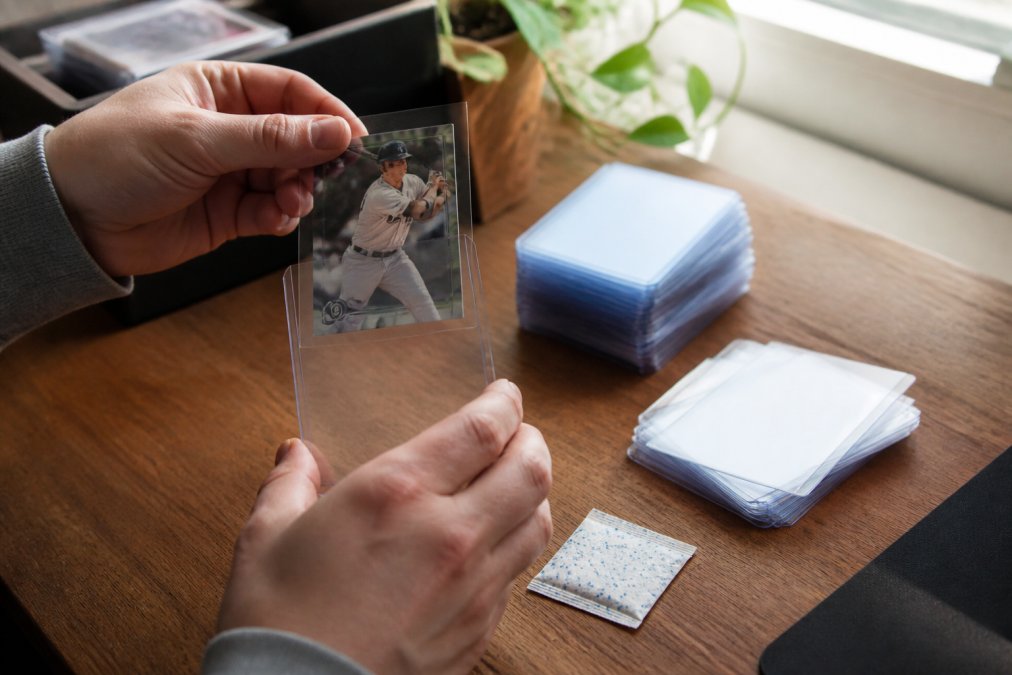
To store trading cards to prevent warping, keep them flat, under gentle even pressure, in a stable environment. Warping comes from moisture and temperature swings, not age: paper fibers swell as humidity rises and contract as it falls. When one side absorbs more moisture than the other, common in loose piles or cards leaning against a box wall, the damp side elongates and the card bows.
Humidity, Temperature, and Light Control
Aim for a stable range rather than a perfect number: big swings do more damage than a steady, slightly imperfect reading. Most preservation practitioners target 45%-55% relative humidity and 65°F-70°F. Consistency matters more than the exact number, a steady 60% RH typically fares better than one swinging between 30% and 70% weekly.
- Monitor, don't guess. A cheap digital hygrometer inside the bin or on the shelf tells you what the cards actually experience; analog dial gauges drift.
- Use silica gel in closed bins. Packets absorb excess moisture in a sealed container; recharge or replace them every three to six months, or when the indicator beads change color. In an open shelf setup, silica gel does almost nothing because room air exchanges freely.
- Avoid attics, garages, and basements. These swing hardest in temperature and humidity, an attic can hit 120°F in summer, a garage can drop below freezing in winter, driving condensation and warping.
- Store away from windows. UV light fades ink and yellows plastic cases, and indirect sunlight adds heat that drives humidity swings inside a bin.
- Never store near heating vents, water heaters, or exterior walls. These create localized hot or damp zones a room-level hygrometer will not catch.
Material Degradation Over Decades
Card stock is chemically stable under good conditions, but enclosures are not always. PVC, polyvinyl chloride, is the main offender: over years it releases hydrochloric acid and plasticizer vapors that migrate into paper, causing yellowing, brittleness, and a faint chemical smell. That is why PVC-free is non-negotiable for anything stored longer than a few months.
Acid-Free Card Storage Boxes: What to Look For
Acid-free card storage boxes are made from materials that will not leach chemicals into card stock over time. Look for acid-free, lignin-free cardboard or inert plastic like polypropylene, and avoid anything with a strong chemical smell.
Cardboard vs. Plastic vs. Wood Containers
- Cardboard: affordable and breathable, but only if acid-free; cheap boxes are the risk
- Plastic bins: excellent moisture barrier and dustproof, best for bulk collection storage
- Wood: attractive for display, but untreated wood can off-gas and trap moisture
For most collectors, a PVC-free plastic bin wins for long-term storage. The BCW 1,600-count card bin listing holds up to 1,600 standard-sized cards and works with Pokémon, Magic, Yu-Gi-Oh!, and sports cards. At $34.99, it is the workhorse of a serious collection.
Binder Storage vs. Box Storage: Which Wins?
Binder storage wins for cards you browse and display; box storage wins for bulk and long-term holds. The answer is usually both, split by how often you touch a card.
Protecting High-Value Cards: Toploaders and Magnetic Cases
High-value cards need rigid protection plus a moisture barrier. Toploaders and magnetic cases both deliver rigidity; choose by handling frequency and thickness. Standard 20pt cards fit standard toploaders, while thicker cards need matched sizes.
Pest, Mold, and Environmental Degradation Prevention
Pests and mold are the two most underestimated threats. Silverfish and carpet beetles eat paper and starch-based adhesives, and mold needs only elevated humidity to start. Both are preventable with the same habits: keep storage sealed, dry, and inspected.
Identifying and Stopping Pests
Silverfish are small, silver, teardrop-shaped insects that feed on paper, glue, and starch sizing in card stock, leaving irregular holes and yellowish stains. Carpet beetles and their larvae feed on natural fibers and paper, with shed skins often found near the damage. Booklice and psocids are less destructive but signal high humidity.
Signs to check for twice a year:
- Frass, tiny dark specks or sawdust-like residue near the bottom of a box
- Holes or chewed edges on card stock or binder pages
- Shed skins or dead insects in the bottom of bins
- Musty or sweet odors that suggest mold or insect activity
- Webbing or silk in corners of boxes
Mold: Detection and Response
Mold needs only elevated humidity, generally above 60% RH, to start. It appears as white, gray, or black spotting, often on card edges or in the gutter of binder pages, and a musty smell is usually the first sign.
Documentation and Insurance for Long-Term Storage
This is the step almost no guide covers, and it matters most for collections stored for years. If cards are damaged by a flood, fire, or pest infestation, an insurance claim without documentation is an uphill fight.
- Card name, set, year, and condition
- Purchase date and price, if known
- Storage location (which bin, which shelf)
- A photograph of the card front and back
Frequently Asked Questions
What is the best way to store trading cards for the long term?
The best long-term card storage combines three layers: a penny sleeve for scratch protection, a semi-rigid holder or toploader for structural support, and an acid-free storage box kept in a cool, dry, dark place. Avoid attics, basements, and garages where humidity and temperature swing. For high-value cards, add a magnetic case and store the box upright so cards do not press against each other. This system minimizes moisture, UV exposure, and physical damage over decades.
Is it better to store cards in a binder or a box?
Binders work well for cards you flip through regularly, especially complete sets or display collections. Use PVC-free pages like BCW Laser Weld 9-Pocket Pages to avoid chemical damage. Boxes suit bulk storage and high-value cards that need maximum protection from light and handling. Many collectors use both: binders for active sets, boxes for duplicates, graded cards, and long-term holds. Just keep binders upright and out of direct sunlight.
What are the best card sleeves for long-term storage?
For long-term storage, look for PVC-free, acid-free penny sleeves as your first layer. The Rip & Protect Bundle from Cardboard Superstars includes 200 penny sleeves and 200 semi-rigid card savers, giving you both everyday protection and sturdier support for submissions or shipping. Semi-rigid holders offer more flexibility than hard toploaders and are commonly used for grading submissions. Avoid any sleeve that feels oily or smells like plastic chemicals, as those can leach onto card surfaces over time.
How do I prevent moisture and UV damage in my card collection?
Control moisture by storing cards in a climate-controlled room. Add silica gel packets to storage boxes and replace them every few months. For UV protection, keep boxes and binders out of direct sunlight and away from fluorescent lights. Acid-free card storage boxes with tight-fitting lids create a moisture barrier.
Are cardboard storage boxes safe for long-term card storage?
Only if they are acid-free and archival-quality. Standard shipping boxes contain lignin and acids that break down over time, causing card yellowing and brittleness. Look for boxes labeled acid-free, archival, or safe for long-term storage. Plastic bins like the BCW Collectible Card Bin hold 1,600 cards and offer a dustproof, waterproof barrier that cardboard cannot match. For maximum protection, use acid-free boxes inside a sealed plastic bin in a climate-controlled space.
Building long-term storage that actually holds value takes the right materials, not the most expensive ones. At Cardboard Superstars, we stock the sleeves, toploaders, semi-rigid savers, PVC-free pages, and 1,600-count bins that make up a complete system, backed by authentic products, secure collector-grade packaging, and clear product details before you check out. Get started with Cardboard Superstars and protect your collection for the long haul.