


Table of Contents
- Where to Buy Authentic Japanese TCG Cards Online
- How to Spot Fake Japanese Pokemon Cards
- Best Proxy Services for Japanese Trading Cards
- Shipping, Customs, and Import Duties Explained
- Booster Boxes vs. Single Cards: What to Buy
- Understanding Japanese TCG Grading and Condition
- Frequently Asked Questions
Last Updated: September 13, 2026
Where to Buy Authentic Japanese TCG Cards Online
Buying authentic Japanese TCG cards online comes down to sourcing from sellers who can prove where the product came from. This guide walks through the pipeline from Japanese retail shelves to your mailbox.
The Japanese TCG market operates differently from what most Western collectors are used to. Sets release in Japan first, print runs are shorter, and certain cards never see an English release at all. That exclusivity drives demand, and demand drives counterfeits. According to the U.S. Customs and Border Protection counterfeit goods overview, counterfeit goods seizures continue to rise year over year, and trading cards sit squarely in that category.
With the right sourcing strategy, you can avoid the fakes entirely. Below, we break down every legitimate channel and how to vet each one.
Direct from Japanese Retailers
Ordering directly from Japanese retailers gives you the highest confidence in authenticity, but most major shops don't ship internationally, and the ones that do charge accordingly.
The Japanese Pokemon Center is the gold standard for sealed product, the official source, so counterfeits are impossible. The catch: it doesn't ship to U.S. addresses, so you'll need a proxy or forwarding service.
Other Japanese retailers operate similar domestic-only policies. Some ship internationally case-by-case, but you'll pay a premium and wait longer. For collectors chasing Japanese releases that never got a Western print, this is often the only direct path.
Local Importers and Specialty Shops
Domestic importers solve the language and logistics problems in one move: they buy Japanese product in bulk, handle customs paperwork, and resell to U.S. buyers with local support.
Cardboard Superstars operates in this space. We stock sealed Japanese booster boxes and Korean-language releases, all with clear condition details and exact product specifications before checkout. With more than 4,600 items sold and 100% positive feedback on eBay, the track record speaks for itself.
The trade-off is selection depth: a specialty shop can't carry every set ever printed, so hunting a specific out-of-print release may mean combining sources.
How to Spot Fake Japanese Pokemon Cards
Learning how to spot fake Japanese Pokemon cards protects your money and your collection. Counterfeits have gotten better, but they still fail on packaging details and print quality.
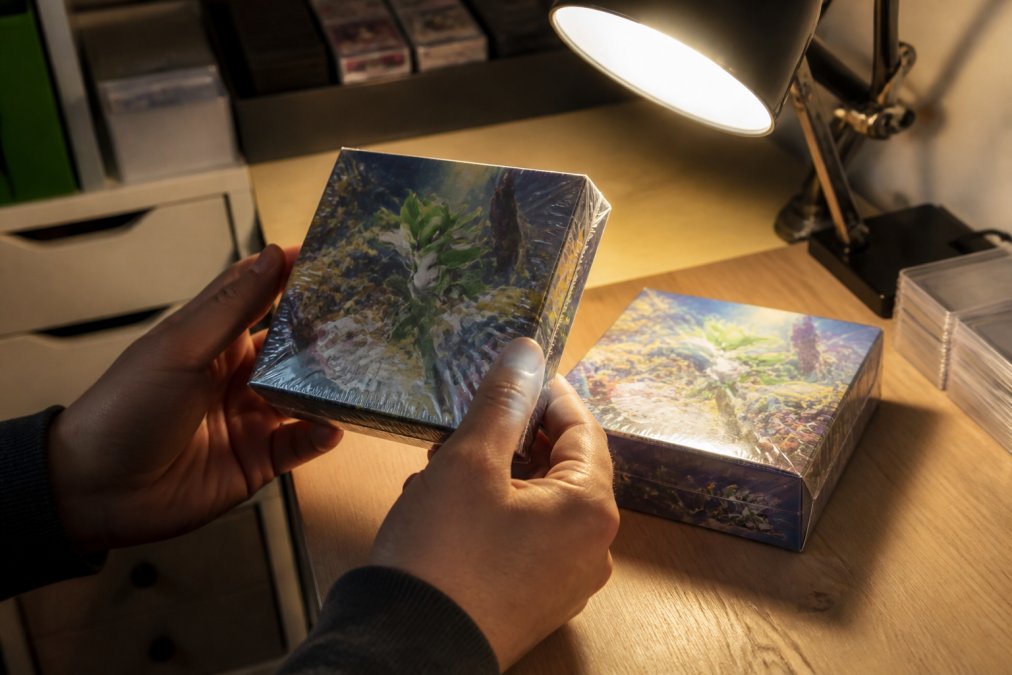
Visual Identification of Counterfeit Packaging
Counterfeit packaging almost always reveals itself under close inspection. Authentic Japanese boxes have a specific shrink wrap tightness and sheen that fakes rarely match.
Check these details before you buy:
- Shrink wrap texture: Authentic wrap is tight, slightly glossy, and has clean seams. Fakes often look cloudy or loose.
- Print registration: Authentic text and logos are razor sharp. Counterfeits show blur, color bleed, or misaligned layers.
- Color accuracy: Compare against official product images. Fakes tend to run warmer or duller.
- Font consistency: Japanese characters on fakes are sometimes subtly wrong in stroke width or spacing.
Card Stock and Print Quality Checks
Real Japanese TCG cards use a specific card stock with a distinct feel and sound. Counterfeits cut corners on materials, which shows up immediately in hand.
Authentic cards have a crisp snap when flexed gently, clean edges, and centered print. Fakes feel flimsier, show dot patterns under magnification, and often have off-center borders or misaligned text. The back is the easiest tell: authentic backs have consistent color saturation and a sharp blue border, while counterfeits look washed out or oversaturated.
Best Proxy Services for Japanese Trading Cards
The best proxy services for Japanese trading cards act as your buying agent inside Japan: you give them a product link, they purchase it domestically, receive it at their warehouse, and forward it to you.
This solves the "won't ship internationally" problem and means you're buying from the original Japanese seller, so authenticity is guaranteed at the source. Costs are layered: item price, domestic shipping, proxy fee, international shipping, and import charges on arrival.
Proxy Service vs. Direct Shipping Comparison
| Factor | Proxy Service | Direct Import from Specialty Shop |
|---|---|---|
| Authenticity confidence | Highest (buys at source) | High (verified importer) |
| Total cost | Item + domestic ship + proxy fee + international ship + duties | Single listed price, duties may apply |
| Selection | Any Japanese retailer | Limited to stocked inventory |
| Language barrier | You navigate Japanese sites | None |
| Shipping speed | Slower, multi-leg | Faster, single shipment |
| Customer support | Proxy handles Japan side only | Full support in English |
| Best for | Hard-to-find exclusives, bulk orders | Beginners, single boxes, fast delivery |
For beginners, a specialty shop removes the guesswork. Proxies shine when chasing something specific that no importer stocks.
Shipping, Customs, and Import Duties Explained
Shipping from Japan to the U.S. involves more variables than domestic ordering. Understanding customs and duties prevents surprise charges at your door, and the biggest variable is the de minimis threshold.
The De Minimis Threshold, Explained
U.S. customs law sets a de minimis threshold: shipments valued at or below a set dollar amount enter duty-free and with minimal paperwork. Historically that figure sat at $200, but it has been the subject of repeated legislative proposals to lower or eliminate it for certain countries and product categories (cbp.gov). Because the number and its exceptions change, always confirm the current threshold and any country-specific carve-outs before you order. The authoritative source is CBP guidance on importing goods by mail.
A single booster box often clears under the threshold, but a multi-box order or high-value graded single can push you over. When you cross the line, expect the carrier to collect duty plus a brokerage or disbursement fee before delivery.

How Duty Is Actually Calculated
Duty is assessed on the declared value of the goods, not on shipping paid. The rate depends on the product's harmonized tariff classification. Trading cards and printed collectibles generally fall into low or zero duty categories, but classification matters and errors are common. A few mechanics worth knowing:
- Declared value: Sellers must declare accurate value. Under-declaration is not a clever workaround, it risks seizure, forfeiture, and penalties, and it voids most carrier insurance claims.
- Brokerage fees: Even when duty is zero, carriers like UPS, FedEx, and DHL often charge a customs brokerage or advancement fee for handling clearance. This is separate from duty and frequently surprises buyers.
- State sales tax: Depending on your state and the seller's nexus, you may also owe use tax on the purchase. This is separate from federal customs.
- Consolidation: Combining multiple purchases into one shipment can reduce per-item shipping cost, but it also raises the declared value and can push a shipment over the de minimis line. Run the math both ways.
Choosing a Shipping Method
- EMS (Japan Post): Reliable, trackable, and often the best balance of speed and cost. Handed off to USPS for final delivery.
- DHL / FedEx / UPS: Fastest, with strong tracking, but the highest brokerage fees and the most likely to bill you for clearance.
- Surface mail: Cheapest, but can take four to eight weeks and offers weaker tracking. Only worth it for low-value, non-urgent orders.
- Tracking number: Always require one. Untracked international packages are effectively impossible to recover if lost.
- Shipping insurance: Worth it on any order above your comfort threshold, especially on graded singles where replacement cost is high.
Payment Methods and Currency Conversion
Payment options for international card purchases include credit cards, PayPal, and increasingly, direct bank transfers for larger orders. Each carries different protections.
Credit cards offer chargeback rights if goods never arrive or arrive misdescribed, and PayPal adds a dispute layer many collectors prefer. The catch is currency conversion: your card issuer applies its own exchange rate plus a foreign transaction fee. Some gateways let you pay in yen to avoid double conversion, but only if the seller supports it. When a seller quotes in dollars, ask whether that rate includes their conversion markup, it often does, and it can be several percentage points worse than the interbank rate.
For bulk purchases, ask about combined shipping. Consolidating boxes cuts per-item shipping cost, but weigh that against the higher declared value and customs consequences described above.
Booster Boxes vs. Single Cards: What to Buy
Sealed booster boxes and single cards serve different goals, and the right choice depends on whether you're collecting, playing, or investing.
Sealed product is the safer authenticity bet: a factory-sealed box from a verified seller is nearly impossible to fake convincingly, and sealed product tends to hold value. Japanese booster boxes like the Pokemon Black Bolt Deluxe Booster Box - Japanese at $300 give you the full opening experience plus the chance at high-value pulls.
Singles give you exactly what you want without gambling on pack odds. If you need one specific card for a deck or graded set, buying the single is cheaper than chasing it through boxes. Graded singles carry extra assurance because the grading company has already verified authenticity.
| Goal | Best Choice | Why |
|---|---|---|
| Start a collection | Sealed booster box | Authenticity certainty, opening experience |
| Complete a deck | Single cards | Exact cards, no pack randomness |
| Long-term value | Graded singles | Verified condition and authenticity |
| Display pieces | Graded cards | Protected, presentable, verified |
| Budget entry | Starter decks | Lower cost, playable out of the box |
For beginners, a starter deck or a mid-priced Japanese booster box is the smartest entry point. The Gundam TCG: New Type Rising Booster Box (Japanese) at $55 is a low-risk way to test the waters.

Understanding Japanese TCG Grading and Condition
Japanese TCG grading is having a third-party company authenticate and score a card's condition on a standardized scale. The grade directly affects market price, often by multiples, but who grades, how they score, and whether it's worth submitting is where most buyers get lost.
The Major Grading Companies
A handful of companies dominate the market, each carrying different weight with buyers:
- PSA (Professional Sports Authenticator): The most recognized name in the U.S. market. A PSA 10 carries a strong price premium, and PSA-graded cards are the easiest to resell to American buyers.
- BGS (Beckett Grading Services): Known for its subgrade system, centering, corners, edges, and surface each get their own score, plus an overall grade. A BGS 10 is rarer and often commands more than a PSA 10.
- CGC (Certified Guaranty Company): A newer entrant to trading cards that has gained traction quickly, particularly for Japanese and non-sports cards.
- ARS: A Japan-based grader that is well regarded domestically and increasingly recognized by international collectors chasing Japanese-exclusive cards.
For Japanese cards, the choice of grader matters. A Japan-based company may be more trusted by Japanese sellers, while a PSA or BGS holder is easier to move in the U.S. If resale is your goal, grade with the company your target buyer recognizes.
How the Scale Works
Grading companies examine four factors, centering, corners, edges, and surface, then assign a numeric score from 1 to 10, with 10 being gem mint. A few anchors:
- 10 (Gem Mint): Flawless or near-flawless. Centering is sharp, corners are crisp, surface is clean. This is the grade that drives price multiples.
- 9 (Mint): A single minor flaw, often centering just off. The price gap between a 9 and a 10 can be dramatic.
- 8 (NM-MT): Minor imperfections visible under close inspection. Still highly collectible.
- 7 and below: Increasingly visible wear. Often not worth the grading cost unless the card is genuinely rare.
Is Grading Worth It?
Grading is not free, and the math doesn't always work. Submission costs, shipping to and from the grader, and insurance add up, and turnaround times can stretch from weeks to months. Before submitting, ask:
- What is the raw card worth? If the ungraded value is low, the grading fee can exceed the value added.
- What is the likely grade? A card with visible centering issues will not grade a 10, and a 9 may not justify the cost.
- What is the graded price gap? For some cards, the difference between a raw copy and a graded 10 is many times the price. For others, it's marginal.
- Who is your buyer? If you plan to sell to U.S. collectors, a U.S. grader's holder is easier to move.
Condition Terminology You'll See on Listings
- Mint condition: Flawless, as printed, no visible defects.
- Near mint: Minimal wear, sharp corners, clean surface.
- Excellent: Light edge wear or minor surface marks.
- Good/Played: Visible wear, suitable for play but not display.
Card condition and rarity drive market price more than anything else: a rare card in mint condition can command many times the price of the same card in played condition. When buying online, insist on clear condition details and photos before checkout. Cardboard Superstars provides exact condition information in every listing.
The single most important habit for online buying is verifying the seller's track record and condition disclosures before you pay. A verified seller with clear listings eliminates most of the risk in this market.
Frequently Asked Questions
Is there an online store that sells authentic Japanese trading cards?
Yes. Reputable options include specialty shops like Cardboard Superstars that source directly from official distributors. Look for sellers with verified feedback, transparent product listings showing exact condition, and clear return policies. Avoid listings with stock photos only or prices far below market rate, as those often signal counterfeit or resealed product.
How do you know if Japanese cards are real?
Check the shrink wrap for a tight, even seal with no wrinkles or reseal marks. Authentic Japanese TCG cards have sharp text, consistent color saturation, and a distinct card stock feel. The rarity symbol and set number should match the official set list. If buying graded cards, verify the certification number with the grading company directly.
What are the most reputable online stores for Japanese trading cards?
Reputable stores provide detailed condition notes, real photos of the actual item, secure collector-grade packaging, and responsive customer support. Cardboard Superstars, for example, has 100% positive eBay feedback and more than 4,600 items sold, which gives buyers a verifiable track record. Always check return policies and shipping insurance options before purchasing high-value items.
Are there risks when importing Japanese TCG products?
Yes. Import duties may apply on shipments above the de minimis threshold, and packages can be delayed at customs. Shipping speed varies by carrier and service level. Always request a tracking number and consider shipping insurance for expensive orders. Customs declaration accuracy matters: mislabeled packages can be seized or returned.
How do proxy services work for buying Japanese TCG cards?
A proxy service buys items on your behalf from Japanese retailers that do not ship internationally, then forwards them to your address. You pay the item price, a service fee, domestic shipping within Japan, and international shipping. Proxy services are useful for exclusive releases and pre-orders, but add cost and time compared to buying from a local importer.
What is the difference between Japanese and English TCG card quality?
Japanese TCG cards generally have tighter print quality control, resulting in more consistent centering and fewer print defects. The card stock is often slightly different in feel and gloss. For collectors, Japanese exclusives and promo cards often hold higher value due to limited distribution and unique artwork not available in other languages.
What should collectors look for in a Japanese TCG retailer?
Look for clear product details before checkout, including exact condition, set name, and language. Check for secure packaging practices, shipping insurance availability, and a responsive customer support channel. Verified seller status, positive feedback history, and a physical business address are strong trust signals. Avoid sellers who cannot provide real photos of the actual item.
The hardest part of collecting Japanese TCG cards isn't finding them. It's trusting that what arrives is real and undamaged. Cardboard Superstars removes that uncertainty with authentic products, secure collector-grade packaging, and clear condition details provided before every checkout. Whether you're hunting a sealed booster box or a graded legend, get started with Cardboard Superstars and collect with total peace of mind.