


Quick Summary
A card grading report is the inspection document a professional grading company issues for a card, listing its identity, numerical grade and the subgrades behind it. To read it, confirm the identification fields and certification number match the slab, then check the overall grade against centering, corners, edges, surface, and any qualifiers or grader notes.
- Confirm the certification number matches the slab label and report, including leading zeros.
- Compare the numerical grade against the subgrades for centering, corners, edges and surface.
- Read every qualifier and grader note, since a short note can change value more than the grade.
- Check the population line to see how many examples exist at the grade you are considering.
- Verify the certification number yourself on the grading company's official lookup page.
Table of Contents
- What a Card Grading Report Is and Why Collectors Use It
- Report, Slab Label and Population Report: Knowing the Difference
- Step-by-Step: Reading a Card Grading Report Field by Field
- PSA Grading Scale Examples: What Each Number Tells You
- Card Grading Scale Differences Across Companies
- Using the Card Grading Report Population Data and Verifying Authenticity
- Booking Your Next Card Purchase With Confidence at Cardboard Superstars
- Frequently Asked Questions
What a Card Grading Report Is and Why Collectors Use It
Last Updated: November 12, 2026
A card grading report is the document a professional grading company issues after it inspects a card. It lists the card's identity, its numerical grade, and the scores behind that grade. Learning to read it is the fastest way to know what you are actually buying.
Collectors use these reports because a grade alone tells only part of the story. Two cards with the same grade can differ in centering, corners, or surface. The report shows those details, so you can judge the card before you pay for it.
Checking the full report before any graded purchase is a sound habit. Compare the grade against what the report says.
Grading companies such as PSA's grading and population resources publish guidance on how their scales work. Read that guidance alongside the report.
- Grade: the single number that summarizes overall condition
- Subgrades: scores for centering, corners, edges, and surface
- Label or slab: the sealed holder that carries the card and key details
- Certification number: the unique ID used to look up the card
Report, Slab Label and Population Report: Knowing the Difference
These three items are often confused, but each does a different job.
The report is the detailed inspection record. The slab label is the printed information on the sealed holder, usually the grade, card details, and certification number. The population report is a count of how many cards a grader has given each grade, which helps show how rare a grade is.
A slab label is a summary. Always compare it with the full report when you can.
Step-by-Step: Reading a Card Grading Report Field by Field
Work through the report in order. This keeps you from skipping details that affect value. The walkthrough below uses a typical report layout; field names vary slightly by company, but the sequence is consistent.
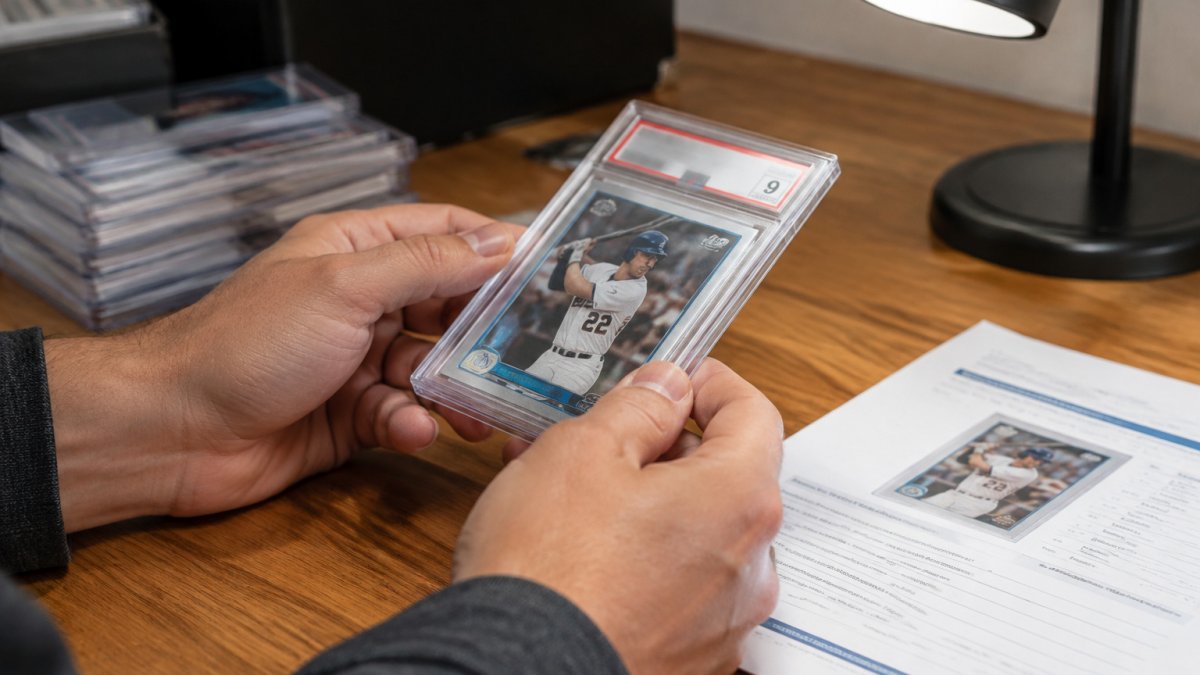
!Collector's hands holding a graded card slab under a desk lamp, with a printed grading report beside it
Identification fields: card, set, year and certification number
Start by confirming the card is the one you want. Check the player or character name, the set, the year, the card number, and any variation or parallel designation. Then find the certification number and match it to the slab.
A common pattern is that the certification number appears in two places: printed on the slab label and encoded in the company's online record. The two must match exactly, including leading zeros. Mismatched details are a warning sign. If the report and the slab disagree, stop and ask the seller before you buy.
Numerical grade and subgrades: centering, corners, edges and surface
The numerical grade is the headline score. The subgrades explain where the card earned or lost points. Look at each one:
- Centering: how evenly the image sits within the borders, usually expressed as a ratio such as 55/45 or 60/40. The first number is the narrower border; the closer the two numbers, the better the centering score.
- Corners: sharpness and any rounding, fraying, or wear at the four tips.
- Edges: chipping, roughness, or whitening along the sides.
- Surface: scratches, print lines, dimples, or staining visible under angled light.
Two cards can share a grade while showing different subgrade patterns. A strong surface score with weak centering tells a different story than the reverse. When subgrades are present, the overall grade is not a simple average, graders weight the components and apply company-specific rules, so a single low subgrade can cap the overall number.
Qualifiers, grader notes and additional observations
Some reports add qualifiers or notes. Qualifiers are short codes, commonly used for issues such as off-center cutting, staining, or print defects, that flag a problem the numerical grade alone does not capture. Grader notes are free-text observations that describe specific flaws, such as a surface scratch near the border or a soft corner.
Read every note. A short note can change a card's value more than the grade does. Watch out: a qualifier can make a card look like a bargain at its grade until you realize the qualifier is the reason for the discount.
A labeled sample report
Use this field map as a checklist when you open any report:
- Header: company name, report date, and report or certification number.
- Card identity block: year, set name, card number, player or character, and variation.
- Overall grade: the single headline number or descriptor.
- Subgrade block: centering, corners, edges, and surface scores, when the company issues them.
- Qualifier and notes block: short codes and free-text observations.
- Population line: how many examples of this card exist at this grade, when the company publishes it.
- Certification lookup: the number you use to pull the online record.
If a field is blank, that is information too, it may mean the company does not issue that subgrade or that no qualifier applies.
The article breaks the report into its key fields, which a reader can check in order:
| Field | What it shows | What to check |
|---|---|---|
| Identification fields | Card, set, year and certification number | Match the certification number on the slab and the report, including leading zeros |
| Numerical grade | Single headline score for overall condition | Compare against the subgrades behind it |
| Centering | How evenly the image sits in the borders | Ratio such as 55/45 or 60/40; closer numbers score better |
| Corners | Sharpness and rounding at the four tips | Look for rounding, fraying or wear |
| Edges | Chipping, roughness or whitening on the sides | Look for chipping or whitening |
| Surface | Scratches, print lines, dimples or staining | Check under angled light |
| Qualifiers and notes | Short codes and free-text flaw observations | Read every note; a qualifier can explain a discount |
PSA Grading Scale Examples: What Each Number Tells You
PSA uses a 1 to 10 scale. A PSA 10 is Gem Mint, with near-perfect centering, corners, edges, and surface. Lower numbers allow more visible wear at each step.
For example, a card graded PSA 8 looks clean but may show slight centering or corner flaws. The subgrades in the report show exactly where those flaws sit.
Card Grading Scale Differences Across Companies
Grading companies do not use identical scales. A grade from one company is not automatically equal to the same number from another. Each company sets its own standards, and some use half-point steps while others do not.
Before comparing cards, check which company graded each one.
Using the Card Grading Report Population Data and Verifying Authenticity
The population report shows how many cards exist at each grade. A low population at a high grade can make a card scarcer, though scarcity alone does not guarantee value. Read the population line alongside the grade, not instead of it.
Reading a population report
Population data is usually broken out by card, by grade, and sometimes by qualifier. Look for three things:
- Total graded: how many examples of the card the company has graded in total. A small total means the grade distribution is thin and less reliable as a value signal.
- Count at the top grade: how many examples sit at the highest grade. A small top-grade count is the number collectors watch most closely.
- Count at or above the grade you are considering: this tells you how many comparable cards exist, which is more useful for pricing than the top-grade count alone.
A common pattern is that population counts rise over time as more cards are submitted, so a low count today can grow. Treat population as one input, not a verdict.
Verifying a certification number step by step
- Find the certification number on the slab label and on the report.
- Go to the grading company's official lookup page, use the company's own site, not a search result or a third-party aggregator.
- Enter the number exactly as printed, including any leading zeros or letters.
- Compare the online record to the physical slab: card identity, grade, subgrades, qualifiers, and any notes should match.
- Check the image on the online record, when one is provided, against the card in the slab.
Watch out: a certification number that returns no record, or returns a record for a different card, is a serious red flag. Do not rely on a screenshot of a lookup, run the lookup yourself.
Connecting report details to buying risk
Use the report to price uncertainty, not just condition. A card with a clean grade but a qualifier or a grader note about surface wear carries more risk than the number suggests. A card with a strong population at its grade is easier to comp against recent sales. When you compare two cards at the same grade, the one with cleaner subgrades and no qualifiers is usually the safer buy, even if the headline number is identical.
Booking Your Next Card Purchase With Confidence at Cardboard Superstars
Once you can read a report, you can shop with more confidence. Cardboard Superstars sells graded hockey cards, so you can check their details against what you have learned here.
Browse current options and find a card that fits your collection and budget. Find the hockey card that earns a spot in your case, then check its report before you buy.
Frequently Asked Questions
What does 1, 2, 3, 4 mean on a report card?
On a card grading report, the numbers are the numerical grade, not a school-style ranking. A grade of 1 indicates a card in poor condition with heavy wear, while 10 signals a card that is nearly flawless. Numbers in between describe progressively better condition. Always read the full grade alongside the subgrades for centering, corners, edges and surface, because a card can earn a strong overall grade while one component scores lower. Grades are assigned by grading companies using their own criteria, so compare numbers within the same company whenever possible.
Is PSA 1 or 10 better?
A PSA 10 is better. It is the highest grade and represents a Gem Mint card with sharp centering, clean corners, clean edges and a flawless surface when examined under magnification. A PSA 1 is the lowest grade, indicating a card in poor condition with significant wear, creases, or damage. Value generally rises with the grade, but the gap between grades can be large, so check recent sales of the same card at each grade before deciding how much a higher grade is worth to you.
Is PSA 7 a bad grade?
A PSA 7 is not a bad grade. It indicates Near Mint condition, meaning the card shows minor flaws such as slight centering variation or light surface wear that are visible on close inspection. Many collectors buy PSA 7 cards for their display and personal collections because they are far more affordable than PSA 9 or 10 copies of the same card. Whether a PSA 7 is a good value depends on the card and current market prices, so compare its sale history with higher and lower grades.
Can a grading report confirm that a card is authentic?
A grading report and its certification number help verify that a card was submitted to and graded by the company, but the report alone does not guarantee authenticity beyond what the grading company has examined. Use the certification number on the company's official website to confirm that the label and report match. Check that the card details, such as player, set and year, agree with the label and the report. If the number does not return a matching record, treat the card with caution.
