


Last Updated: November 22, 2026
Quick Summary
Trimmed trading cards are cards whose edges have been cut to hide wear or change size, so you spot them by measuring the card, checking all four edges, and comparing it to an authentic example from the same set. Measure width and height at several points with a digital caliper, then look for uneven borders, squared corners, and shearing marks.
- Measure width and height with a digital caliper at several points on each card.
- A card reading about 1/32 inch under standard size on a side deserves closer inspection.
- Check all four edges for uneven borders, missing printing, and shearing marks.
- Compare suspect cards side by side with a verified example from the same set and year.
- Do not call a card trimmed from a rough edge alone; check for matching wear on all four edges.
Table of Contents
- Comparing the Card Against Known Authentic Examples
- Trading Card Dimensions: Measuring a Card Accurately
- Signs of Trimmed Card Edges to Look For
- Step-by-Step Inspection Workflow for Spotting Trimmed Cards
- How Grading Companies Detect Card Trimming
- How to Inspect Cards at a Card Show
- Troubleshooting: Factory Cuts, Miscuts, and Limits of Visual Inspection
- Protecting Yourself When Buying and Selling: Your Next Step
- Frequently Asked Questions
Trimmed trading cards look almost identical to honest ones at a glance, and that is exactly why they cause so much trouble. For a broader set of checks on suspect cards, see how to spot fake graded cards.
Card trimming is the practice of cutting away a thin strip of the card's edges to hide wear, sharpen corners, or change the card's measured size. Collectors sometimes trim cards to remove whitening, dings, or uneven borders. Others do it to make a card look more attractive to a grader, or to pass off a lower-value card as something rarer.
Trading cards are printed to standard dimensions, and most sports cards measure close to 2.5 by 3.5 inches. Start by measuring the card with a digital caliper, which gives readings to the hundredth of an inch. Measure the width and height at several points, not just one, and note any readings that fall outside the expected range.
Trimmed cards often show a few telltale signs at the edges. Look for these clues before deciding whether a card has been altered:
- Uneven borders: One side is noticeably thinner than the others
- Flattened or squared corners: Corners look cut rather than naturally rounded or sharp
- Missing printing: The colored edge or border lines stop short of where they should
- Unusual edge color: Cut edges may show a white or pale core that doesn't match the rest
- Chipping along the cut: A trimmed edge can look rough or chipped under magnification
- Shearing marks: Fine parallel lines or a slight bevel from a blade
Watch out: A card with a rough edge is not always trimmed. Check for matching wear on all four edges before drawing a conclusion.
Follow this workflow each time you examine a card. It keeps your checks consistent and helps you catch small problems you might otherwise miss.
- Set the card in good light on a clean, flat surface.
- Measure width and height with a digital caliper at several points.
- Examine all four edges and corners under a jeweler's loupe.
- Look for uneven borders, missing printing, and shearing marks.
- Compare the card against a known authentic example from the same set.
- Record your findings with photos before you make an offer or purchase.
Comparing the Card Against Known Authentic Examples
Measurements alone can mislead you, because factory production varies slightly from card to card. The strongest evidence comes from side-by-side comparison. Place the suspect card next to a verified example from the same set and year, then check the border width, corner shape, and edge color. A card that differs consistently from several authentic copies deserves a closer look.
Trimmed edges are often easiest to spot when you compare both sides of the same card. If the front border is noticeably thinner than the back, that asymmetry is a red flag.
Grading companies generally rely on magnification, measurement, and comparison to decide whether a card has been altered. To see how resealed slabs can hide tampering, read identifying resealed card slabs step by step. Understanding this process helps you know what to look for before you submit or buy.
Trading Card Dimensions: Measuring a Card Accurately
Accurate measurement is the foundation of any trimming check, but most collectors stop at "measure the card" without a method. A repeatable measurement routine is what separates a useful reading from a number that creates false confidence.
Standard trading card dimensions are nominally 2.5 by 3.5 inches (63.5 by 88.9 mm) for the traditional sports card size, with the modern 2.5-by-3.5-inch format still the most common reference point. Vintage cards from different eras can vary slightly, and some sets use different stock thickness or trim allowances, so always confirm the expected size for the specific set and year before treating a deviation as evidence of trimming.
Use a digital caliper that reads to 0.01 inch or 0.1 mm. A plastic vernier caliper is workable but harder to read consistently; a digital caliper removes parallax error and lets you record numbers quickly.
Measure at three points along each dimension: near the top edge, at the midpoint, and near the bottom edge for height; near the left edge, midpoint, and right edge for width. Take each reading with the caliper jaws parallel to the edge being measured, and let the jaws close gently rather than squeezing, since compressing the card stock will read undersized. Record every reading rather than averaging in your head.
A common pattern is for honest cards to fall within a few thousandths of an inch of nominal size, with variation coming from stock thickness, printing registration, and the cutting die. A card that reads consistently undersized across multiple points, especially by more than roughly 1/32 inch (about 0.03 inch) on a side, is worth closer inspection.
Watch out: A card that measures slightly under standard size is not automatically trimmed. Factory cutting dies wear, stock varies, and centering shifts the printed area without changing the physical dimensions. Treat measurement as one input, not a verdict.
Keep a simple log for cards you examine repeatedly: date, set, year, measured width and height at each point, and the reference card you compared against. Over time this log becomes your own tolerance baseline for a given set, which is more reliable than a generic standard.
Signs of Trimmed Card Edges to Look For
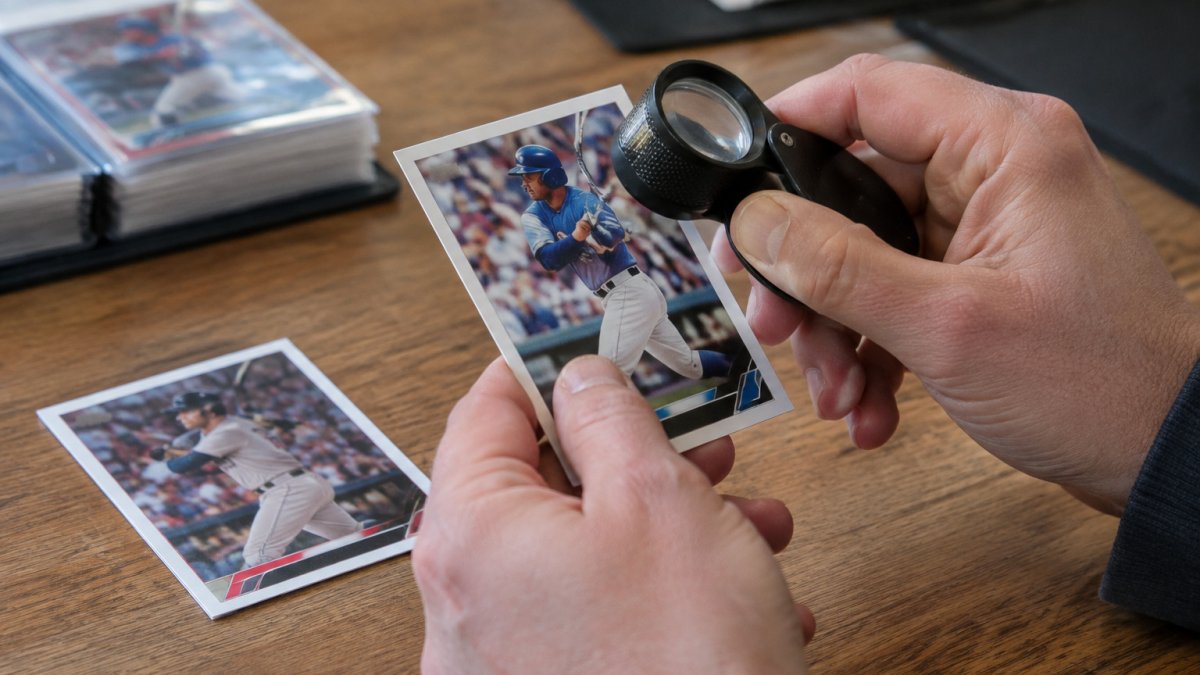
Trimmed edges leave a set of clues that careful inspection can reveal. The most reliable signs are uneven borders, squared corners, and inconsistent edge color. Many collectors also notice that a trimmed card feels slightly different in the hand, with edges that catch more easily on a sleeve. Use these signs together rather than relying on any single clue.
Step-by-Step Inspection Workflow for Spotting Trimmed Cards
A repeatable process keeps you from missing details when you are tired or rushed. If you cannot inspect in person, verifying card condition online walks through remote checks. Work through each step in order, and do not skip the comparison stage, since it provides the most reliable evidence.
Comparing the Card Against Known Authentic Examples
Return to this step whenever a measurement or visual check leaves you unsure. Authentic reference cards are the best way to calibrate your eye for a specific set.
Work through these six steps in order each time you examine a card, so small problems don't slip past you.
| Step | What to do | Time or frequency |
|---|---|---|
| 1 | Set the card in good light on a clean, flat surface | Every card |
| 2 | Measure width and height with a digital caliper at several points | Every card |
| 3 | Examine all four edges and corners under a jeweler's loupe | Every card |
| 4 | Look for uneven borders, missing printing, and shearing marks | Every card |
| 5 | Compare the card against a known authentic example from the same set | Every card |
| 6 | Record findings with photos before making an offer or purchase | Before any offer or purchase |
How Grading Companies Detect Card Trimming
Professional grading services generally use magnification and precise measurement to check cards for alteration. If you plan to submit cards for grading, expect this level of scrutiny and set realistic expectations about the result. Before committing, you can compare grading services in how to evaluate card grading services.
How to Inspect Cards at a Card Show
Card shows are fast-paced, so bring a few basic tools with you: a digital caliper, a jeweler's loupe, and a soft cloth. Ask the seller if you can handle the card under good light, and take your time on each edge. If a seller resists close inspection, treat that as a warning sign.
Troubleshooting: Factory Cuts, Miscuts, and Limits of Visual Inspection
Not every irregular edge is the result of trimming, and the fastest way to lose credibility as a buyer or seller is to call a factory miscut a trimmed card. Surface marks can also be confused with edge damage, so see removing dust from trading cards without scratching for how minor surface issues are handled.
Factory cuts. Production cards are cut with a die, and die wear, stock variation, and registration drift produce edges that can look slightly rough or uneven under magnification.
Miscuts. A miscut happens when the cutting die is misaligned with the printed sheet, so the card shows part of a neighboring card's image, a shifted border, or a visible cut line inside the printed area.
Wear and handling. Rounded corners, edge whitening, and small dings come from sleeves, shuffling, storage, and handling.
A practical diagnostic order is: measure first, then compare against a known authentic example from the same set and year, then inspect edges under magnification, and only then form a conclusion.
Visual inspection has real limits. Skilled trimming can remove a strip thin enough that dimensions stay close to nominal, and some alterations are only confirmed by examining edge microstructure under high magnification or by comparing against a large reference database.
Watch out: Accusing a seller of trimming without measurement and comparison evidence can damage relationships and is difficult to walk back. Document your findings with photos and measurements before raising a concern.
Protecting Yourself When Buying and Selling: Your Next Step
Once you can spot the signs, take steps to protect every transaction. Ask for clear photos of all four edges and corners, request measurements, and buy from sellers who offer detailed condition information. At Cardboard Superstars, we list product details before checkout. Protect the cards you own with sleeves and semi-rigid holders such as the Rip & Protect Bundle 200 Penny Sleeves, 200 Semi Rigid Card Savers for $32.00, and the BCW Semi-Rigid Card Holder #1 for $11.99.


Frequently Asked Questions
How can you tell if a trading card has been trimmed?
Start by measuring the card with a digital caliper and comparing its width and height to the standard size of about 2.5 by 3.5 inches. Next, examine all four edges under magnification for uneven borders, a lack of the factory cut's clean sharpness, or a shiny, smoothed look where material was removed. Compare the card against a known authentic example from the same set and era. Trimmed cards often show borders that are noticeably thinner on one side, or edges that look slightly rounded or different in color from the rest of the card. A single sign is not proof, so look for several indicators together.
What dimensions should a trading card have?
Most modern sports and trading cards measure about 2.5 by 3.5 inches, which is the standard size used by most major manufacturers. Some older sets and certain formats vary slightly, so compare against an authentic card from the same set rather than relying on one number. Measure at several points along each edge, since a card that measures correctly in one spot but not another may have been trimmed or damaged. Small variations are normal due to production differences, so look for consistent, meaningful deviations rather than a fraction of a millimeter.
Will a grading company grade a card that has been trimmed?
Professional grading companies examine cards for alteration, and trimmed cards are generally identified during the grading process. Grading companies do not guarantee that a card has never been altered, because their assessment is based on visual and physical inspection at the time of submission. Collectors should not assume a graded slab confirms the card is untouched.
How can I inspect cards at a card show without damaging them?
Bring a jeweler's loupe or a small magnifier and a digital caliper, and ask the seller for permission before handling any card. Hold the card by its edges, keep your fingers away from the surface, and examine each edge under good light. Compare the card with a known authentic copy if you have one. Avoid rubbing or pressing the card, and return it to its sleeve after inspection. Local card stores and shows are good places to practice these checks on common cards before spending money on high-value items.
