


Table of Contents
- Why Storage Matters for Pokémon Booster Box Investment
- The Best Way to Store Sealed Pokémon Products
- Choosing the Right Pokémon Booster Box Storage Case
- How to Store Booster Bundles and Multiple Boxes
- How to Organize a Sealed Pokémon Collection
- Avoiding Common Storage Mistakes
- Monitoring and Maintaining Your Collection Over Time
- Frequently Asked Questions
Last Updated: October 20, 2026
Why Storage Matters for Pokémon Booster Box Investment
Proper storage directly impacts the long-term value when you store pokémon booster boxes correctly. Store pokémon booster boxes incorrectly and you risk fading, warping, and physical damage that can slash resale value by 30-50%.
The difference between a box worth $100 and one worth $40 often comes down to storage choices made years earlier. Temperature swings, humidity, sunlight, and careless stacking leave permanent marks.
The Best Way to Store Sealed Pokémon Products
Temperature and Humidity Control
Store your sealed Pokémon collection in a cool, dry place: 65-75°F with 30-50% humidity. Fluctuations cause cardboard to expand and contract, warping the box and separating internal glue seals.
Avoid damp basements and heat-blasted attics; a climate-controlled closet, storage room, or cabinet works better. Add these controls:
- Use a small dehumidifier in the storage area to maintain consistent humidity
- Place silica gel packets near (but not touching) your boxes to absorb excess moisture
- Monitor temperature with a basic thermometer to catch seasonal swings
Humidity is particularly destructive: cardboard absorbs moisture, softens, and grows mold. High heat accelerates ink fading and warps plastic components.
UV Light and Sunlight Protection
Direct sunlight fades booster box artwork within weeks, bleaching colors on sealed products exposed to natural or intense artificial light.

Store your collection in a dark location or in opaque storage containers. If you display sealed boxes, use UV-blocking glass or acrylic barriers. Here's what to avoid:
- Windows with direct sunlight exposure
- Bright LED displays or intense spotlights pointed at boxes
- Rooms with large skylights or glass doors facing south
For long-term storage, darkness is best. Many serious investors keep sealed collections in closed cabinets to eliminate light exposure entirely, you lose the display, but the investment value stays protected.
Choosing the Right Pokémon Booster Box Storage Case
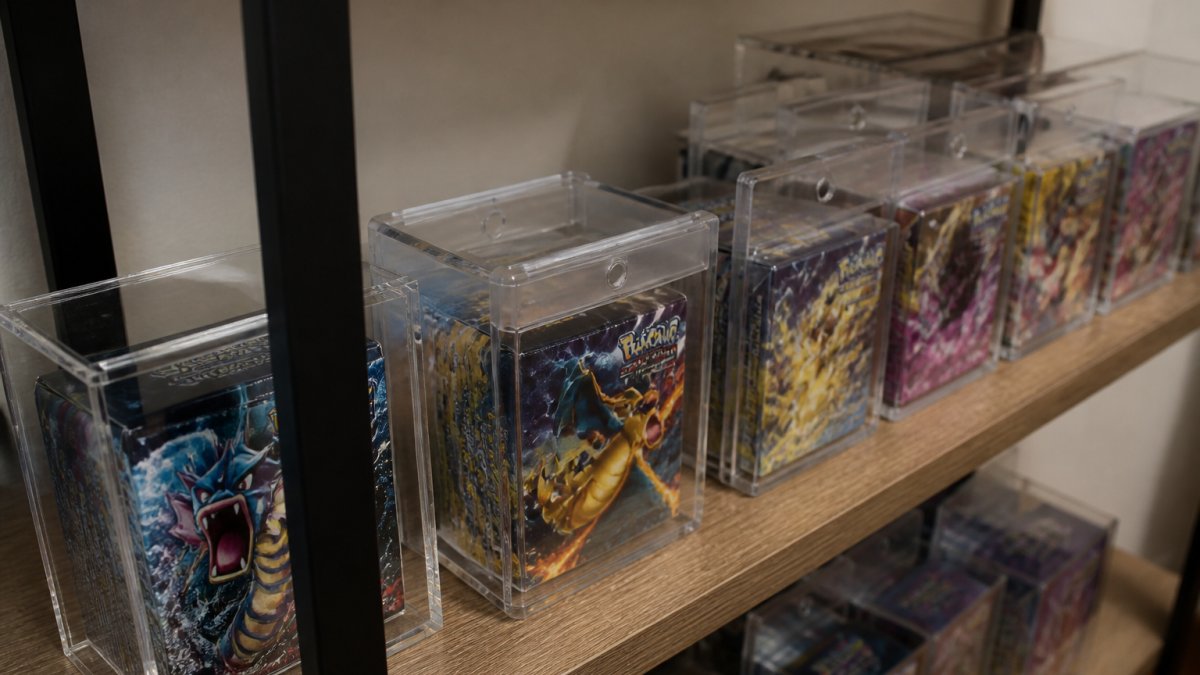
Most storage guides treat booster boxes like oversized cards. They are not. A factory-sealed booster box is a rigid cardboard carton with internal trays, shrink wrap, and printed seals, so the case must account for its actual footprint, the shrink wrap's vulnerability to abrasion, and enough clearance to lift the box without scuffing corners.
Measure Before You Buy
Dimensions vary by language and release. English-language boxes from recent sets commonly measure roughly 5.5" × 3" × 4.75" (about 14 × 7.6 × 12 cm); Japanese-language boxes are typically smaller, often around 5.2" × 2.8" × 3.5". Measure your specific box with a ruler or caliper and add at least 1/8" (3 mm) of clearance per side, too tight compresses the shrink wrap and can crack the factory seal at the corners, while too loose lets the box slide and abrade.
Acrylic Cases: Rigid Protection With a Visibility Trade-Off
Acrylic display cases are the closest thing to a standard for investment-grade sealed boxes: rigid, chemically inert, and clear enough to inspect the box without opening it.
When fitting an acrylic case, check three things: interior clearance (at least 1/8" per side), lid fit (a friction lid that does not press on the box), and ventilation (some cases are fully sealed, which can trap humidity).
Semi-Rigid Holders: Compact and Stackable
Semi-rigid holders, sold as "booster box protectors" or "storage shells", are made from PET or similar semi-rigid plastic. They cost less than acrylic (commonly $5-$15 each), stack more compactly, and are lighter for shipping, but offer less impact resistance and can become brittle in cold storage. For boxes kept in a climate-controlled closet and handled gently, they're a reasonable budget option; for long-term investment storage where the box may be moved or shipped, acrylic is safer.
Materials to Avoid
Not all clear plastic is safe long-term. Polyvinyl chloride (PVC) can off-gas plasticizers that migrate onto cardboard and shrink wrap, leaving a sticky film and dulling print. Avoid PVC and soft vinyl bags; look for PET, acrylic (PMMA), or polypropylene, materials common in archival storage. If a product doesn't state its material, ask the seller.
Sleeves and Inner Protection
If you use a sleeve inside a rigid case, choose an acid-free, archival-quality sleeve sized to the box, not a standard card sleeve. Too tight wrinkles the shrink wrap; too loose adds bulk and prevents the box from seating. Many collectors skip the inner sleeve with a well-fitted acrylic case, since the case already isolates the box from dust and handling.
Clearance and Handling
Even a correctly sized case can damage a box if handled carelessly. Lift boxes straight up rather than sliding them across the case floor, sliding abrades corners and can catch the shrink wrap on a seam. Keep fingernails and rings away from the shrink wrap; a single nick in the factory seal is a condition downgrade buyers notice.
Matching the Case to the Storage Plan
Case choice should follow your storage plan. For dark, long-term storage in a climate-controlled cabinet, semi-rigid holders or bare boxes on a clean shelf may suffice if the cabinet is dust-free and boxes aren't stacked. For display, acrylic protects while allowing inspection. For shipping or moving, use a rigid case plus outer padding, never ship a bare booster box in a mailer.
How to Store Booster Bundles and Multiple Boxes
Booster bundles (multi-pack sealed products) require the same protection as individual booster boxes but take up more space. Stack bundles horizontally rather than vertically to prevent crushing from weight.
For 5+ boxes, use a dedicated shelf or cabinet with adjustable shelving, and never stack booster boxes more than 3-4 high, even in protective cases, the weight compresses the ones below.
For large collections, organize by:
- Set and language (Japanese, English, etc.)
- Release date (older boxes on top, newer below)
- Condition tier (premium sealed boxes separate from played/opened products)
This prevents stacking incompatible items or forgetting where specific boxes are stored.
How to Organize a Sealed Pokémon Collection
Organization isn't just about finding boxes later. For an investment collection, it's the record that supports resale, insurance claims, and condition disputes.
Inventory Tracking That Supports Resale
A useful inventory answers four questions for every box: what it is, what you paid, what condition it's in, and where it is.
For each booster box, record:
Munikis Zero M3 Nihil Japanese Booster Box (Factory Sealed) →

- Set name, language, and product type (booster box, elite trainer box, special set)
- Purchase date, seller, and purchase price in USD
- Any purchase documentation, receipt, order confirmation, or invoice number
A spreadsheet or dedicated collection app works; consistency matters more than format. Update estimated value every six months and note the source (recent sold listings, a price guide, or a dealer quote).
Documenting Condition So It Holds Up
Condition is the biggest driver of resale value for sealed boxes and the hardest thing to prove after the fact. Photograph each box under consistent lighting against a neutral background, with close-ups of every corner, the shrink wrap seams, and any pre-existing flaw.
Use a simple condition scale and apply it consistently:
- Mint: no visible flaws, factory seal intact and tight
- Near Mint: minimal handling wear, seal intact
- Excellent: light shelf wear, seal intact
Professional grading services use a 1-10 scale, but for personal records these categories suffice, as long as you apply them the same way every time.
Security and Access
Sealed booster boxes are compact, valuable, and easy to resell, a target. Basic security is cheap relative to collection value:
- Store boxes in a locked cabinet or closet rather than open shelving
- Keep the storage room door locked if others have access to the home
- Do not post shelf photos that reveal the full collection and its location
If the collection justifies it, a home safe rated for its value is reasonable. For most collectors, a locked, climate-controlled closet plus a documented inventory is sufficient.
Disaster Planning
Fire, flooding, and plumbing failures are the risks most often ignored until they happen. A few practical steps reduce the damage:
- Store boxes off the floor on shelving at least 6-12 inches above the ground, especially in rooms with any plumbing risk
- Keep boxes away from exterior walls that can condense moisture in winter
- Do not store boxes directly under a water heater, HVAC unit, or bathroom above
If you rent, check whether renter's insurance covers collectibles, many policies have low sub-limits and may require a rider. If you own, confirm whether contents coverage applies or a separate schedule is needed. Keep the inventory and photos with your insurance documents.
Display Versus Long-Term Storage Trade-Offs
Displaying sealed booster boxes looks great but exposes them to light, dust, and temperature fluctuations.
For investment-focused storage, forgo display entirely and keep boxes in opaque, climate-controlled storage. You sacrifice visual appeal but maximize value preservation; many serious investors never display their collection, they check condition annually and sell when prices peak.
Decide early whether your collection is for enjoyment or pure investment.
Avoiding Common Storage Mistakes
The biggest mistake collectors make is storing booster boxes in basements or attics, where extreme temperature and humidity swings damage cardboard and fade ink.
Avoid garages with severe temperature swings, spots near water heaters, furnaces, or any heat-generating appliance, and windows, even north-facing ones, since indirect light still fades boxes over years.
One overlooked mistake: placing a humidifier or dehumidifier too close to your collection. These devices create moisture pockets, keep them at least 3-4 feet away.
Monitoring and Maintaining Your Collection Over Time
Check your collection every 6-12 months.
Update inventory and condition notes during inspections, adjust estimated value for any new wear or damage, and take fresh photos to document changes.
If you notice mold or moisture damage, move affected boxes to a drier location immediately.
For investment-grade sealed collections, consider basic insurance.
Protecting your sealed Pokémon collection requires intentional storage choices, but the payoff is substantial: a properly stored booster box holds its condition and investment value for decades.
When you're ready to add investment-grade sealed boxes to your collection, explore our curated selection of factory-sealed booster boxes like the Ninja Spinner M4 Japanese Booster Box ($95.00) or the Storm Emeralda M6 Japanese Booster Box ($105.00).
Frequently Asked Questions
What is the best way to store Pokémon booster boxes to preserve their investment value?
Store sealed Pokémon booster boxes in a cool, dry place between 65-75°F with humidity below 50%. Use protective cases like acrylic holders or semi-rigid sleeves to prevent physical damage, and keep boxes away from direct sunlight and UV exposure. Sealed products maintain their market value best when kept in original shrink wrap, undisturbed, in climate-controlled environments. Avoid stacking heavy items on top of boxes, as crushing and dents directly reduce resale value.
Should I keep Pokémon booster boxes in their original shrink wrap during storage?
Yes. Keeping sealed booster boxes in their original shrink wrap protects the cardboard from dust, moisture, and minor handling damage. Removing the wrap exposes the box to environmental contaminants and increases the risk of shelf wear and fading. For investment purposes, unopened shrink wrap signals authenticity and preserved condition to future buyers. Only remove packaging if you plan to open and use the contents immediately.
How do I organize and track a sealed Pokémon collection for investment purposes?
Create an inventory spreadsheet or use collection-tracking apps that record set name, language, purchase date, purchase price, current condition, and storage location. Include photos of each booster box for reference. Track condition grading if boxes are professionally evaluated. This documentation helps you monitor market value changes, calculate investment returns, and provide proof of ownership for insurance purposes. Regular inventory checks also help you spot environmental damage early before it affects resale value.
What temperature and humidity levels are safe for long-term booster box storage?
Maintain storage temperatures between 65-75°F and relative humidity below 50%. Temperatures above 80°F or below 50°F can warp cardboard and degrade packaging ink over time. Humidity above 60% encourages mold growth and causes cardboard to swell or warp. Humidity below 30% can make cardboard brittle. A climate-controlled closet, basement corner, or storage unit with a dehumidifier works well. Use a basic thermometer and hygrometer to monitor conditions monthly.