


Table of Contents
- What Professional Card Grading Actually Does
- PSA Pack Grading Cost and Fee Structure
- Authentication and Third-Party Vetting Benefits
- How to Identify Resealed Vintage Packs Before Grading
- Best Grading Companies for TCG Packs
- ROI Analysis: When Grading Pays Off
- Common Pitfalls and When to Skip Grading
- Frequently Asked Questions
Last Updated: September 29, 2026
What Professional Card Grading Actually Does
Professional card grading is the process of having a third-party company authenticate and assess the condition of a trading card, then seal it in a protective slab with a standardized grade. The grading company examines centering, corners, edges, and surface defects under controlled conditions, then assigns a numerical grade (typically 1-10) that becomes the card's official condition rating.
This authentication protects you from counterfeits and provides standardized condition assessment that buyers trust across the market. A PSA 8 card means the same thing whether you're buying from a dealer in California or a collector in Florida.
The tamper-evident slab ensures the card hasn't been swapped or altered since grading, creating market liquidity so buyers know exactly what they're getting without inspecting the raw card in person.
PSA Pack Grading Cost and Fee Structure
The cost of grading a vintage pack depends on the declared value and turnaround speed you choose. For packs valued under $500, most grading companies charge between $50 and $150 per submission, depending on how fast you need the results. Faster turnaround (5-7 business days) costs more than standard service (20-30 days).

Grading fees represent a percentage of the card's value. A pack worth $200 that costs $75 to grade means you're paying 37.5% in fees before you even sell it. That math only works if grading significantly increases resale value, which it often does for vintage, high-grade material, but rarely does for packs in poor condition.
Some grading companies offer bulk discounts if you submit multiple cards at once, dropping the per-card fee by 20-30%. Calculate this before deciding whether grading makes financial sense.
A hidden cost is opportunity cost: while your pack sits in the grading queue (20-30 days standard, 2-3 weeks expedited), you can't sell it and market conditions may shift.
Long-Term Asset Costs Beyond the Grading Fee
Once a pack is graded and slabbed, collectors often overlook the ongoing costs of ownership. Graded collections have tax and insurance implications that raw packs don't trigger in the same way.
Graded collections need insurance: homeowners' policies typically cap collectibles coverage at $2,500-$5,000, so packs worth $500+ require a separate rider. Specialized collectibles insurance costs 1-2% of appraised value annually, a $10,000 collection costs $100-$200 per year.
Climate control is critical for graded packs. Basements or attics subject to temperature and humidity swings can cause adhesive breakdown, card warping, or slab cloudiness over decades. Climate-controlled storage (65-70°F, 40-50% humidity) costs $30-$100+ per month.
Graded collections trigger capital gains tax when sold. If you purchase a pack for $300 and sell it for $600, the $300 gain is taxable. Grading fees, storage, and insurance are not deductible for casual collectors, so the true cost includes tax liability on appreciation.
Authentication and Third-Party Vetting Benefits
The biggest benefit of professional grading is authentication. Counterfeit vintage packs exist, especially for high-value sealed products from the 1980s and 1990s. A grading company's authentication process includes examining the packaging materials, printing quality, seal integrity, and other details that are nearly impossible for a collector to verify without specialized equipment.
Third-party vetting creates trust in the secondary market. Buyers don't need to inspect the pack in person or worry about deception; the slab provides proof of authenticity and condition.
Standardization enables price discovery: a PSA 8 vintage pack has known market value from comparable sales. Raw cards lack this transparency, making price dependent on your description and introducing friction into every sale.
For collectors who plan to sell, grading removes the biggest objection: "How do I know it's real?" This is especially valuable for junk wax era packs (late 1980s-early 1990s), when production quality varied wildly and counterfeiting became common.
PSA's authentication standards and grading criteria
How to Identify Resealed Vintage Packs Before Grading
A resealed pack has been opened, had cards removed, and then resealed to look factory-fresh. Sending one to a grader wastes your submission fee and can damage your reputation.
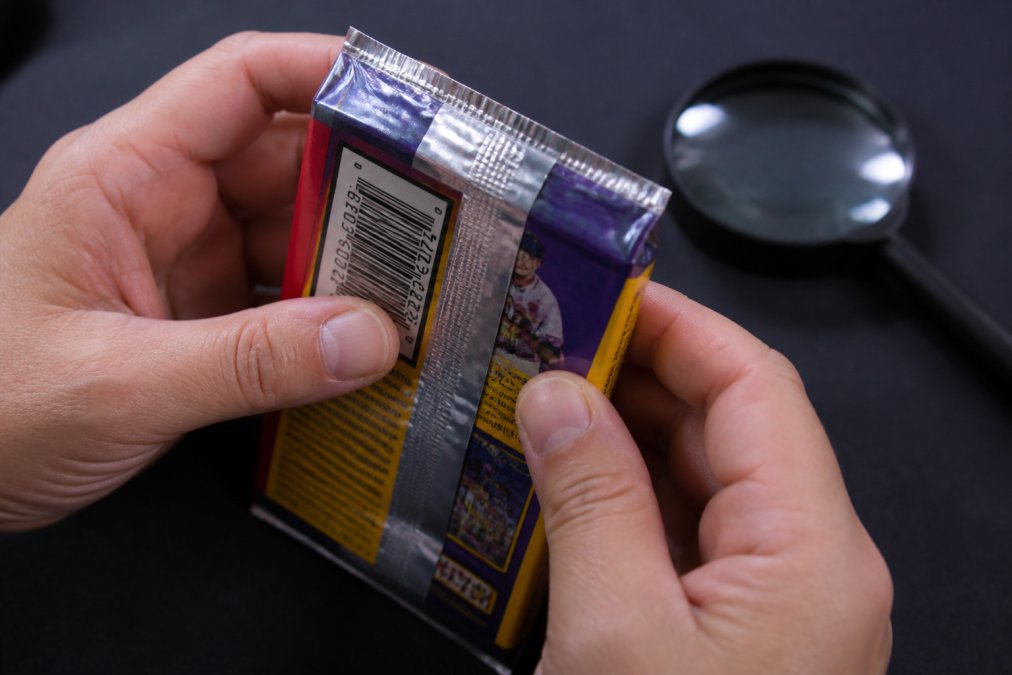
Examine the seal for inconsistencies in tape color, texture, or adhesive residue. A seal that looks too clean or has visible tape seams is a red flag. Original factory seals have minor imperfections, slight wrinkles, uneven tape application, or discoloration from age. A perfect seal on a 40-year-old pack is suspicious.
1975-76 O-Pee-Chee Bobby Orr #288 PSA 8 →
Check the pack's weight and feel with a gentle shake. If contents shift inside, the pack may have been opened and resealed with cards removed.
Examine corners and edges under bright light for tiny cuts, separations, or disturbed cardboard. Resealing leaves microscopic damage; original factory seals have clean, uniform edges.
For high-value packs, use a jeweler's loupe at 10x magnification to inspect the seal. Original tape shows aging patterns, discoloration, adhesive crystallization, and fiber breakdown. New tape looks pristine, standing out against an aged pack.
Best Grading Companies for TCG Packs
Major grading services differ in turnaround time, fee structure, and market recognition. PSA is most widely recognized and commands consistent resale value. SGC is respected for vintage packs from the 1950s-1970s. Beckett offers competitive pricing and faster turnaround.
PSA grades tend to have the strongest market demand and fastest resale velocity due to greater market liquidity and buyer recognition.
Choose a grader based on turnaround time, fee structure, and reputation for your card type. PSA and SGC have strong track records for vintage hockey packs; all three are equally recognized for newer products.
| Grading Company | Standard Turnaround | Expedited Option | Best For |
|---|---|---|---|
| PSA | 20-30 days | 5-7 days | Maximum resale value and market recognition |
| SGC | 15-25 days | 3-5 days | Vintage packs from 1950s-1980s |
| Beckett | 10-20 days | 2-3 days | Collectors prioritizing speed and cost |
ROI Analysis: When Grading Pays Off
Grading makes financial sense when resale value increase exceeds the grading fee. A $200 pack grading at PSA 8 with a $75-100 fee that sells for $350 graded versus $200 raw gains $150-175 in value, covering the fee and creating profit.
A pack worth $50 raw that costs $50-75 to grade and sells for $80-100 graded loses money or breaks even. For low-value packs, grading is rarely worth the expense.
Junk wax era packs are common and low-value. A 1991 Topps Series 1 pack sells for $15-30 raw; grading costs $50-75 and bumps value to $60-80, barely covering the fee. These packs are rarely worth grading unless in exceptional condition or completing a graded set.
Vintage packs from the 1970s and early 1980s are genuinely rare.
Common Pitfalls and When to Skip Grading
Grading for Personal Collection vs. Investment-Grade Decisions
The 'Crack and Resubmit' Strategy: Risks and Ethics
However, this strategy carries significant risks and ethical concerns:
Financial Risk: Grading is subjective within a range. A pack that grades PSA 6 on the first submission might grade PSA 6 again on the second submission, or even lower if the pack shows handling damage from being removed from the slab. You've paid two grading fees with no improvement. Grading companies also track resubmissions; if you crack and resubmit the same pack multiple times with no grade improvement, you may develop a reputation as a problem submitter.
Frequently Asked Questions
How much does it cost to grade a vintage pack?
Grading fees vary by service and turnaround time. Standard turnaround typically ranges from $20 to $100+ per pack depending on declared value and the grading company. Express or bulk submissions may offer different pricing tiers. Higher-value packs justify premium grading services, while lower-value vintage packs may cost more to grade than their market resale value, making professional grading uneconomical for those items.
What's the difference between grading a sealed pack versus individual cards?
Sealed pack grading evaluates the entire unopened package for condition, authenticity, and content integrity, assigning a single grade to the slab. Individual card grading assesses each card's centering, corners, edges, and surface. Pack grading is more complex because graders must verify the pack hasn't been resealed and contains original contents without opening it. This specialized process typically costs more and requires expertise in detecting tampering.
How do professional grading companies verify authenticity of sealed vintage packs?
Graders examine printing quality, paper stock, ink consistency, packaging materials, and seal integrity against known examples. They check for signs of resealing, such as uneven glue, mismatched edges, or altered foil. Advanced services use UV light and magnification to detect counterfeit elements. However, grading companies cannot open the pack to verify contents, so authentication relies entirely on external inspection and population reports comparing similar items.
Is professional card grading worth it if I'm collecting for personal enjoyment, not profit?
For personal collectors, grading offers asset verification and preservation benefits rather than financial ROI. A graded slab protects cards from handling and environmental damage, and the third-party vetting confirms authenticity, giving you peace of mind. However, if you plan to keep the collection long-term without selling, the grading fee is a sunk cost. Many personal collectors skip grading for mid-range vintage packs and focus on proper storage and handling instead.