


Table of Contents
- Why Sealed Trading Cards Are a Smart Buy in 2026
- How to Spot Resealed Pokemon Booster Boxes Before You Buy
- Difference Between Hobby and Retail Boxes Explained
- Best Practices for Storing Sealed Trading Cards
- Authentication Checklist for Beginners
- Investing vs. Collecting: Understanding Market Value and Comps
- Tax, Insurance, and Digital Verification Tools
- Frequently Asked Questions
Last Updated: September 15, 2026
Why Sealed Trading Cards Are a Smart Buy in 2026
Sealed trading cards are factory-wrapped boxes and packs that have never been opened, preserving both the condition inside and the product's provenance. That unbroken chain of custody is the point: a sealed box cannot have been picked over for hits. Buyers ask the same questions: is this real, is it worth it, and how do I avoid getting burned?
Sealed product rewards patience and punishes shortcuts. Buy from a source that documents condition before checkout, inspect the factory seal on arrival, and store the box properly from day one, get those three right and you avoid most losses.
How to Spot Resealed Pokemon Booster Boxes Before You Buy
The fastest way to spot a resealed Pokemon booster box is to compare the factory seal against the box's own printing: legitimate shrink wrap sits tight, reflects evenly, and matches the manufacturer's original fold pattern. Resealed boxes usually show a seam running the wrong direction, cloudy or loose wrap, or stray tape.
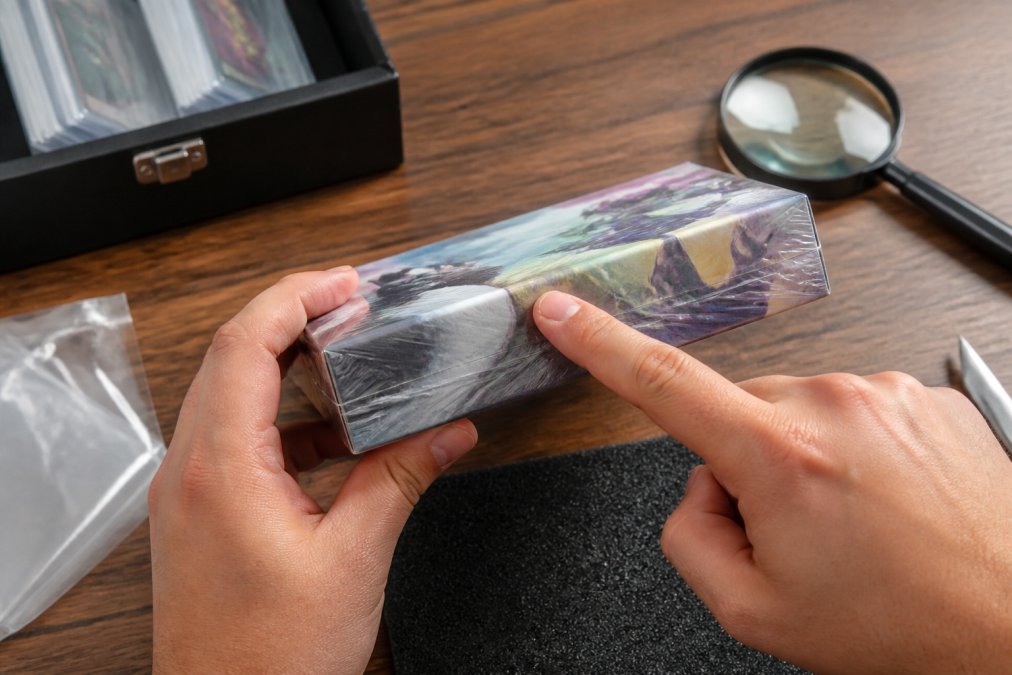
Checking the Factory Seal and Shrink Wrap
Run your thumb along every edge. Factory shrink wrap clings with a consistent, high-pitched crinkle; replacement wrap feels thicker, sits looser, and often leaves a visible seam where the original was cut away. Check that the manufacturer's logo on the wrap covers the box uniformly rather than bunching at one corner.
Go past feel and check four specific things:
- Corner folds. Factory wrap folds the same direction on all four corners with a clean diagonal crease. Resealed boxes often have one corner folded the opposite way, or re-creased with a heat gun so it looks glossy or slightly melted.
- Wrap-to-print alignment. On most modern booster boxes, the shrink wrap is printed with the set name, logo, or a repeating pattern that lines up with the box art. If the wrap print is rotated, offset, or the wrong scale, it did not come from that box.
- Seam placement. Factory seams run along a predictable edge, usually the bottom or one long side. A seam on the top face, or a second seam where there should only be one, is a strong tell.
- Wrap clarity. Original wrap is optically clear; replacement wrap is often hazy, faintly yellow, or scratched from being handled and re-shrunk.
Red Flags: Weighing, Searching, and Tamper-Evident Tape
Pack searching and weighing remain the two oldest tricks in the hobby. A searched box has been opened, its best packs removed or replaced, then resealed. Warning signs:
- A box that weighs noticeably lighter or heavier than a comparable sealed unit. A difference of more than a few grams is worth investigating.
- Tape applied over the factory seal, especially mismatched or off-brand tape. Clear packing tape over a factory seam is almost never legitimate; manufacturers do not tape over their own shrink wrap.
- Packs inside that feel rigid or unusually flat, or that slide around more than they should.
- A seller who refuses to provide photos of the seal before shipping.
- A batch code or date stamp on the flap that does not match the code on the wrap or outer case.
- A price well below every other listing for the same sealed box; resealed product is priced to move quickly.
A Five-Minute Authentication Checklist
Most buyers lose money because they inspect in the wrong order, falling in love with the box first and looking for problems second. Run this sequence before you commit:
- Verify the seller. Check feedback history on the platform, look for a business address or storefront, and confirm the return policy is in writing.
- Request dated photos. Ask for all four corners, both long edges, the top face, and a close-up of any printed code on the wrap or flap.
- Compare the wrap print to the box art. If the wrap pattern does not match the set, stop.
- Check the corners. All four should fold the same direction with a clean crease.
- Weigh the box. Compare against a known-good unit or a published weight for that configuration.
- Look for tape, staples, or adhesive residue. Any of these on the wrap is disqualifying.
- Confirm the batch code. The code on the flap, the wrap, and the outer case should be consistent on modern product.
- For high-value or vintage boxes, require third-party authentication. A BBCE authentication service sticker tells you an independent party has verified the seal, which matters enormously on vintage product.
If any step fails, treat the box as resealed until the seller explains it. Walking away costs nothing; buying a searched box costs full price plus the value of the hits already pulled.

Difference Between Hobby and Retail Boxes Explained
The difference between hobby and retail boxes comes down to distribution and guarantees. Hobby boxes ship to card shops and dedicated online retailers and typically promise a set number of hits per box. Retail boxes, sold through big-box stores, offer no such guarantee and carry lower pull rates.
| Box Type | Where It Sells | Typical Guarantee | Best For |
|---|---|---|---|
| Hobby box | Card shops, online retailers | Stated hits per box | Collectors chasing autographs |
| Retail blaster | Big-box stores | No guaranteed hits | Budget rips and set building |
| Hanger box | Big-box stores | No guaranteed hits | Low-cost pack opening |
| Mega box | Big-box stores | Occasional exclusive parallels | Retail-exclusive chasers |
Hobby Boxes: Guaranteed Hits and Higher Pull Rates
A hobby box is the format most collectors build around because the manufacturer publishes its contents up front. The 2026 Topps Series 1 Baseball Hobby Box is a clean example: 20 packs per box, 12 cards per pack, with autographs and relics distributed at a stated rate. That transparency is why hobby boxes hold value better than retail when a set goes out of print.
Retail Blasters, Hangers, and Mega Boxes: What You Get
Retail formats trade guarantees for accessibility. A retail blaster is the entry point most beginners start with, and the 2026 Topps Series 1 Baseball Retail Blaster Box delivers retail-exclusive parallels without the hobby price tag. The trade-off is real: no guaranteed hit, and pull rates that are harder to predict.
Best Practices for Storing Sealed Trading Cards
Storing sealed trading cards well means controlling three things: light, heat, and humidity. UV light fades printing, heat warps cardboard and softens shrink wrap, and humidity invites mold and warping over years. "Keep it cool and dry" is not a storage plan, it is a wish. Sealed wax is a paper-and-plastic composite that degrades predictably when any of those three variables drifts.
What Light, Heat, and Humidity Actually Do to Sealed Wax
- UV light breaks down the dyes in printed box art and fades the ink on the wrap. Damage is cumulative and irreversible, a box that sat in a sunny display case for two years will never look new again, even with the seal intact.
- Heat softens shrink wrap and lets it sag or wrinkle against the box, the same visual signature buyers associate with resealed product. Sustained heat also bows the cardboard so the seal no longer sits flat.
- Humidity is the slowest and most destructive variable. Above roughly 60% relative humidity, paperboard absorbs moisture, the box swells, and mold can colonize the interior (NPS Conserve O Grams). Below roughly 30%, the cardboard dries out and becomes brittle, and the wrap can crack along the folds.
A Storage Setup That Actually Works
Long-Term Storage for High-Value Boxes
Authentication Checklist for Beginners
Investing vs. Collecting: Understanding Market Value and Comps
Tax, Insurance, and Digital Verification Tools
On any high-value sealed purchase, the certificate matters as much as the box. A verifiable certificate you can look up independently is worth more than any seller's description.
Frequently Asked Questions
How can you tell if a trading card box has been tampered with?
Check the factory seal for uniform tightness and the shrink wrap for consistent gloss. Look for loose or re-glued flaps, mismatched tape, or a box that feels heavier or lighter than expected. Weighing packs and pack searching are common tampering signs. If the seal looks cloudy or has wrinkles that do not match the original fold, treat it as suspect and ask for provenance before buying sealed trading cards.
What are the signs of a resealed Pokemon booster box?
Resealed Pokemon booster boxes often show glue residue along the seams, a seal that peels too easily, or shrink wrap with an uneven pattern. The box may have dents or corner wear inconsistent with a factory-fresh product. Some sellers reseal with heat guns, leaving a glossy, melted look. Compare the seal to known authentic boxes and request close-up photos of the crimp before you commit.
How should I store sealed trading card products to maintain value?
Keep sealed boxes in a cool, dry place away from direct sunlight and humidity swings. Use a climate-controlled room or a sealed storage bin with silica gel packets. Avoid stacking heavy boxes on top of each other, which can crush corners. For long-term holds, store vertically and check periodically for pest damage. Proper storage protects the factory seal and preserves grading potential for years.
Are sealed trading cards a good long-term investment?
Sealed wax can be a good long-term investment when print runs are limited and demand stays strong, but market volatility applies. Hobby boxes with guaranteed hits often hold value better than retail blasters. Study comparable sales and sold listings before buying. Authenticity and provenance are critical for resale.