


Table of Contents
- Top Rated Card Protective Supplies 2026: Quick Comparison
- Best Protective Sleeves for Graded Cards and Raw Cards
- Toploader vs Semi-Rigid Holder: Which Protects Better?
- How to Store Trading Cards Long Term Without Damage
- How to Spot Counterfeit Card Supplies Before You Buy
- Environmental Impact of Plastic Card Supplies
- Matching Card Protective Supplies to Card Thickness
- Conclusion
- Frequently Asked Questions
Last Updated: September 16, 2026
Top Rated Card Protective Supplies 2026: Quick Comparison
Card protective supplies are the sleeves, holders, and storage containers that shield trading cards from scratches, moisture, and bending. This guide from Cardboard Superstars breaks down the top rated card protective supplies 2026 has to offer, from penny sleeves to rigid holders built for grading submissions.
| Supply Type | Best For | Protection Level | Typical Use |
|---|---|---|---|
| Penny sleeves | Everyday handling | Light | Binder storage, sorting |
| Toploaders | Display and shipping | Rigid | High-value singles |
| Semi-rigid savers | Grading submissions | Semi-rigid | Mail-in grading |
| Card bins | Bulk storage | Moderate | Large collections |
Best Protective Sleeves for Graded Cards and Raw Cards
The best protective sleeves for graded cards differ from those for raw cards: graded slabs are thicker and need a looser fit, while raw cards fit snugly into standard sleeves that keep the surface clean without adding bulk.
Penny Sleeves: The Everyday First Layer
Penny sleeves are the thin, clear sleeves most collectors reach for first. They cost little, protect against fingerprints and scratches, and fit inside almost every other holder. Skipping them and sliding a raw card straight into a rigid holder leaves the surface exposed to dust and friction.
Sleeve Materials: PVC-Free and Acid-Free Matters
Material choice is where cheap supplies quietly fail. PVC-free and acid-free sleeves won't break down or leach chemicals onto your card's surface. Standard Card Sleeves from BCW fill this everyday role, and the Rip & Protect Bundle pairs 200 penny sleeves with 200 semi-rigid card savers for both layers.

Toploader vs Semi-Rigid Holder: Which Protects Better?
The toploader vs semi-rigid holder question comes down to rigidity versus flexibility. Toploaders offer maximum rigidity for display and shipping, while semi-rigid holders balance protection with a slimmer profile that fits grading submission requirements.
Rigid Protection: Standard and Thick Toploaders
Standard toploaders handle cards up to roughly 35pt (What Thickness of Toploader Do I Need? - BCW Supplies - BlogBCW Supplies). For relics, patch cards, and premium inserts that exceed that, you need thick toploaders. The Team Leader Supply Pack pairs 100 sleeves with 100 35pt toploaders, and the Mixed Case of Thick Card Topload Holders fits cards that won't fit a standard holder.

Semi-Rigid Card Savers for Grading Submissions
Semi-rigid card savers are the standard choice for grading submissions because they hold a card firmly without the bulk of a hard case. The BCW Semi-Rigid Card Holder #1 fits most standard-size trading cards, including Pokémon, Magic: The Gathering, and sports cards, and is reusable with care.
| Holder | Rigidity | Best For | Reusable |
|---|---|---|---|
| Penny sleeve | None | Surface protection | No |
| Standard toploader | Rigid | Display, shipping | Yes |
| Thick toploader | Rigid | Relic and patch cards | Yes |
| Semi-rigid saver | Semi-rigid | Grading submissions | Yes |
How to Store Trading Cards Long Term Without Damage
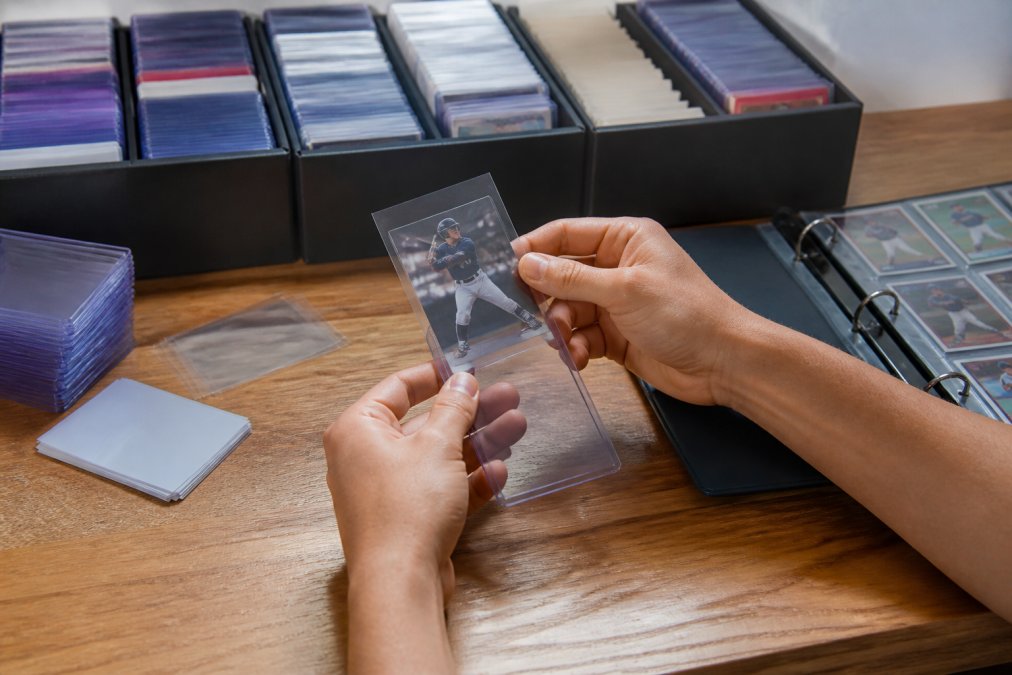
Long-term storage comes down to four variables: light, moisture, temperature stability, and physical pressure. Get them right and a collection can sit safely for decades; get them wrong and even a well-sleeved card will curl, fade, or haze.
Light and UV Exposure
Paper stock, ink, and sleeve plastic all react to ultraviolet light. UV breaks down polymer chains in polypropylene and PVC, which is why a sleeve on a sunny windowsill turns yellow and brittle while one in a closet stays clear. The card underneath fades at the same time, and the damage is cumulative and irreversible.
Humidity, Climate Control, and Card Warping
Card warping is almost always a moisture problem. Card stock is hygroscopic, absorbing and releasing water vapor from the air. When one side absorbs more moisture than the other, its fibers expand and the card curls toward the drier face. Foils and holofoils warp faster because the foil layer doesn't absorb moisture the way paper does, so the two sides move at different rates.
A few concrete practices that help:
- Keep a cheap hygrometer in the storage area so you can see swings before they damage cards
- Use silica gel packets in sealed storage bins, and replace them on a schedule
- Avoid storing cards against exterior walls, which run colder and damper than interior walls
- Let cards acclimate in their sleeves for a few hours before moving them between very different environments
Binders, Storage Boxes, and Bulk Storage Bins
For bulk storage, the BCW Collectible Card Bin holds up to 1,600 standard-sized cards and works with Pokémon, Magic, and sports cards alike. For display and browsing, BCW Laser Weld 9-Pocket Pages are PVC-free and fit standard 3-ring binders, with laser-welded seams that hold up to repeated page turns.
Physical Pressure and the Weight Problem
Pressure damage is the slowest and most overlooked failure mode. A stack of toploaders under a heavy box will bow the bottom holders, and a binder stored flat will imprint page rings onto the cards beneath it. Cards should be supported, not compressed: store boxes on shelves, avoid stacking heavy items on card storage, and rotate long-term boxes so no single row bears weight indefinitely.
A Simple Long-Term Storage Checklist
- Cards sleeved in PVC-free, acid-free sleeves before any other holder
- Rigid or semi-rigid holders for anything worth more than the cost of the holder
- Storage in a climate-stable interior room, away from windows and exterior walls
- Hygrometer in the storage area, with silica gel in sealed bins
- Binders upright, boxes full, nothing stacked on top
- Periodic inspection, pull a sample card every few months and check for curl, haze, or discoloration
None of this requires expensive equipment. It requires consistency, which is the part most collectors skip.
All-Star Supply Pack – 200 Toploaders + →
How to Spot Counterfeit Card Supplies Before You Buy
Counterfeit and mislabeled card supplies are a real problem, and the damage they cause is usually invisible until it is too late. A fake toploader may look identical on arrival, then yellow, crack, or leach plasticizer onto a card months later. Here is a concrete inspection protocol to run before and after a purchase.
Why Counterfeit Supplies Are Dangerous, Not Just Cheap
The risk is not that a fake holder fails to protect a card, it's that it actively damages one. Off-spec polypropylene and PVC can contain plasticizers and stabilizers that migrate onto card surfaces, causing a hazy film, ink lift, or irreversible discoloration. A loose-fitting counterfeit holder also lets a card slide, producing edge and corner wear that graders will catch.
Pre-Purchase Checks
Before you buy, run these checks on the listing or packaging:
- Confirm the sleeve or holder is labeled PVC-free and acid-free, with the material named (polypropylene, polyethylene, or PET are the common safe options)
- Check that sizing is stated in points (pt) or millimeters, not vague terms like "standard size"
- Look for a manufacturer name, part number, and country of origin, legitimate suppliers print all three
- Be wary of prices far below everything else on the market; a 100-count toploader pack at a fraction of the going rate is a red flag, not a deal
- Search the seller's name alongside "counterfeit" or "fake" before ordering from an unfamiliar source
Post-Purchase Inspection
Once supplies arrive, inspect a sample before committing a valuable card to them:
- Measure thickness. A digital caliper is inexpensive and settles the pt question in seconds. Compare the measured thickness to the stated spec.
- Check clarity and color. Genuine polypropylene is water-clear. A faint yellow or gray tint suggests recycled or off-spec resin.
- Flex test. A genuine toploader flexes slightly and returns to shape. A brittle one cracks or whitens at the fold.
- Smell test. A strong chemical or plastic odor is a sign of unreacted plasticizers, which are exactly what you do not want near a card.
- Fit test. Slide a common card in and out. It should move with light resistance, not fall out and not require force.
- Seam check. On sleeves and pages, look for uneven or weak welds. Laser-welded seams should be consistent along the full edge.
Labeling Red Flags
Authentic products from established manufacturers carry clear labeling and consistent specs. Reliable signals that something is off:
- No material listed, or a material listed that contradicts the product type
- Thickness given in vague terms rather than points or millimeters
- Inconsistent branding between the packaging, the product, and the seller listing
- Stock photos that do not match the product received
- Reviews that mention yellowing, cracking, or chemical smell within weeks of purchase
Building a Trusted Supply Chain
The most reliable defense against counterfeit supplies is buying from sources that can trace their inventory: authorized retailers, manufacturer-direct storefronts, and established hobby suppliers carry accountability that anonymous marketplace sellers do not. When a supply passes inspection, note the brand, part number, and batch so you can reorder the same spec rather than gamble on a lookalike.
Environmental Impact of Plastic Card Supplies
Plastic card supplies have a real environmental footprint that most guides ignore. Sleeves and holders are typically made from polypropylene and similar plastics, recyclable in some areas but rarely accepted curbside.
Matching Card Protective Supplies to Card Thickness
Card thickness is measured in points, written as "pt," and it decides which holder fits. Standard cards run about 35pt; thicker relics, patches, and premium inserts run higher and need a thick toploader.
Conclusion
Building a protection setup that holds up takes a little planning, and the right supplies make the difference between a collection that stays sharp and one that quietly degrades. Cardboard Superstars carries the essentials, from penny sleeves and semi-rigid savers to thick toploaders and 1,600-count storage bins, all backed by authentic products, clear product details before checkout, and secure collector-grade packaging.

Frequently Asked Questions
Are penny sleeves enough to protect trading cards?
Penny sleeves stop scratches, fingerprints, and dust during handling, but they offer no rigidity. A card in a penny sleeve alone can still bend, crease, or take corner damage in a box or mailer. For anything you plan to store long term or ship, pair the sleeve with a rigid toploader, a semi-rigid card saver, or a binder page. The Rip & Protect Bundle pairs 200 penny sleeves with 200 semi-rigid card savers so you always have both layers on hand.
What is the difference between semi-rigid holders and toploaders?
A toploader is a stiff, fully rigid plastic holder that resists bending and works well for display, sorting, and shipping. A semi-rigid holder, like the BCW Semi-Rigid Card Holder #1, flexes slightly, weighs less, and fits more easily into envelopes and submission boxes. Grading companies commonly ask for cards in semi-rigid holders because they grip the card snugly without the bulk. Choose rigid for storage and display, semi-rigid for transport and grading submissions.
How do I choose the right card sleeve for graded cards?
Graded cards come back in sealed plastic slabs, so standard penny sleeves will not fit them. What you need instead is a sleeve or bag sized for the slab, plus a storage bin or display case that holds the slab flat and away from sunlight. Keep raw cards in penny sleeves and toploaders, and keep slabs in UV-blocking storage. The BCW Collectible Card Bin holds up to 1,600 standard cards and works as a tidy home base for graded and raw cards alike.
Do I need acid-free supplies for my card collection?
Yes, if you plan to keep cards for years. Acid-free, PVC-free materials like the BCW Laser Weld 9-Pocket Pages and BCW Standard Card Sleeves avoid the chemical breakdown that cheaper plastics can cause. Over time, non-archival plastic can leach, cloud, and stick to card surfaces, dulling gloss and lowering condition grades. Look for PVC-free wording on the packaging and store cards in a cool, dry place to slow any degradation.
What are the best card storage solutions for high-value collections?
High-value cards need three things: a snug inner sleeve, a rigid outer holder, and a climate-stable container. Start with a penny sleeve, then a toploader or thick toploader for relics and patch cards. Move the protected cards into a PVC-free binder or a BCW Collectible Card Bin, and keep the bin out of direct sun and away from damp basements. The Mixed Case of Thick Card Topload Holders covers premium inserts, autographs, and patch cards that do not fit standard 35pt holders.