


Table of Contents
- Why Card Condition Decides Value Before Rarity Does
- The Four Pillars of Card Condition: Centering, Corners, Edges, Surface
- A Trading Card Centering Guide for Beginners
- How to Spot Fake Pokemon Cards Before You Buy
- PSA Grading Standards Explained Without the Jargon
- How to Inspect a Card Safely at Home
- Common Mistakes Collectors Make When Judging Card Condition
- Conclusion
- Frequently Asked Questions
Last Updated: September 18, 2026
Why Card Condition Decides Value Before Rarity Does
Two identical cards can sit thousands of dollars apart, and the difference almost always comes down to what to look for in card condition. At Cardboard Superstars, the same pattern shows up constantly: collectors chase the rare card, then get blindsided by flaws they missed during a ten-second inspection.
The Four Pillars of Card Condition: Centering, Corners, Edges, Surface
Every professional assessment of card condition rests on four attributes: centering, corners, edges, and surface. Graders score each independently, then combine them. Miss one pillar and your value estimate will be wrong.
Centering: The 60/40 Rule That Separates a 9 From a 10
Centering measures how evenly the card's image sits within its borders. The benchmark is 60/40: no more than 60% of the border on one side, 40% on the other. Cards within 55/45 or better are eligible for the highest grades; anything past 70/30 caps well below mint.
Corners and Edges: Where Handling Damage Shows Up First
Corners and edges take the first hit from handling. A "soft" corner shows rounding under magnification, and one dinged corner can drop a card two full grades. Edges reveal chipping, especially on dark-bordered designs where any white fleck stands out.
A Trading Card Centering Guide for Beginners
Centering is the easiest pillar to measure and the one beginners misjudge most. A trading card centering guide boils down to one question: how far off-center is the image, and does it cross a grading threshold?
Here's a practical method:
- Place the card on a dark, flat surface under even lighting.
- Measure the border width on the left and right sides with a ruler or caliper.
- Repeat for the top and bottom borders.
- Divide the smaller measurement by the larger to get your ratio.
- Compare against the thresholds below.
| Ratio | Typical Grade Ceiling | What It Means |
|---|---|---|
| 50/50 to 55/45 | 10 | Near-perfect centering |
| 60/40 | 9 | Slightly off, still premium |
| 65/35 | 8 | Noticeably shifted |
| 70/30 or worse | 7 or below | Visibly off-center |
How to Spot Fake Pokemon Cards Before You Buy
Knowing how to spot fake Pokemon cards is a condition skill as much as an authentication one, because counterfeits fail the same physical tests genuine cards pass. Most fakes give themselves away within seconds of handling.
Texture, Stiffness, and Ink Quality: The Physical Tests
Three physical signals separate genuine cards from counterfeits:
- Texture: Genuine cards have a subtle, consistent surface grain. Fakes feel slick or waxy.
- Stiffness and flex: Real card stock resists a gentle bend and springs back. Counterfeits often feel flimsy or overly rigid.
- Ink quality: Look for bleeding at the edges of text, muddy colors, or a rainbow sheen under angled light. Genuine printing stays sharp.
The 1st Edition Stamp: Where Fakes Fail Hardest
The 1st Edition stamp deserves its own check, and it's the feature counterfeiters get wrong most. A genuine stamp is crisp, correctly positioned, and sits under the surface finish, part of the card, not applied to it. A fake looks stamped on top, with fuzzy edges, uneven ink density, or wrong placement.
How the Stamp Changed Across Early Sets
A common misconception is that the 1st Edition stamp looks identical on every early set. It does not, placement, size, and ink behavior shifted across the first few print runs, and knowing those differences separates confident authentication from a guess.
- Base Set: The stamp sits to the left of the card's artwork window, typically just below the top edge of the yellow border. On Shadowless Base Set cards, the stamp and the shadowless border appear together, but they are two separate features, not one.
- Jungle: The stamp placement stays in the same general zone, but the surrounding border treatment differs from Base Set, so a stamp that looks "right" on a Base Set card can look wrong here.
- Fossil: Similar placement to Jungle, with the same caution: verify the stamp against the set's own border and finish, not against a Base Set reference.
- Team Rocket: Later print runs introduced different card stock and finish behavior, so the stamp's interaction with the gloss layer can look subtly different even on genuine cards.
Shadowless vs. 1st Edition: The Confusion That Costs Money
Beginners routinely treat "Shadowless" and "1st Edition" as the same thing. They are not. Shadowless is a border treatment, the right side of the image frame lacks the drop shadow of later prints. 1st Edition is the stamp. A card can be Shadowless without a stamp, and the two are verified independently.
Build a personal reference set. Keep one known-genuine card from each early set, even a low-value common, and compare every suspect stamp against it under the same lighting. Side-by-side comparison beats memory every time.
PSA Grading Standards Explained Without the Jargon
PSA grading standards translate condition into a 1-to-10 scale, and the tiers tell you what flaws are tolerated at each level. You don't need the full rubric; you need to know where your card lands, and why.
Rookie Supply Pack – 100 Card Sleeves + →
The short version:
- 10 (Gem Mint): Near-perfect in all four pillars, centering within 55/45.
- 9 (Mint): One minor flaw, often centering or a single soft corner.
- 8 (NM-MT): Visible but minor wear on two or more pillars.
- 7 (Near Mint): Light surface or edge wear, still sharp overall.
- 6 and below: Increasingly visible flaws, creases, or rounding.
Why Grades Cap: The Weakest-Pillar Rule
The most useful thing to understand about grading is that the lowest pillar sets the ceiling. A card with flawless corners, edges, and surface but 70/30 centering doesn't average out to a high grade, it caps. Graders identify the limiting flaw and score against it.
Using Population Reports to Sanity-Check a Claimed Grade
A grade is only meaningful in context. A PSA 9 on a card with thousands of 9s and 10s in the population is a different asset than a PSA 9 where only a handful exist at that level. Population reports, running counts of how many examples have been graded at each tier, show where a card sits in the distribution.
Digital Authentication Tools Worth Using
Several database tools and apps verify card numbers, set symbols, and population data from your phone. The workflow:
- Identify the card's set and number from the card itself.
- Look up the card in a public database to confirm the set, number, and any known variants.
- Check the population report at the grade being claimed.
- Compare the card's physical condition against the grade tier descriptions above.
Grade tiers are a starting point, not an answer. The weakest pillar caps the grade, population reports tell you whether the grade matters, and digital tools confirm the card exists in the form being claimed. Use all three before you trust a number.
How to Inspect a Card Safely at Home
Careless handling during inspection can cost you the grade you're trying to protect. The goal: see every flaw without adding new ones.
Inspect cards on a matte black surface, not white. Dark backgrounds make edge chips, corner wear, and surface scratches pop instantly, flaws that vanish against a bright white table.
Common Mistakes Collectors Make When Judging Card Condition
Most bad buys trace back to a handful of repeatable errors. Fix these and your hit rate climbs.
- Judging from photos alone. Glare and compression hide surface scratches and print lines. Always request angled shots.
- Ignoring centering. Collectors fixate on corners and forget that centering caps grades just as hard.
- Overvaluing a 1st Edition stamp. A stamp doesn't rescue a card with soft corners and surface wear.
- Handling without protection. Bare fingers and hard tables add wear during the very inspection meant to preserve value.
- Trusting a seller's grade. Verify condition yourself, or buy graded cards where the grade is already locked in.
Conclusion
Judging card condition is a skill that rewards consistency over gut feeling. Check all four pillars, measure centering instead of eyeballing it, and run the physical tests on anything you suspect is counterfeit.
Frequently Asked Questions
What tools do I need to properly examine card condition?
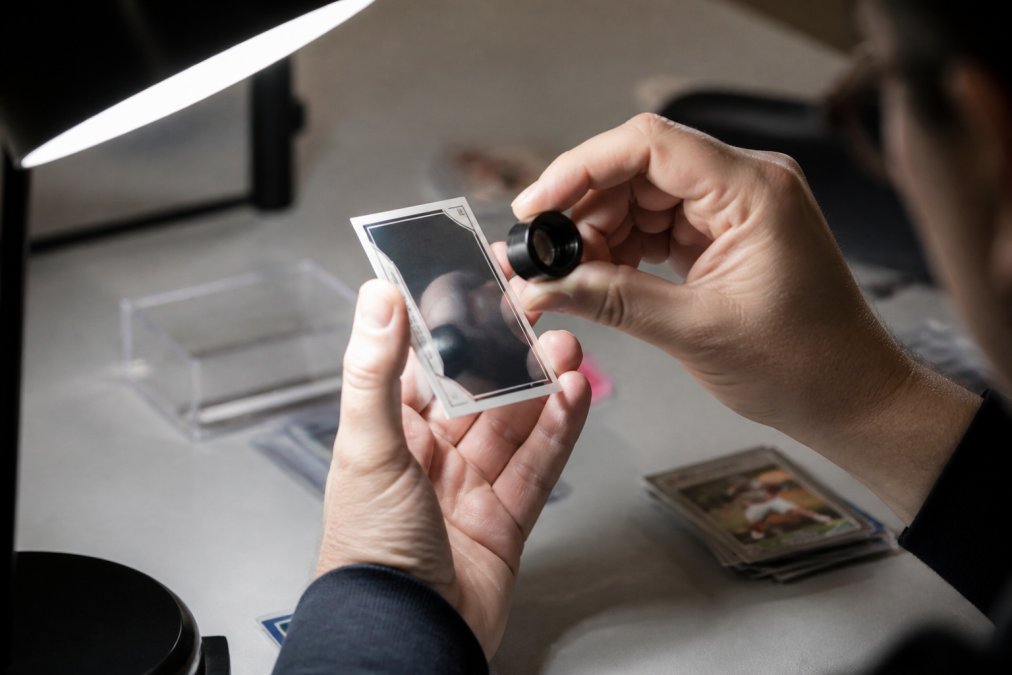
A jeweler's loupe (10x magnification) is the single most useful tool, since it reveals surface scratches, print lines, and corner wear your eyes miss. Add a bright, diffused desk lamp for raking light across the surface, a black light for detecting reprints, and a centering tool or ruler for measuring borders. Once you've graded your cards, store them in penny sleeves and toploaders to prevent further handling damage. The Rookie Supply Pack from Cardboard Superstars includes 100 sleeves and 50 toploaders, enough to protect a starting collection.
How does surface wear affect the value of a card?
Surface wear is often the difference between a PSA 8 and a PSA 9, and that one-point gap can cut a card's market price significantly. Scratches, print lines, and scuffing on the holographic foil are the most common culprits. Under raking light, tilt the card at an angle and look for hazy patches or fine lines that don't move with the card. Even light handling without sleeves can leave micro-scratches that graders catch, which is why penny sleeves matter from the moment you pull a card.
What is the difference between centering and edge wear?
Centering measures how evenly the card's image sits within its borders, usually expressed as a ratio like 60/40. Edge wear is physical damage along the card's perimeter, such as chipping, whitening, or fraying where the printed layer meets the cut edge. A card can be perfectly centered but still grade low due to edge whitening, and vice versa. Check centering first with a ruler or centering tool, then run your eye along all four edges under good light to catch whitening.
Does a card's condition matter for its authenticity?
Yes, condition and authenticity are linked in ways beginners often miss. Counterfeit cards frequently show telltale physical flaws: blurry print, incorrect card stock stiffness, missing texture on holographic areas, or a stamp that sits on top of the surface rather than being pressed into it. A card that feels too glossy, flexes oddly, or shows ink that smears under light is worth a closer look. Comparing a suspect card side by side with a known original is the fastest way to spot these differences.