


Table of Contents
- What Is a Booster Box and Why Start Here?
- Booster Box vs Singles: Which Builds Your Collection Faster?
- How to Spot Resealed Booster Boxes Before You Pay
- Where to Buy Authentic Pokemon Booster Boxes and Other TCGs
- Booster Box vs Elite Trainer Box: Know the Difference
- Pull Rates, Rarity, and the Gambler's Fallacy in TCGs
- How to Store Sealed Product and Protect Your Investment
- Your First Booster Box Purchase: A Simple Decision Framework
- Frequently Asked Questions
Last Updated: September 5, 2026
What Is a Booster Box and Why Start Here?
A booster box is a sealed, factory-packaged case of booster packs from one TCG expansion, offering the lowest cost per pack and the most consistent path to building a collection quickly.

Most modern booster boxes contain between 24 and 36 packs, depending on the game (wizards.com). Pokémon boxes typically hold 36 packs, while Yu-Gi-Oh! boxes come with 24. Magic: The Gathering boxes vary by type, with Draft and Play boosters usually landing at 36 packs per box.
Opening a full box guarantees a baseline number of rare and holofoil cards, making budgeting easier than chasing singles at market price.
Booster Box vs Singles: Which Builds Your Collection Faster?
Singles give you exactly what you want but cost more per card and lack the opening experience. A booster box gives volume, variety, and the chance to pull chase cards at a fraction of their market price.

The real difference comes down to your goal. If you need specific cards for a competitive deck, buying singles is more efficient. If you want to fill a binder, trade with friends, or experience the joy of discovery, a sealed box delivers more cards for your dollar.
A common mistake is assuming every box pays for itself. Pull rates vary, and most boxes will not contain the set's most valuable card. A box reliably provides a foundation of playable cards, bulk for trading, and the occasional memorable hit.
How to Spot Resealed Booster Boxes Before You Pay
Authenticity checks start before you hand over any money. The most common scam is the resealed booster box, where someone opens the product, removes valuable cards, and carefully reseals it to look factory fresh.
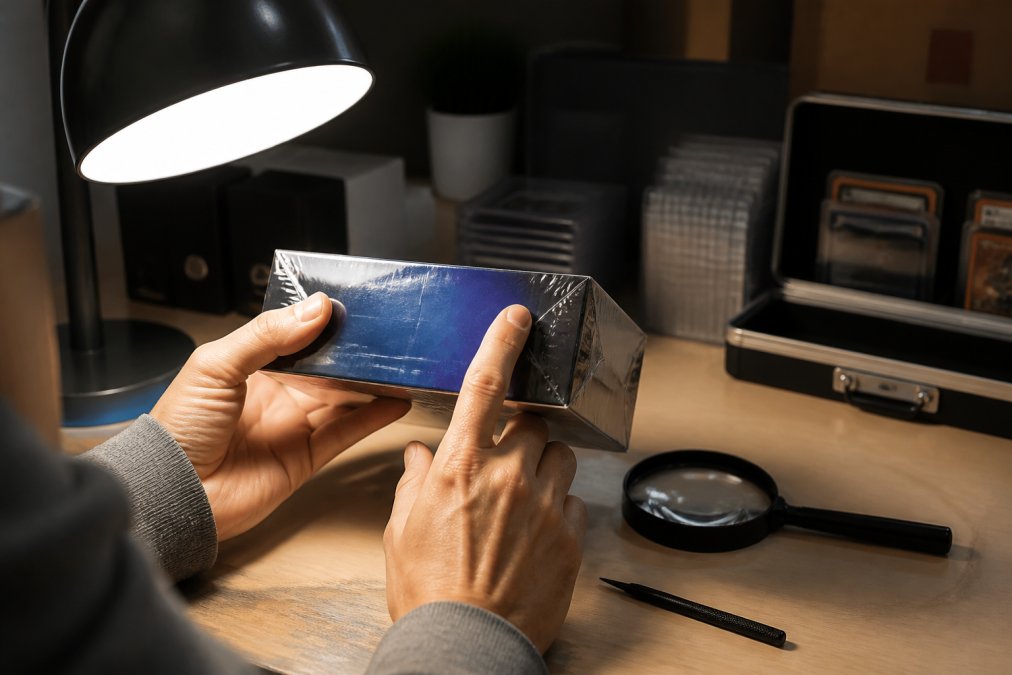
Most guides stop at "check the shrink wrap." That is not enough. Run this exact inspection sequence before you pay, a visual checklist you can perform in under two minutes.
Step 1: The Shrink Wrap Tension Test
Factory wrapping is drum-tight, feeling almost like a second skin (uspto.gov). Run your thumb across the surface; any give, ripples, or air pockets mean stop. Resealers' household guns cannot replicate industrial tension, and factory corners are crisp, rounded or bunched corners indicate hand-wrapping.
Step 2: The Seam and Seal Line Inspection
Every major TCG has a distinct factory seal pattern. For Pokémon, the vertical seal on the back should be straight, centered, and uniform; it should feel smooth, not tacky. Yu-Gi-Oh! boxes have a horizontal seal across the flaps; Magic boxes use a continuous wrap with a bottom seal. A crooked, wavy, or off-center line or glue residue is a red flag.
Step 3: The Flap and Crease Check
Factory boxes are pristine, no bent flaps, crushed corners, or creases. Opening the box to remove packs almost always leaves a subtle crease or slight bowing. Hold the box at eye level toward a light source; any cardboard irregularity signals prior opening.
Step 4: The Pack Crimp Verification
If the seller allows pack inspection, check the crimp seals on each pack's top and bottom. Factory crimps are tight, uniform, and have a distinct diamond or waffle pattern. Resealed packs often show crimps that are too wide, too loose, or missing the pattern; wavy edges indicate heat resealing.
Step 5: The Weight and Rattle Test (For In-Person Purchases)
If buying in person, gently tilt the box. A sealed 36-pack box should feel solid and uniform. Excessive shifting or a noticeably lighter feel means walk away. Counterfeiters use filler to match weight but rarely match it perfectly.
Purchase Channel Risk Tiers
Not all buying channels carry the same risk:
- Safest: Authorized local game stores and established online retailers with documented authenticity guarantees and buyer protection (e.g., eBay's Authenticity Guarantee program for items over $200). These sellers have reputations to protect.
- Moderate: Individual sellers on marketplaces with high feedback scores (98%+ and hundreds of transactions). Check their recent feedback, not just the lifetime score. A sudden string of negative reviews about "resealed" or "damaged" product is a massive red flag.
- Highest Risk: Social media marketplaces, auction sites without buyer protection, and any seller offering prices 20% or more below market. Scammers thrive where there is no accountability.
The Return Policy Test
Before you pay, read the return policy. A legitimate seller offers a clear, documented return window for damaged or misrepresented product. A scammer hides behind "all sales final" or "no returns on sealed product." If a seller refuses to stand behind authenticity, that is your answer.
Where to Buy Authentic Pokemon Booster Boxes and Other TCGs
Your safest options are reputable online retailers, authorized local game stores, and established sellers with verifiable feedback histories. The seller's reputation matters as much as the price.
Cardboard Superstars provides clear product details, and collector-grade packaging ensures your product arrives in the same condition it left the warehouse.

For Japanese exclusives like the Pokemon Black Bolt Deluxe Booster Box - Japanese, sourcing matters even more. Japanese boxes have different distribution channels, and counterfeiters target them heavily. Stick with sellers who specialize in authentic imports and can document their supply chain.
Booster Box vs Elite Trainer Box: Know the Difference
An Elite Trainer Box (ETB) is a different product. While a booster box contains only packs, an ETB bundles 8 to 10 packs with accessories like sleeves, dice, condition markers, and a storage box. The ETB is a complete starting kit, but the booster box delivers far more cards for the price.
The decision comes down to what you own. If you lack sleeves, dice, or storage, an ETB gives you everything to start playing immediately. If you have accessories, a booster box stretches your budget further.
| Product Type | Pack Count | Extras Included | Best For |
|---|---|---|---|
| Booster Box | 24-36 packs | None | Maximizing cards per dollar |
| Elite Trainer Box | 8-10 packs | Sleeves, dice, storage | New players needing accessories |
| Deluxe Booster Box | 10 packs | Premium packaging | Collectors wanting Japanese exclusives |
A middle path exists too. The Pokemon White Flare Deluxe Booster Box packs 10 deluxe packs with rare holographic cards and chase pulls, offering a premium opening experience without committing to a full 36-pack box.
Pull Rates, Rarity, and the Gambler's Fallacy in TCGs
Every booster box follows a fixed rarity distribution: common, uncommon, rare, then the ultra rare, secret rare, and full art cards collectors chase. Understanding pull rates keeps expectations realistic.
The gambler's fallacy is the belief that a big pull is "due" after a string of misses. Each pack is independently randomized, so ten boxes without a secret rare do not make the eleventh more likely (stat.berkeley.edu). This mindset leads to overspending on a hit statistics say is never guaranteed.
Treat every box as an entertainment purchase first and an investment second. Most boxes will not contain a card worth more than the box itself. Value comes from playable cards, trade bulk, and the enjoyment of opening. If buying strictly for financial return, singles at market price are almost always smarter.
How to Store Sealed Product and Protect Your Investment
Proper storage preserves card condition and resale value. Keep sealed boxes in a cool, dry environment away from direct sunlight, humidity, and temperature swings.
Opened cards need different protection. Sleeves are the minimum for play or display. Top loaders and semi-rigid holders protect valuable pulls during shipping or storage. A binder with pocket pages prevents edge damage from loose stacking.
For serious collectors in humid climates, consider a dehumidifier. Cardboard warping and foil peeling are permanent damage that destroys value. The small cost of proper storage protects every dollar in your collection.
Your First Booster Box Purchase: A Simple Decision Framework
Choosing your first booster box does not need to be complicated. But "pick a game you like and set a budget" is a platitude, not a framework. Here is a decision tree mapping your budget and goal to a specific product.
Step 0: Define Your Goal First
Before you look at prices, answer one question: Are you buying to collect, to play, or to open for fun?
- Collecting: You want to fill a binder, chase specific cards, and build a long-term collection. Your priority is pack count per dollar and pull rate depth.
- Playing: You need playable cards for a deck. Your priority is card utility, not chase cards.
- Opening for fun: You want the experience. Your priority is the thrill of the reveal, not the financial outcome.
Your goal determines which box type and set to buy. A collector and a player should not buy the same product.
Step 1: Match Your Budget to a Product Tier
Here is a budget roadmap with real price points and product types in the current market.
Budget Tier: Under $75
What you can buy: A standard Yu-Gi-Oh! booster box (24 packs) or a Pokémon Elite Trainer Box (8-10 packs with accessories).
Best pick for collectors: A Yu-Gi-Oh! box like The Infinite Forbidden Booster Box 1st Edition at $69.00. You get 24 packs, enough volume for meaningful pull rates without breaking the bank.
Best pick for players: An Elite Trainer Box. The included sleeves, dice, and markers mean you do not need to buy accessories separately, effectively lowering your total cost to start playing.
What to skip: Loose packs at this budget. You will pay a per-pack premium and lose box-level pull rate guarantees.
Budget Tier: $100-$150
What you can buy: A standard Magic: The Gathering Play Booster Box (36 packs) or a premium Pokémon collection box.
Best pick for collectors: The Tarkir Dragonstorm Magic the Gathering Play Booster Box at $139.00. Thirty-six packs gives the best cost-per-pack ratio in the hobby, with a mix of playable cards and potential hits.
Best pick for players: The same MTG Play Booster Box. The card pool is deep enough for multiple decks, and you will have trade fodder to acquire specific cards.
What to skip: Japanese exclusive boxes at this price point. Authentic imports typically start above $150; anything cheaper is likely counterfeit.
Budget Tier: $250-$300
What you can buy: A Pokémon Deluxe Booster Box, a Magic Draft Booster Box, or a premium Japanese exclusive.
Best pick for collectors: The Pokemon White Flare Deluxe Booster Box at $288.00. Ten deluxe packs with rare holographic cards and chase pulls offer a premium experience without a full 36-pack commitment.
Best pick for players: The Magic The Gathering Adventures in the Forgotten Realms Draft Booster Box at $285.00. Draft boxes are designed for limited formats, making this the highest-utility purchase for a playgroup.
What to skip: A second box in this tier just because you enjoyed the first. Diversify into a different game or set to spread risk.
Step 2: Match the Set to Your Goal
Once you know your budget tier, the next question is which set to buy:
- Newer sets have higher chase card values but also higher box prices, better for collectors wanting the newest secret rare.
- Older sets (6-12 months old) have settled prices, often below MSRP, better for players wanting specific cards at a discount.
- Avoid brand-new sets on release week. Prices peak on hype. Wait 2-4 weeks for prices to stabilize.
Step 3: The One-Box Rule
Here is the discipline that separates smart collectors from broke ones: Buy one box, open it, and stop. Do not buy a second box hoping to "make up" for a bad first box, that is the gambler's fallacy. If you did not get the card you wanted, buy it as a single; it will cost less than a second box and is guaranteed.
Step 4: Verify the Seller and Plan Storage
Before you pay, check the seller's feedback score, authenticity guarantees, and return policy. If buying online, use a platform with buyer protection. Have storage ready, sleeves, a binder, and a cool, dry shelf, before the box arrives.
| Budget | Collector Pick | Player Pick | Why This Split Works |
|---|---|---|---|
| Under $75 | Yu-Gi-Oh! box ($69) | Pokémon ETB | Collectors need pack volume; players need accessories |
| $100-$150 | MTG Play Booster ($139) | MTG Play Booster | Best cost-per-pack; deep card pool for decks |
| $250-$300 | Pokémon Deluxe Box ($288) | MTG Draft Box ($285) | Collectors want premium pulls; players want draft utility |
The best first purchase is one you can afford without regret, from a seller you trust, in a game you love. Start with a single box, enjoy the opening, and let your collection grow naturally.
Frequently Asked Questions
How much should I pay for an authentic booster box?
Prices vary by game and set. For example, a Yu-Gi-Oh! 1st Edition box with 24 packs is around $69, while premium Japanese Pokemon Deluxe boxes run $288 to $300. Magic: The Gathering draft boxes are typically $139 to $285. If a deal looks far below market price, treat it as a red flag. Authentic sealed product rarely gets steep discounts.
How can I tell if a booster box is authentic or resealed?
Check the shrink wrap first. Factory wrap is tight, uniform, and has clean seams. Examine the box for creases, dents, or re-gluing marks. Inspect the seal flaps on the box itself for glue residue. Compare the box art and print quality to unboxing videos online. If anything feels loose or looks sloppy, walk away.
Are booster boxes better for investing or opening?
Sealed booster boxes hold value better than opened packs because the contents remain a mystery. Collectors pay a premium for that chance at a chase card. If you want to play the game or build a deck, opening packs is the point. For pure collecting, keeping the box sealed protects your investment. Many serious collectors buy two boxes: one to open and one to store.
What is the difference between a booster box and an Elite Trainer Box?
A booster box contains only booster packs, usually 36 for Pokemon and Magic, or 24 for Yu-Gi-Oh. An Elite Trainer Box (ETB) is a smaller bundle with about 8 to 10 packs plus accessories like card sleeves, dice, and a storage box. ETBs cost less upfront but offer fewer packs per dollar. Booster boxes give you the best price per pack for serious opening.
What Pokemon packs should I buy as a beginner?
Start with a booster box from a recent, popular set that fits your budget. The Pokemon White Flare Deluxe Booster Box at $288 offers 10 packs with chase pulls. For a lower entry point, look for standard 36-pack boxes from current expansions. Avoid older, out-of-print sets as a first purchase since they cost more and attract counterfeiters.
Which booster box is the best to invest in for 2026?
Look for 1st Edition boxes and sets with strong competitive staples or popular Pokemon. The Yu-Gi-Oh! The Infinite Forbidden 1st Edition box is an affordable entry at $69. For Pokemon, Japanese Deluxe boxes like Black Bolt or White Flare hold value due to higher pull rates for rare cards. Research the set list and demand before you buy.
Buying your first booster box should feel exciting, not risky. The challenge is separating authentic sealed product from counterfeits and resealed boxes while staying within your budget. Cardboard Superstars removes that guesswork with authentic products verified before shipping, secure collector-grade packaging that protects every order, and clear product details provided before you check out. Find cards with confidence and start your collection the right way.
This article was written using GrandRanker