


Last Updated: November 9, 2026
Quick Summary
Yes, you can grade cards with minor surface scratches, since graders weigh surface condition as one of four factors. A small scratch lowers the surface sub-grade but does not automatically disqualify the card. Whether it is worth grading depends on how visible the scratch is and what it costs you in expected grade.
- Surface condition is one of four main grading categories, alongside centering, corners, and edges.
- A single hairline scratch can drop a card from gem mint to near mint.
- Use raking light at a low angle to reveal micro-scratches that overhead light hides.
- Scratches are irregular, while print lines appear consistently on other copies of the same card.
- Price the grade you realistically expect, not the Gem Mint 10 value, before paying grading fees.
Table of Contents
- How Surface Scratches Affect Grading Scores
- How to Inspect Trading Cards for Scratches
- PSA Grading Surface Standards by Grade
- Chrome Versus Paper: Which Cards Show Scratches More
- Is It Worth Grading Cards With Minor Defects?
- Can Surface Scratches Be Repaired Before Submission?
- Deciding Whether to Submit Your Card
- Frequently Asked Questions
Can you grade cards with minor surface scratches? Yes, you can, and many collectors do. Professional grading companies evaluate surface condition as one of several factors, so a small scratch can lower a card's surface sub-grade without automatically disqualifying it. The real question is how much the scratch costs you, and that depends on the card, the scratch, and whether it is visible under normal light. This guide is meant to help you judge your own cards before you spend money on grading.
How Surface Scratches Affect Grading Scores
Surface condition is one of the four main categories grading companies score, alongside centering, corners, and edges. A card with a clean surface can still earn a high grade overall, but a visible scratch usually caps the surface score. A single hairline scratch can drop a card from gem mint to near mint.
The impact depends on severity. A faint scuff on a card with otherwise strong sub-grades may cost only a point. A deep scratch that cuts through the printed layer can cost much more, because it reads as damage rather than wear.
Watch out: do not assume a scratch you can barely feel is invisible to a grader, since inspection under strong light at varied angles can reveal marks that are easy to miss.
How to Inspect Trading Cards for Scratches
Before you submit anything, inspect the card yourself using a method graders would recognize. Good inspection does not require expensive equipment, but it does require patience and the right lighting.
Start by handling the card only by its edges and wearing clean gloves or washed hands. Then work through these steps:
- Place the card on a neutral, dark surface so light and marks stand out.
- Check the front and back separately under the same light.
- Use a magnifying loupe at 10x to examine the card's surface in sections.
- Note every mark, even ones you think are harmless, in a simple written list.
- Repeat the check after changing the light angle.
Using Raking Light to Find Micro-Scratches
Raking light is the most reliable way to find micro-scratches. Hold a desk lamp close to the card and angle it so the light skims across the surface at a low angle, nearly parallel to the card. Slowly move the lamp from one side to the other.
Micro-scratches that are invisible under direct overhead light often show up as thin bright lines when the light rakes across them. This is also how the surface flaws that graders notice tend to appear. A card that looks flawless in a store can show fine scratches under raking light at home.
Chrome and holographic cards need extra care. Their reflective surfaces can make ordinary light look like scratches, so compare any mark against the card's pattern before deciding it is damage.
Telling Scratches Apart From Print Lines
Not every line on a card is a scratch. Print lines are part of the card's manufacturing and can look like thin marks at first glance. A print line usually runs in a consistent direction across the card and appears in the same place on similar cards.
A scratch tends to be irregular. It may vary in depth, stop and start, or cross the printed pattern at an unexpected angle. If you compare the mark with a second copy of the same card, a print line will usually show up in both, while a scratch will not.
PSA Grading Surface Standards by Grade
PSA's surface standards are a commonly referenced benchmark, and they matter because surface is one of four sub-grades that combine into the final number. The scale runs from Gem Mint 10 down to Authentic, and surface condition is weighted heavily at every level. Understanding what PSA tolerates at each grade helps you predict where a scratched card will land before you pay a submission fee.
At the Gem Mint 10 level, Gem Mint 10 standards describe a card that appears to be in virtually perfect condition, with sharp corners, centered imaging, and a clean surface. A single hairline scratch that catches raking light is usually enough to pull a card out of the 10 tier.
At Mint 9, the standards allow one minor flaw, and that flaw is often a surface issue.
Near Mint-Mint 8 and Near Mint 7 tolerate more visible surface wear. At these grades, light scratches, minor scuffs, and faint print imperfections are common and expected. The key distinction is whether the scratch is visible under normal viewing conditions or only under raking light. A scratch you can see without angling the card is more likely to cap the surface sub-grade at 7 or 8.
Below Near Mint 7, the standards allow progressively more visible damage, including deeper scratches that cut through the gloss or printed layer.
Watch out: PSA's published standards are descriptive rather than a rigid checklist, and graders apply judgment.
A useful diagnostic exercise is to compare your card against known examples at each grade. Some collectors keep a small reference set of cards, or review auction photos of cards at each grade to calibrate their eye.
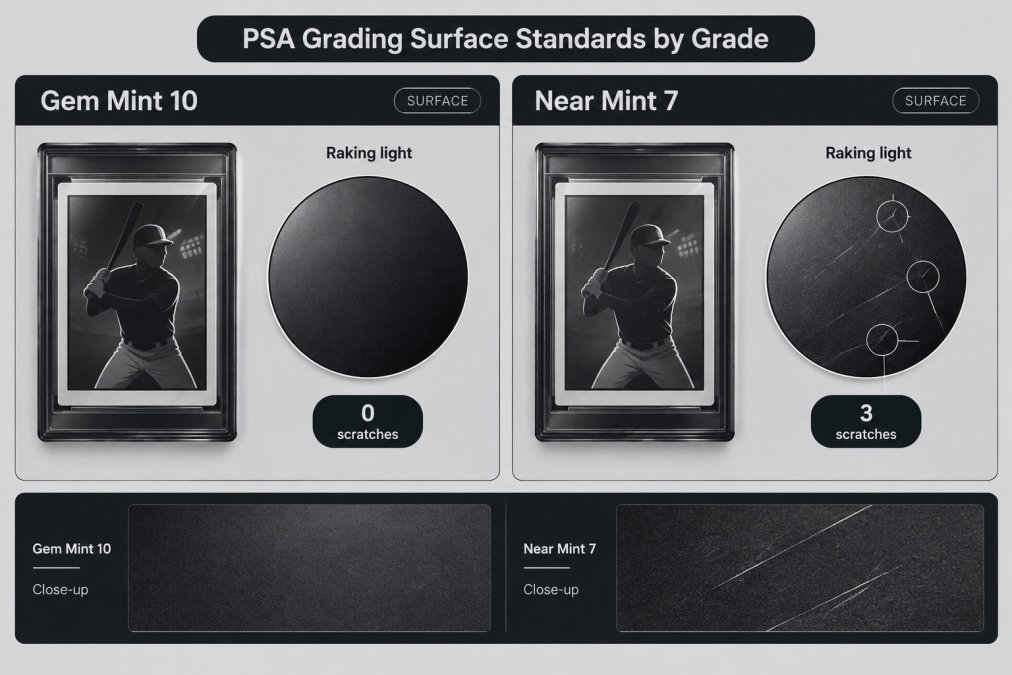
PSA official grading standards
The article's PSA surface standards show how a light scratch can shift a card's grade across the scale.
| Grade tier | Surface tolerance | Scratch effect |
|---|---|---|
| Gem Mint 10 | Virtually perfect surface | Hairline scratch usually drops card out of 10 |
| Mint 9 | One minor flaw allowed | Faint scratch visible only at an angle may still qualify |
| Near Mint-Mint 8 / Near Mint 7 | More visible wear tolerated | Scratch visible without angling likely caps surface at 7 or 8 |
| Below Near Mint 7 | Progressively more visible damage | Deeper scratches cut through gloss or printed layer |
Chrome Versus Paper: Which Cards Show Scratches More
Surface material changes how easily scratches show. Chrome cards have a reflective, metallic finish that reveals every mark, especially under bright light. A scratch that would be hard to spot on paper can stand out clearly on chrome.
Paper cards absorb light more evenly, so fine marks can be harder to see at first. However, paper cards also scuff more easily during handling, and dull finishes can hide wear until you look closely.
Holographic and foil cards sit somewhere in between. Their reflective surfaces make scratches look worse than they may be, so inspect them at several angles before deciding.
Is It Worth Grading Cards With Minor Defects?
Grading costs money, and a scratched card is a bet that the grade will still add enough value to cover the fee, shipping, and insurance.
Start with three numbers. First, the card's raw value in its current condition, which you can estimate from recent sold listings on marketplaces. Second, the likely graded value at the grade you expect, which you can estimate from sold prices for that card in that grade. Third, the all-in grading cost: the per-card fee for your chosen service level, plus shipping both ways, plus insurance based on declared value.
The scratch matters because it changes the expected grade, and the expected grade changes the value.
Run the same math for a higher-value card.
Use this decision sequence before you submit:
- Estimate raw value from recent sold listings in the card's current condition.
- Estimate graded value at the grade you realistically expect, not the grade you hope for.
- Subtract the all-in grading cost, including shipping and insurance.
- If the net gain is small or negative, keep the card raw or sell it as-is.
- If the net gain is meaningful, submit and document the scratch in your photos.
Watch out: do not use the Gem Mint 10 price as your expected value when the card has a visible scratch, since that can lead to a submission that loses money. Price the grade you expect, not the grade you want.
There is also a material-specific wrinkle.
Finally, consider the non-financial reasons. If the card is for your personal collection and you want it encapsulated for protection and display, the cost-benefit math matters less.
PSA grading fees and service levels
Can Surface Scratches Be Repaired Before Submission?
Some collectors try to remove scratches, but this is risky. Abrasive cleaning, polishing, or chemical treatments can damage the printed layer and create new flaws. A repair attempt can lower a card's grade or make the card look altered, which graders may flag.
The safer approach is to store cards properly and avoid creating new scratches. Use penny sleeves and top-loaders to prevent friction, and handle cards carefully. If a card already has a scratch, grading it honestly is usually better than attempting a repair that could make things worse.
Deciding Whether to Submit Your Card
Make the final decision based on your inspection notes, the card's value, and your goals.
Whatever you choose, document the card's condition with clear photos before you submit or store it. Good records help you compare results and make better decisions on future cards.
Frequently Asked Questions
Can a card with a minor surface scratch still get graded? Yes.
Do graders see scratches that are hard to notice? Often, yes.
Should I try to remove a scratch before grading? Usually no.
How do I know if a card is worth grading? Compare the estimated graded value against the raw value, grading fee, shipping, and insurance.
Cardboard Superstars is here to help you collect with confidence. Find cards from our curated selection and build your collection with clear condition details you can trust.
Frequently Asked Questions
Can a card with a scratch get a PSA 10?
A PSA 10 requires a surface that is essentially flawless under magnification and raking light. A visible scratch, even a small one, typically keeps a card from a 10 and usually places it in the PSA 8 to 9 range, depending on severity, location and how many other sub-grades are strong. Cards with a single hairline scratch in a non-focal area sometimes still grade 9 or 10 on the surface sub-grade, but a PSA 10 is generally out of reach for any card with a clearly visible scratch. Check the card under raking light before deciding whether a 10 is realistic.
Do scratches on a PSA slab matter?
Scratches already on a card matter because they are part of the grade the card received. Scratches that appear on the holder itself, or scuffs on the slab, do not change the card's grade, but they can affect resale appeal. Collectors typically prefer a clean slab, so a damaged holder may lower perceived value even when the card inside is well graded. If the holder is cracked or scratched, contact PSA about its condition rather than assuming the card's grade has changed.
How much does a surface scratch lower a card's grade?
The effect depends on the scratch's depth, length, location and visibility under light. A faint micro-scratch may cost a half point or less on the surface sub-grade, while a deeper scratch crossing the image area can drop a card by a full grade or more. Scratches on the chrome or foil surface are often more damaging than similar marks on matte paper, because they reflect light differently. Compare your card against published PSA grade standards and sample slabs before estimating.
Can you remove surface scratches before submitting a card for grading?
Attempting to remove scratches usually makes things worse. Polishing, buffing or applying coatings can damage the print layer, dull the finish or leave residue, and graders can often detect altered surfaces. Honest submission of the card in its original condition is the safer approach. If you are considering any treatment, weigh the risk of permanent damage against the modest gain in grade, and remember that altered cards may be flagged or rejected.
