


Table of Contents
- Where to Hunt: Online Marketplaces for Rare Card Deals
- Best Card Price Tracking Tools for Spotting Undervalued Cards
- Negotiating Sports Card Prices at Shows
- How to Spot Fake Trading Cards Before You Buy
- Hidden Gems: Flea Markets, Garage Sales, and Antique Stores
- Common Mistakes That Cost You Rare Card Deals
- Conclusion
- Frequently Asked Questions
Last Updated: September 12, 2026
Where to Hunt: Online Marketplaces for Rare Card Deals
Finding rare card deals starts with knowing where inventory actually surfaces. At Cardboard Superstars, we've watched collectors overpay on mainstream platforms simply because they never learned where the quieter listings live. This guide breaks down how to find rare card deals across auction sites, specialty shops, and physical venues, plus the tools and habits that separate patient buyers from impulse spenders.
The core tension in this hobby is simple: the best deals rarely appear where the most eyes are watching. A rare card deal is any purchase where you pay meaningfully below current market value for a card in comparable condition. That gap exists because most buyers cluster around the same few listings while overlooking auctions that end at odd hours, mislabeled singles, and estate sales nobody photographs well.
eBay's guide to bidding and buying explains how auction formats affect final prices, and the pattern holds: listings with clear photos and accurate titles attract more bidders, which usually means higher closing prices. The flip side is your opportunity. Listings with poor titles, blurry photos, or misspelled player names often slip through with far less competition.
Auction Sites vs. Buy It Now Listings
Auction sites reward patience; Buy It Now listings reward speed. On auction platforms, bidding wars push prices above market value more often than beginners expect, especially on hyped rookies. Buy It Now listings, by contrast, let you lock in a price instantly, and sellers who need quick cash sometimes list below market without realizing it. Search completed sales first, then compare against active listings before committing.
Specialty Shops and Sealed Product
Specialty shops and sealed product sellers offer something auction sites can't: verified condition and provenance. Sealed booster boxes and starter sets hold value partly because their contents are unopened and authenticated. Cardboard Superstars stocks sealed boxes, graded legends, and protective supplies with clear product details before checkout, so you know exactly what you're buying.

Best Card Price Tracking Tools for Spotting Undervalued Cards
The best card price tracking tools combine historical sales data with real-time listing alerts. Without a price guide or collection tracker, you're guessing. With one, you can spot the gap between asking price and actual market value in seconds. The deeper edge, though, is automation: most collectors still refresh listings by hand, which means a well-built alert system sees deals before the crowd does.
Price tracking works in four layers:
- Historical sales data: completed auction results show what buyers actually paid, not what sellers hope to get
- Listing alerts: saved searches notify you the moment a matching card appears
- Collection trackers: log your purchases and current valuations so you know your cost basis when you sell
- Automated deal filters: rules that flag listings priced below a threshold you set, so you only see the outliers
Price Guides and Collection Trackers
A price guide gives you a baseline; a collection tracker gives you context. Serious collectors use both. Track every purchase, note the grade and condition, and revisit valuations monthly. Market volatility in trading cards is real, and a card that looked like a bargain in spring can look expensive by fall if a reprint or a new set shifts demand.
When you read sold comps, filter out the noise before you trust the number. A single outlier sale, a mislabeled listing, a shill bid, or a lot that bundled ten cards, can drag an average in the wrong direction. A common pattern among experienced buyers is to look at the median of the last several sales in comparable condition, not the highest or lowest result. If a card has fewer than a handful of recent sales, treat any "market value" figure as a rough estimate rather than a fact.
Building Automated Alerts That Actually Work
Saved searches are only as good as the keywords you feed them. Most platforms let you save a search and turn on notifications, but the collectors who win deals go a step further:
- Save multiple variants of the same card, full name, nickname, common misspellings, and the set name plus card number
- Set a price ceiling in the filter so you only get pinged on listings below your target
- Choose the notification channel you actually check, whether that's email, a mobile app push, or a browser extension that highlights matching listings as you browse
- Re-run the search weekly and prune keywords that generate too much noise
Browser extensions that overlay recent sold prices directly onto listing pages are especially useful because they remove the step of opening a second tab to check comps. The trade-off is accuracy: extension data is only as fresh as its last crawl, so verify anything that looks like a steal against the platform's own sold history before you commit.
Deal scanners take this further by flagging listings priced below recent comparable sales. The catch: scanners are only as good as their data, and rare vintage cards often have too few recent sales for reliable comparisons. Use scanners for high-volume modern cards and rely on manual research for vintage and limited production runs.
Where Tooling Breaks Down
No tracker solves the thin-market problem. A card with two sales in the last year has no reliable price, and an alert that fires on a "below market" listing may be comparing against a stale number. For vintage, low-population, and error cards, the tool's job is to surface the listing, your job is to research the card's population, condition, and recent auction history yourself. Treat automated alerts as a first filter, not a final answer.
Negotiating Sports Card Prices at Shows
Negotiating sports card prices at shows comes down to preparation and timing. Vendors expect offers, and the collectors who get the best deals are the ones who did their homework before walking in.
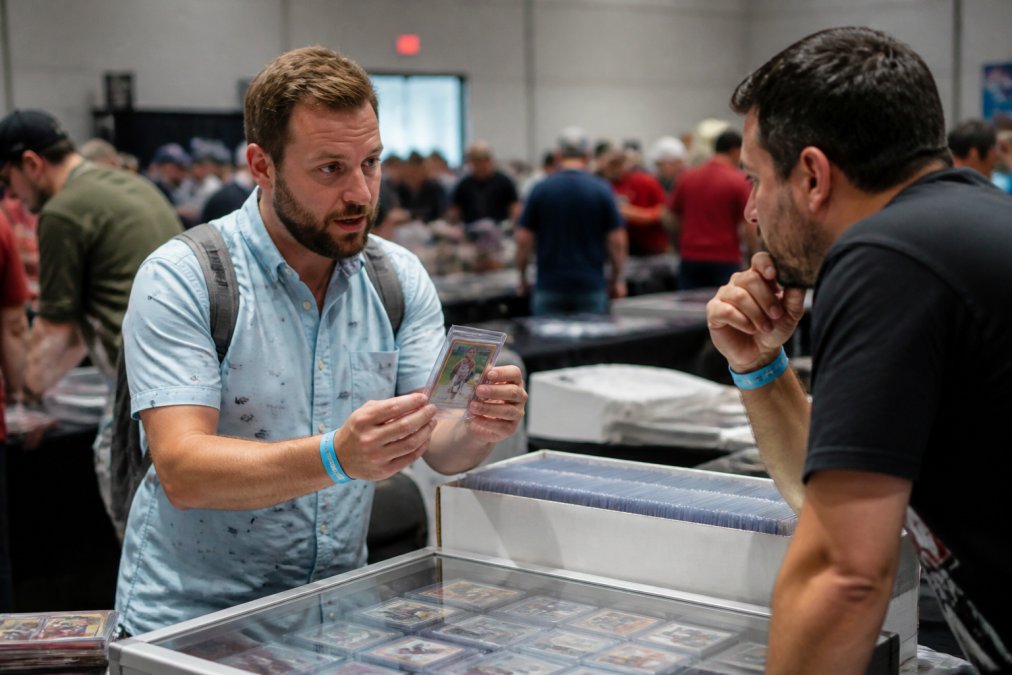
Before you make an offer, check recent sold prices on your phone. Know the card's condition honestly, since centering, corners, and surface flaws all affect value. Then follow this approach:
- Ask the vendor what they have in the card, conversationally
- Bundle multiple cards to justify a discount
- Make a specific offer, not a vague "what's your best price"
- Be ready to walk away
Cash talks at shows. Vendors avoid processing fees and appreciate immediate payment, which often earns you a few extra percentage points off the sticker.
How to Spot Fake Trading Cards Before You Buy
Spotting fake trading cards requires knowing what authentic printing looks like. Counterfeits have improved, but most still fail basic checks once you know where to look. This is the section most deal-hunting guides skip entirely, and it's the one that protects your money: a "deal" on a counterfeit is a total loss, not a bargain.
Start with the physical card. Authentic cards have clean edges, consistent centering, and print quality that holds up under magnification. Fakes often show fuzzy text, off-color borders, or a different card stock feel. A FTC consumer guide on counterfeit goods notes that counterfeits frequently violate trademark law, which matters if you're buying investment grade cards.
Physical Checks You Can Do in Under a Minute
- Light test: hold the card up to a bright light. Authentic stock blocks most light evenly; many counterfeits look translucent or show a different glow because the paper is thinner or coated differently.
- Magnification: a jeweler's loupe or a phone macro lens reveals print dots. Authentic cards use fine, consistent halftone patterns; fakes often show coarse dots, blurry edges, or solid color where there should be a dot pattern.
- Texture and feel: run a thumb across the surface. Authentic cards have a slight tooth; many fakes feel slick, waxy, or overly glossy.
- Back-of-card print: the reverse is often where counterfeiters cut corners. Compare border thickness, logo sharpness, and color against a known authentic copy of the same set.
- Dimensions: a standard card measures about 2.5 by 3.5 inches. Trimming to hide edge wear makes a card measure smaller than standard, which is a red flag on its own.
Authentication Red Flags and Grading Basics
Grading companies examine centering, corners, edges, and surface, then assign a numeric grade (psacard.com). A slabbed card from a reputable grader carries a serial number you can verify online. Red flags include:
- Sellers who avoid close-up photos of corners and edges
- Prices far below market for a mint condition key card
- No return policy or pressure to pay outside the platform
- Trimming, which makes a card measure smaller than standard
- A slab whose label font, spacing, or hologram doesn't match the grader's known design
Resealed Packs and Boxes
Sealed product carries its own fraud risk. Resealed packs are opened, stripped of the good cards, refilled with commons, and re-glued. Warning signs include glue residue along the crimped edges, a crimp pattern that doesn't match other packs from the same box, loose or shifted cards inside, and a wrapper that feels unusually tight or slack. On sealed boxes, check the factory shrink wrap for the manufacturer's logo pattern and look for re-taped seams. Buy sealed product from sellers with a track record and a clear return policy, and photograph the package before opening it so you have a record if something is wrong.
Verify Before You Pay
Authentication matters most on high-value vintage and limited production cards. If a deal looks too good, verify the grade serial number on the grader's own website before you pay, not through a link the seller sends you. Pay through the platform's checkout so you keep buyer protection, and avoid any seller who pushes you to complete the deal off-platform. If a deal looks too good to be true, it usually is, and walking away costs you nothing.
Hidden Gems: Flea Markets, Garage Sales, and Antique Stores
Flea markets, garage sales, and antique stores remain the best sources for hidden gems because sellers there rarely price cards at market. They price them at whatever feels reasonable, which is often well below resale value.
Go early, bring cash, and ask specifically for cards rather than browsing passively. Estate sales often include vintage collections that heirs don't know how to value. Antique stores sometimes have cards buried in display cases behind glass, priced years ago and never updated. The trade-off is time: you'll dig through a lot of commons to find one real card.
Common Mistakes That Cost You Rare Card Deals
Most missed deals trace back to the same handful of errors. Avoid these and you'll consistently buy better than the average collector.
| Mistake | What It Costs You | The Fix |
|---|---|---|
| Bidding emotionally in auctions | Paying above market value | Set a max price before bidding |
| Skipping condition checks | Overpaying for flawed cards | Inspect or request close-ups |
| Ignoring shipping and tax | Eroding your margin | Factor total cost into offers |
| Buying without a price guide | Guessing at value | Check completed sales first |
| Chasing every deal | Spreading budget thin | Target specific cards |
The psychology of the seller matters too. Motivated sellers, whether downsizing, raising cash, or clearing an estate, accept lower offers. Patient sellers wait for full market value. Reading which type you're dealing with tells you how much room you have.
Conclusion
Finding rare card deals rewards preparation over luck. Track prices, verify authenticity, negotiate with data, and hunt where the competition isn't looking. When you're ready to buy with confidence, Cardboard Superstars offers authentic cards, sealed boxes, and protective supplies with clear condition details before checkout, collector-grade packaging, and fast shipping backed by more than 4,600 items sold. Find cards at Cardboard Superstars and build your collection with peace of mind.
Frequently Asked Questions
How do I find good Pokemon card deals without overpaying?
Track market value with price guides and collection trackers before you buy. Set alerts on auction sites for specific cards and check sold listings, not asking prices. At shows, compare at least three vendors before negotiating. Sealed product like value packs can offer strong entry points, and buying during off-season lulls often means lower prices on vintage and modern singles alike.
What are the best platforms for tracking rare card price trends?
Dedicated card price tracking tools let you monitor market volatility across auction sites and marketplaces. Look for platforms that pull sold-listing data rather than asking prices, since sold data reflects real market value. Many collectors pair a price guide subscription with a collection tracker app that sends deal scanner alerts when a card drops below a target threshold.
How can I verify the authenticity of a rare card before buying?
Check for consistent centering, correct font weight, and clean edges under good lighting. Graded cards in a slabbed holder from PSA or another recognized grader carry a certification number you can verify online. For raw cards, compare print patterns against known authentic examples. Buy from sellers with strong feedback and clear return policies, and avoid deals that seem far below market value.
What are the best strategies for negotiating at card shows?
Bundle multiple cards into one offer rather than haggling on a single item. Know the market value beforehand so you can make a confident counteroffer. Cash often gets a better price than card. If a vendor won't budge, leave your contact info and check back near the end of the show when sellers are more motivated to move inventory.