


Table of Contents
- What Is a First Edition Pokémon Card?
- Where to Look for the 1st Edition Stamp
- How to Spot Fake Pokémon Cards
- Shadowless vs. 1st Edition: What's the Difference?
- Base Set vs. Later Sets: Identifying Your Card's Origin
- Pokémon Card Grading Services and Authentication
- Common Misconceptions About First Edition Cards
- Conclusion
- Frequently Asked Questions
Last Updated: September 18, 2026
What Is a First Edition Pokémon Card?
A first edition Pokémon card is a trading card from the initial print run of a specific set, marked with an official stamp that distinguishes it from later reprints. Collectors prize first edition pokemon cards for their original release status and higher values. This designation matters enormously to collectors because first edition cards represent the original release and typically command higher values than their unlimited counterparts.
The first edition stamp appears as a small black circular emblem on the card's left side. This marking certifies that the card came from the very first printing of that set. For the Base Set, the most sought-after and valuable Pokémon cards in existence, first edition status can mean the difference between a card worth hundreds of dollars and one worth far less.

Understanding first edition cards requires knowing how Pokémon's printing process worked. The Pokémon Company released sets in waves. The first wave received the first edition stamp. Once those initial copies sold out, subsequent print runs were released without this stamp, labeled as "Unlimited." Collectors prioritize first edition cards because they represent the original, limited distribution of that set's cards.
At Cardboard Superstars, we help collectors navigate these distinctions with confidence. Whether you're hunting for your first graded first edition card or building a serious collection, identifying authentic first edition stamps is the foundation of smart collecting.
Where to Look for the 1st Edition Stamp
The location of the first edition stamp varies depending on which set you're examining. Knowing exactly where to look prevents you from missing this critical authentication detail.

Stamp Location on Base Set Cards
On Base Set Pokémon cards, the most collected and valuable cards in the hobby, the first edition stamp sits on the left side of the card, roughly centered vertically. The stamp appears as a small black circle containing the words "1st Edition" in white text. It's positioned between the card's left edge and the main card artwork.
This placement is consistent across all Base Set first edition cards: Charizard, Blastoise, Venusaur, and every other card from that legendary set. The stamp should be crisp and clearly defined. A blurry, smudged, or poorly printed stamp is a red flag for counterfeits. The circular emblem has a precise diameter and clean edges on authentic cards.
The stamp's ink quality matters. Genuine first edition stamps use high-quality printing that creates sharp, consistent black ink. When you examine the stamp closely, the edges should be clean and defined, not feathered or faded. This is one of the easiest ways to spot a fake, counterfeiters often struggle to replicate the exact ink density and sharpness of the original stamp.
Stamp Placement on Later Sets
Sets released after Base Set moved the first edition stamp to different locations. On Jungle and Fossil sets, the stamp appears in similar positions but sometimes with slight variations in placement depending on the card layout. By the time Rocket set arrived, Pokémon had adjusted the stamp positioning again.
Later set stamps tend to be slightly larger than Base Set stamps, making them easier to spot once you know where to look. The variation in placement across sets means you need to familiarize yourself with your specific set's stamp location before authenticating cards from it. Consulting set-specific guides prevents confusion.
The key principle remains constant: first edition stamps on all sets should be crisp, clearly printed, and positioned exactly where they appear on known authentic cards from that set. Any deviation in placement, size, or print quality warrants closer inspection.
How to Spot Fake Pokémon Cards
Counterfeits have become increasingly sophisticated, but several telltale signs reveal fakes when you know what to examine.
Examining Ink Quality and Print Sharpness
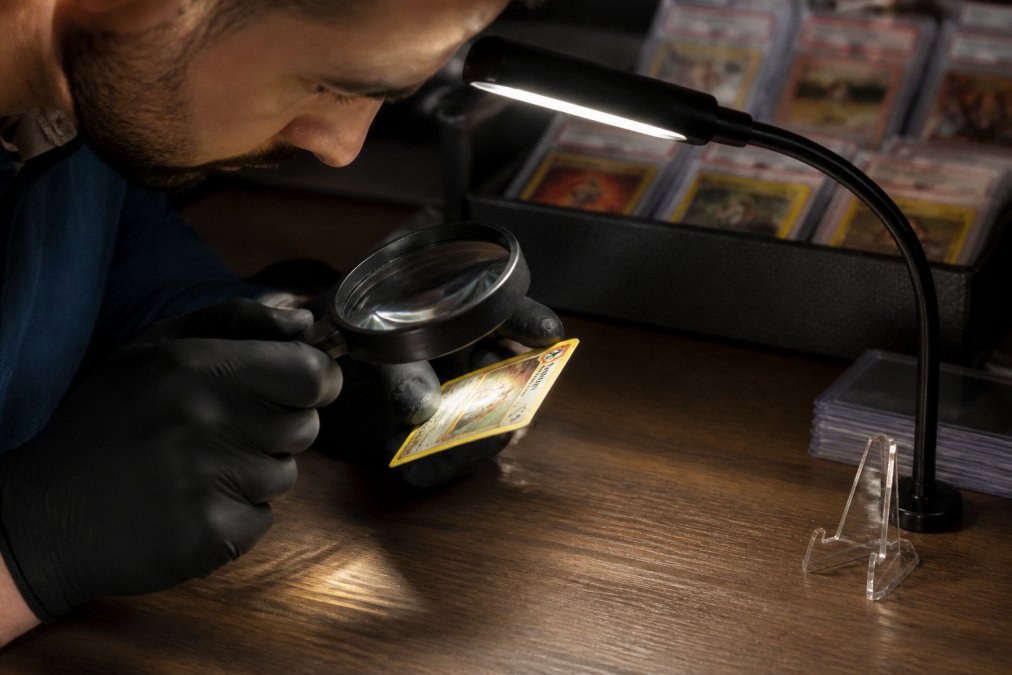
The first edition stamp's ink is where fakes most often fail. Genuine stamps have perfectly sharp, consistent black ink. The edges of the circular emblem are crisp. Counterfeiters typically produce stamps with fuzzy edges, inconsistent ink density, or slightly blurred text inside the circle.
Run your finger lightly across the stamp area on a genuine card. You should feel a slight raised texture from the printing process. Many counterfeits are printed flat, creating no texture variation. This tactile test catches fakes that pass a visual inspection.
The card's overall print quality also reveals authenticity. Pokémon's official printing creates sharp, vibrant colors with no bleeding or misalignment. Fake cards often show color bleeding at the edges, slightly misaligned borders, or dull, washed-out colors. The holographic pattern on holos should be consistent and precise. Counterfeit holos often display irregular patterns or poor alignment with the card artwork.
Checking Card Stock and Texture
Authentic Pokémon cards have a specific card stock composition that feels distinctly different from counterfeits. Genuine cards have a particular weight and stiffness. When you hold an authentic first edition card, it has a premium feel, substantial but not brittle.
Counterfeits often use cheaper card stock that feels too thin, too flimsy, or overly rigid. Some fakes use glossy finishes that authentic cards lack. Run your thumb across the card surface. Genuine cards have a subtle texture. Fakes often feel either too smooth or too rough.
Pokemon White Flare Deluxe Booster Box →
The card's edges reveal quality too. Authentic cards have clean, precisely cut edges with no rough spots. Counterfeit edges often show rough spots, uneven cutting, or visible layering where cheaper materials show through. This edge quality is difficult for counterfeiters to replicate because it requires precision manufacturing.
Shadowless vs. 1st Edition: What's the Difference?
These terms describe different print runs, and understanding the distinction is essential for accurate identification and valuation.
Shadowless cards are first edition cards from the very earliest print runs of Base Set, produced before Pokémon added drop shadows to the card artwork. These cards lack the small shadow effect beneath the Pokémon illustration. Shadowless first edition cards are rarer and more valuable than shadowed first edition cards from later Base Set print runs.
The difference is visual. Look at the Pokémon artwork. On shadowless cards, the Pokémon sits directly on the background with no shadow effect. On shadowed cards, a subtle shadow appears beneath the Pokémon. Shadowless cards represent the absolute earliest printing of Base Set. They command premium prices because fewer were produced.
Shadowless cards always have the first edition stamp. If you find a shadowless card without the stamp, it's from an even earlier experimental print run or it's a fake. The combination of shadowless artwork and first edition stamp creates the most valuable Base Set cards. Identifying both characteristics correctly is crucial for serious collectors.
Base Set vs. Later Sets: Identifying Your Card's Origin
Knowing which set your card comes from helps you locate the stamp correctly and understand its potential value.
Base Set cards feature the original Pokémon artwork and the most sought-after first edition stamps. These cards have a distinctive look, simpler artwork, different text formatting, and the iconic Base Set symbol in the lower right corner. The set symbol for Base Set is a small circle.
Later sets like Jungle, Fossil, and Rocket introduced new Pokémon and updated artwork. Each set has its own set symbol. Jungle uses a leaf symbol, Fossil uses a fossil symbol, and Rocket uses a flame symbol. These symbols appear in the lower right corner of every card and are the quickest way to identify which set you're holding.
The card's overall design changes across sets. Text positioning shifts. The card border styling evolves.
Pokémon Card Grading Services and Authentication
Professional grading services provide authoritative authentication and condition assessment for valuable cards.
Common Misconceptions About First Edition Cards
Several widespread myths lead collectors astray when evaluating first edition cards.
Conclusion
Identifying first edition Pokémon cards accurately protects your collection and your investment. The first edition stamp's location, ink quality, and card stock characteristics are your primary authentication tools. Shadowless cards represent the rarest first edition cards, and understanding the differences between sets ensures you're examining cards correctly.
| Authentication Method | Best For | Time Required | Cost |
|---|---|---|---|
| Visual inspection | Quick reference checks | 2-5 minutes | Free |
| Magnifying glass examination | Detailed stamp analysis | 10-15 minutes | $10-30 |
| Professional grading | High-value cards | 2-4 weeks | $20-100+ |
| Comparative reference | Learning identification | 15-30 minutes | Free |
Frequently Asked Questions
Where exactly is the 1st edition stamp located on a Pokémon card?
The 1st edition stamp appears as a black circular emblem on the lower left corner of the card's front face, just above the card number. On Base Set cards, this stamp is solid black and clearly defined. On shadowless cards, there is no stamp at all. The stamp's placement and clarity are critical authentication markers, counterfeits often have blurry, misaligned, or incorrectly sized stamps that don't match the original printing process specifications.
What is a shadowless Pokémon card and how does it differ from 1st edition?
A shadowless card is from Pokémon's initial print run before the 1st edition stamp was introduced. Shadowless cards have no black circular emblem and no drop shadow around the card's border. 1st edition cards came after shadowless and feature the black circular stamp. While both are valuable from the original print run, shadowless cards are rarer and typically command higher prices. Identifying which you have requires checking for the stamp's presence or absence and examining the card's border for the characteristic shadow effect.
How can I verify a first edition card is authentic and not counterfeit?
Examine the 1st edition stamp under magnification for sharp, clean lines and consistent ink saturation. Check the card stock's thickness and flex, authentic cards have a specific stiffness that counterfeits rarely replicate. Look at the holographic pattern for proper alignment and texture. Inspect the printing process quality: authentic cards have crisp text and images with no bleeding or misalignment. If you're uncertain, professional grading services authenticate and grade cards, providing third-party verification that protects your investment.
Are all 1999 Pokémon cards first edition?
No. 1999 Pokémon cards include shadowless cards (the very first print run with no stamp) and 1st edition cards (which have the black circular stamp). Later printings from 1999 and beyond have no stamp and are considered unlimited editions. The year alone doesn't determine edition status, you must check for the 1st edition stamp and the presence or absence of a shadow around the border to classify your card correctly.