


Table of Contents
- Why Organization Matters for Sealed Booster Packs
- Step 1: Assess Your Current Collection and Set Goals
- Step 2: Choose Your Primary Storage Method
- Step 3: Organize by Set or Release Date
- Best Acrylic Cases for Booster Packs and Display
- How to Track Trading Card Collection Inventory
- Sealed Product Storage Humidity Control and Environmental Protection
- Displaying vs. Long-Term Archival Storage
- Frequently Asked Questions
Last Updated: October 1, 2026
Why Organization Matters for Sealed Booster Packs
Without a clear system, sealed booster packs quickly become chaotic. You lose track of inventory, duplicates accumulate, and damage risk increases exponentially.
Organization preserves value and protects your investment. Losing inventory visibility means losing control of your assets, you might accidentally open a pack meant to stay sealed or miss spotting appreciating releases.
A simple organizational system to organize sealed booster packs transforms your hobby experience: you find cards faster, protect your collection better, and make smarter buying decisions.
Step 1: Assess Your Current Collection and Set Goals
Before buying storage, take inventory of what you have. Count sealed booster packs by product type, set, and release date, this is the foundation for everything that follows.
Ask yourself: Are you collecting for display or investment? How many packs will you add annually? Are you focused on one TCG or multiple games?
Skipping this step leads to buying wrong-sized storage and upgrading within months.
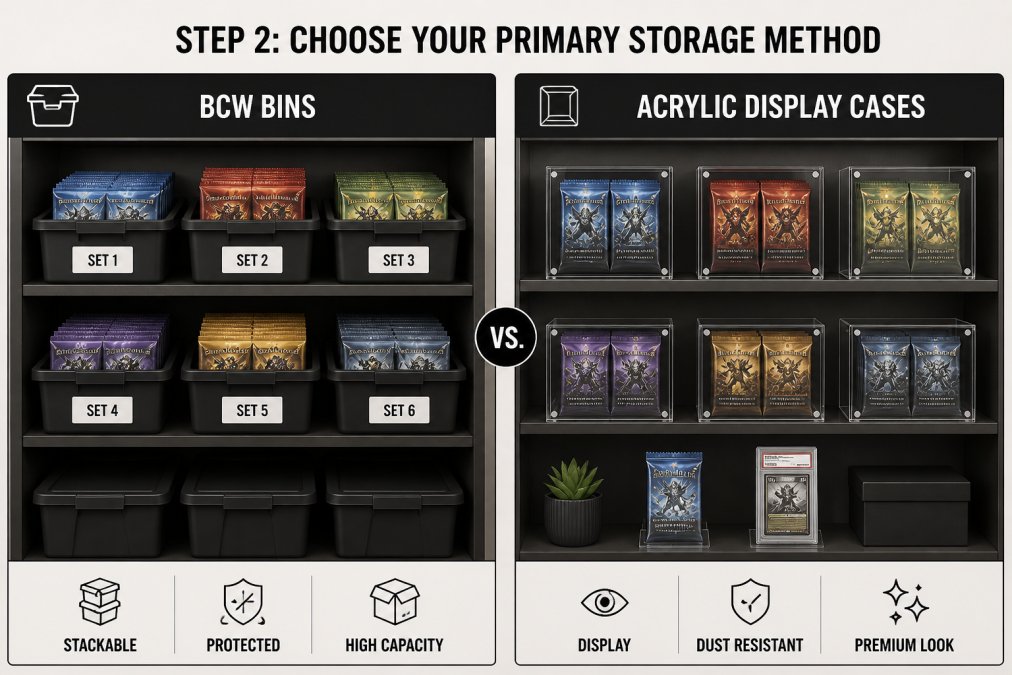
Step 2: Choose Your Primary Storage Method
Your collection needs a home base, a primary storage solution where most packs live. This choice depends on three factors: collection size, display priority, and environmental control.
Toploaders and Semi-Rigid Card Holders for Individual Packs
Toploaders work best for your most valuable sealed booster packs you want to inspect or grade, protecting them from bending and dust while keeping them visible.
Semi-rigid holders offer similar protection with more flexibility. Both work for collections under 100 packs but become impractical at scale, consuming shelf space and complicating inventory tracking.
Use toploaders selectively for your crown jewels. Protect the rest with bulk storage solutions.
Hard Plastic Cases vs. Soft Storage Solutions
Hard plastic cases, especially acrylic display cases, offer superior protection and visual appeal, keeping packs safe from humidity, dust, and handling damage while showcasing 10-20 of your best packs.
Soft storage like cardboard boxes or cloth bags offers minimal protection, cardboard absorbs moisture and breaks down, inviting creasing and damage. Avoid soft storage for sealed packs.
For bulk storage of 100+ packs, plastic storage bins with lids provide the best balance of protection, capacity, and cost efficiency.
Storage Containers and Bins for Bulk Organization
The BCW Collectible Card Bin holds up to 1,600 cards and works exceptionally well for organizing sealed booster packs at $34.99, with a secure lid that keeps out dust and environmental contaminants.

These bins come in multiple colors (blue, yellow, green, gray) for color-coding by TCG type or release year. Stack them on shelves or in closets for protection and accessibility.
For 200-500 packs, two to three BCW bins handle everything. The modular design scales as your collection grows.
Step 3: Organize by Set or Release Date
Set-based organization works best if you collect multiple TCGs, letting you instantly find any pack. Label bins clearly: "Pokémon 2024-2025" or "Magic: The Gathering 2023-2024."
Release date organization works better for single-TCG collectors tracking market trends, making it easy to see which eras you've collected and which gaps exist.
Pick one method and stick with it. Consistency matters more than which system you choose. A well-organized collection by release date beats a chaotic collection organized by set.
Best Acrylic Cases for Booster Packs and Display
Acrylic cases elevate your collection from storage into display.
A quality acrylic case should have UV-protective properties, secure closures (magnetic seals or locking mechanisms), and protective padding or dividers to prevent packs from shifting.
Display cases typically hold 5-20 packs and are perfect for featuring your rarest releases.
Prioritize thickness (at least 3mm) and clarity, thicker acrylic resists warping and yellowing, while crystal-clear acrylic shows off packs without distortion. Avoid thin, cloudy cases.
How to Track Trading Card Collection Inventory
Inventory tracking separates serious collectors from casual ones. You need a record of every sealed booster pack: what it is, when acquired, purchase price, and estimated current value. For collections, this documentation is essential for insurance.
Building Your Core Inventory Spreadsheet
Start with a simple spreadsheet with columns for: Set Name, Product Type, Quantity, Acquisition Date, Purchase Price, Current Estimated Value, Storage Location, and Notes. Update it whenever you add new packs.
Be specific: write "Pokémon Base Set Unlimited Edition Booster Pack" to distinguish between first edition, unlimited, and shadowless variants, which have drastically different values.
Update your spreadsheet monthly, especially the "Current Estimated Value" column. Sealed booster pack prices fluctuate based on market demand, set rotation, and nostalgia cycles.
Valuation and Insurance Documentation
For collections, create a separate valuation document for insurance purposes. Insurance companies require detailed asset documentation in case of theft, fire, or water damage.
For packs, photograph both front and back against a neutral background with consistent lighting as evidence for potential claims.
Update your valuation document quarterly. Use pricing databases like TCGPlayer, eBay sold listings, or specialized trading card price guides to establish fair market value.
Photography and Cloud Storage
Photograph your entire collection twice per year and store photos in cloud storage (Google Drive, Dropbox, or iCloud) with clear labeling. This provides documentation for insurance claims if disaster strikes.
BCW Collectible Card Bin Holds 1600 Cards Blue →
Create a folder structure: Collection Photos > [Year] > [Set Name] > [Individual pack photos].
For collections, maintain a printed backup of your valuation document and key photographs in a fireproof safe or with a trusted family member, protecting against data loss from hacking or outages.
Inventory Management Software for Larger Collections
For collections exceeding 500 packs, consider inventory management software designed for trading cards. These tools photograph packs, track condition, monitor prices, and generate reports automatically.
Popular options include inventory management software designed for trading cards.
Software becomes worthwhile when manual updates consume more than 2-3 hours per month.
Insurance Claim Preparation
Maintain a one-page insurance summary listing: total number of sealed booster packs, total estimated value, breakdown by TCG type, insurance policy number and coverage limits, and date of last valuation update.
Share this summary with your insurance agent. Many homeowners policies limit collectibles. If your collection exceeds that, you'll need a rider or separate collectibles insurance policy.
Update your insurance summary annually. If your collection grows significantly, notify your insurance agent and adjust your coverage. Underinsured collections are a common mistake collectors make.
Sealed Product Storage Humidity Control and Environmental Protection
Humidity is your biggest enemy. High humidity (above 60%) encourages mold and card warping; low humidity (below 30%) makes cardboard brittle and prone to cracking.
Maintain humidity between 40-50% using a digital hygrometer (typically $15-30) placed inside your storage bin or closet. Analog hygrometers are unreliable; microenvironments vary significantly.
Desiccant Selection and Replacement
If your home tends toward high humidity, place silica gel packets inside your storage bins, the industry standard for card storage.
For a BCW Collectible Card Bin, place two to three 10-gram silica gel packets inside and replace every 3-6 months.
Avoid calcium chloride desiccants, they can leak and damage cardboard. Never use baking soda or charcoal; they're ineffective and introduce odors.
Temperature Stability
Keep sealed packs in areas that stay between 65-75°F year-round. Fluctuations of more than 10°F in a single day stress cardboard and encourage condensation inside sealed boxes.
Avoid basements prone to flooding, attics heating above 85°F, or uninsulated garages that freeze. For collections, a climate-controlled storage unit is worthwhile.
UV Protection and Light Exposure
Store bins away from direct sunlight. UV exposure fades card colors and degrades cardboard. Use opaque storage bins or cover shelves with UV-blocking film if storing near windows.
Even indirect sunlight causes gradual fading over time.
Ventilation and Airflow
Never store sealed packs in plastic bags without ventilation, trapped moisture breeds mold. Use breathable storage solutions like plastic bins with ventilation holes. If your bins lack ventilation, drill small 1/8-inch holes in the bottom and sides.
Position bins with at least 2-3 inches of space on all sides for air movement. Don't stack bins directly against walls or in tight closets where stagnant air accumulates.
Monitoring and Documentation
Record humidity and temperature readings monthly in your inventory spreadsheet under a "Storage Conditions" column. This creates a historical record proving you maintained proper conditions if you file an insurance claim.
If humidity spikes above 55% for more than a week, investigate the cause. Check for leaks, poor ventilation, or seasonal changes. Adjust desiccant placement or add a small dehumidifier to the storage area. A compact dehumidifier ($50-150) can protect a collection worth thousands.
Displaying vs. Long-Term Archival Storage
Display storage and archival storage serve different purposes.
Display cases should sit in climate-controlled rooms with stable humidity and temperature.
Archival storage prioritizes protection over visibility. Use sealed plastic bins with desiccant packets.
Label everything clearly. Write directly on bins with permanent marker or use printed labels.
For collections, document everything with photographs and insurance appraisals. Store copies of documentation separately from the collection itself.
Organizing a growing collection of sealed booster packs transforms a chaotic hobby into a manageable system.
Frequently Asked Questions
What is the best way to organize sealed booster packs to prevent damage?
Store sealed booster packs in protective sleeves or semi-rigid card holders, then place them in storage containers like BCW bins or acrylic cases. Keep them in a climate-controlled environment with stable humidity (40-50%) and temperature (65-75°F). Avoid stacking heavy items on top, and use acid-free materials to prevent degradation. For high-value packs, use toploaders or individual protective cases to minimize handling and exposure.
How do I organize sealed booster packs by set or release date?
Group packs chronologically by their release date, then organize within each set by edition or rarity tier if applicable. Label each storage container with the set name and year using waterproof markers or printed labels. This method makes inventory tracking easier and helps you quickly locate specific releases. Consider using dividers inside bins to separate sets clearly and prevent mixing during retrieval.
How do I keep track of my sealed TCG inventory?
Use a spreadsheet (Google Sheets or Excel) or dedicated inventory software to log each pack's set name, release date, condition, estimated value, and storage location. Include photos of rare or high-value packs for reference. Update your inventory whenever you add or remove items. This documentation is essential for insurance purposes, grading preparation, and tracking collection growth over time.
Does humidity affect sealed trading card packs?
Yes, humidity significantly impacts pack integrity and card preservation. High humidity (above 55%) can cause pack seals to weaken, allowing air and moisture infiltration, which damages cards inside. Low humidity (below 35%) can cause packaging materials to become brittle. Maintain 40-50% humidity with desiccant packets in storage containers and a climate-controlled environment. Monitor conditions regularly to protect your long-term investment.