


Table of Contents
- Define Your Collecting Focus
- Set a Realistic Monthly Budget
- Understand Card Types and What You're Buying
- Best Sports Card Protective Supplies for Your Collection
- Where to Buy Cards: Hobby Shops, Retail, and Online
- Sports Card Grading Explained and Why It Matters
- How to Identify Card Value and Market Trends
- Storing and Organizing Your Collection
- Frequently Asked Questions
Last Updated: September 2, 2026
Define Your Collecting Focus
The first decision when starting to collect sports cards is deciding what you actually want to collect. You could chase baseball cards from the 1980s, modern basketball rookies, vintage football legends, or Pokémon TCG booster boxes. Each path requires different knowledge, budgets, and strategies.
Pick a sport or game first, then narrow further: are you collecting for nostalgia, investment potential, or gameplay? Do you want modern releases or vintage cards? Are you targeting a specific team, player, or era? The clearer your focus, the faster you'll learn the market and spot genuine opportunities.
At Cardboard Superstars, we've seen collectors succeed fastest when they choose a niche they're genuinely passionate about. Passion keeps you collecting through dry spells when prices rise or inventory disappears. Some collectors focus on a single player across their entire career, others build complete base sets from one year, and still others hunt for serial-numbered parallels or autographed rookie cards. Your focus determines which card shows you attend, which online communities you join, and which price guides you study.
Set a Realistic Monthly Budget
Before you buy a single card, establish a monthly budget and stick to it. This is non-negotiable. The collecting hobby can drain your wallet fast without guardrails.
Start small. Many successful collectors began with 20 to 50 dollars per month, enough to buy a few retail packs, a hobby box occasionally, or some graded singles from the secondary market. As you learn the hobby and your income allows, you can increase spending. Your budget should cover three categories: sealed products (booster boxes and packs), protective supplies (sleeves, toploaders, binders), and grading fees if you plan to submit cards.
Discipline matters more than raw spending power. A collector who buys 50 dollars of carefully selected cards monthly will outpace someone who randomly spends 500 dollars once a quarter.
Understand Card Types and What You're Buying
Not all sports cards are created equal. Understanding the differences between base cards, inserts, parallels, autographs, and memorabilia cards is essential before you spend money.
Base Sets, Inserts, and Parallels
Base cards form the foundation of any set. These standard cards are produced in high volume and feature the player's photo, name, stats, and basic information. A single base card might cost 25 cents to 2 dollars depending on the player and year.
Inserts are special cards inserted randomly into packs at lower odds than base cards. They might feature a different design, foil treatment, or special theme. An insert card might run 5 to 25 dollars depending on the specific card and player.
Parallels are variations of base or insert cards printed on different colored stock or with special finishes. A parallel might be a blue version of a base card or a gold-foil version of an insert. Serial-numbered parallels, cards numbered to a specific print run like 1 of 25, are especially valuable.
How to Identify Rookie Cards
Rookie cards (or RCs) are the first official cards of a player and hold special significance because they're often the most valuable cards of a player's career, especially if the player becomes a star.
Identifying a true rookie card requires knowing the player's first year in the league and understanding how manufacturers designate rookies. Most modern sets clearly mark rookie cards with an RC logo or special design element. Vintage cards are trickier, you need to research whether a card was actually a player's first official card.
When you start collecting, don't chase every rookie card you see. Focus on rookies of players you genuinely believe in or players from your favorite team. This keeps costs down and makes the hobby more enjoyable.
Autographs and Memorabilia Cards
Autographed cards feature a player's signature printed or handwritten on the card. Memorabilia cards include a swatch of a player's game-worn jersey, a piece of bat, or other authentic game material embedded in the card.
These cards command premium prices. An autographed rookie card of a star player can cost hundreds or thousands of dollars. For beginners, autographs and memorabilia cards are usually out of reach. Focus on building your foundational knowledge with base cards, inserts, and parallels first.
Best Sports Card Protective Supplies for Your Collection
Once you own cards, you need to protect them. The right supplies prevent damage from handling, humidity, light exposure, and accidents.
The essential supplies are penny sleeves, top loaders, and storage binders. Penny sleeves are thin plastic sleeves that fit snugly around a card and protect against dust and minor handling damage. Top loaders are rigid plastic holders that provide serious protection.
For everyday protection and display, the 200 Count Card Sleeve and Toploader Combo Pack from Cardboard Superstars offers both sleeves and toploaders at 24.99 dollars. For cards you want to showcase, the 3x4 Topload Card Holder - Standard - BCW at 3.25 dollars per holder provides individual rigid protection. If you're building a larger collection, the BCW Collectible Card Bin Holds 1600 Cards at 34.99 dollars offers organized storage for hundreds of cards.


Invest in a storage binder with acid-free pages. Acid-free materials prevent chemical degradation over decades (si.edu). Store your binder in a cool, dry place away from direct sunlight. Humidity and temperature fluctuations are the silent killers of card collections.
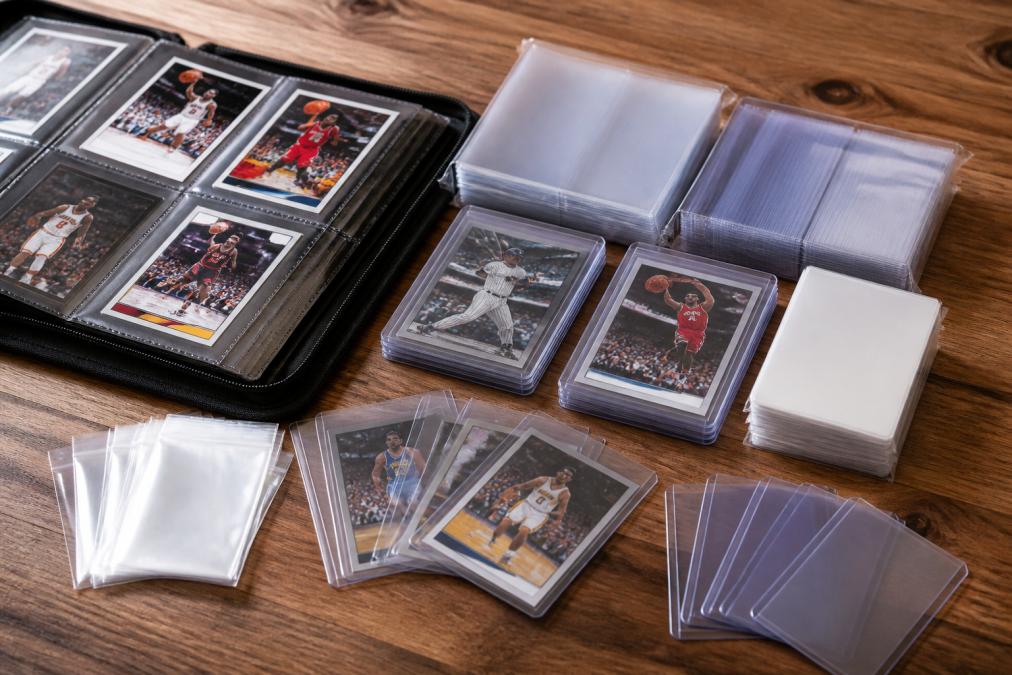
High-value cards deserve grading-quality storage. Some collectors use card safes or climate-controlled storage rooms for premium cards. A single graded card worth thousands of dollars justifies the investment in proper protection.
Where to Buy Cards: Hobby Shops, Retail, and Online
You have three main channels to buy cards: local hobby shops, big-box retailers, and online marketplaces.
Local hobby shops stock sealed products, graded singles, and supplies. The owner often has expertise and can guide you. You can inspect products before buying. The downside is limited selection and typically higher prices than online competitors. Hobby shops also host card shows and community events, which are invaluable for networking and learning.
Big-box retailers like Target and Walmart carry sealed booster boxes and packs at competitive prices. The advantage is convenience and lower prices. The disadvantage is unpredictable inventory and staff with limited hobby knowledge.
Online retailers like Cardboard Superstars offer curated selection, competitive pricing, and the ability to compare products before purchasing. You can read detailed product descriptions and condition information. Prioritize sellers with transparent product details and positive feedback. Cardboard Superstars provides clear condition information and uses secure collector-grade packaging. The 2025 Series 1 Baseball - Factory Sealed - Mega Box at 134.68 dollars is a solid entry point for baseball collectors wanting sealed product with confidence in authenticity and condition.
Verify seller credentials before spending significant money. Look for feedback scores, return policies, and customer reviews. Counterfeit cards exist in the hobby, so buy from established sellers with verifiable track records.
Sports Card Grading Explained and Why It Matters
Card grading is the process of having a third-party expert evaluate a card's condition and assign a numerical grade. Grading companies like PSA, Beckett, and SGC examine cards for centering, corners, edges, and surface quality, assigning grades from 1 (poor) to 10 (gem mint).
A graded card is encased in a tamper-proof holder with the grade printed on the label (beckett.com). This holder protects the card and provides third-party authentication. For high-value cards, grading adds credibility and often increases market value.
Grading matters most for cards worth more than 100 dollars. A raw (ungraded) card in excellent condition might be worth 500 dollars. The same card graded at 8 (very fine-mint) might sell for 1,200 dollars. The grade difference justifies the 50 to 100 dollar grading fee because it adds 700 dollars of value.
For lower-value cards, grading doesn't make financial sense. A 10-dollar card costs 50 to 100 dollars to grade. You'd lose money on the transaction. Keep low-value cards raw and stored in penny sleeves and top loaders.
How to Identify Card Value and Market Trends
Card prices fluctuate based on player performance, rarity, condition, and market demand. Learning to identify value separates successful collectors from those who overpay.
Use price guides like TCGPlayer, eBay sold listings, and PWCC Marketplace to research recent sales. Don't trust asking prices, look at actual sold prices. A seller might list a card for 500 dollars, but if it hasn't sold in six months, that's not the real market value.
Player performance drives demand. When a player wins an award or breaks a record, their card prices spike. Conversely, injuries or poor performance suppress prices. Smart collectors buy cards of rising players before the market fully prices in their success.
Serial-numbered and low-print-run cards hold value better than high-volume releases. A card numbered 1 of 10 is inherently scarcer than a card numbered 1 of 1,000. Join online communities and card forums to stay current on market trends. Experienced collectors share insights about which players are rising, which sets are hot, and where opportunities exist.
Storing and Organizing Your Collection
How you store your collection determines whether it appreciates or deteriorates over decades.
The enemy of card condition is humidity, heat, light, and physical pressure. Store cards in a cool, dry place between 65 and 75 degrees Fahrenheit with humidity around 50 percent (loc.gov). Avoid basements (moisture), attics (heat), and direct sunlight (fading).
Use acid-free storage materials exclusively. Regular plastic and cardboard contain acids that degrade cards over time. Organize your collection in a way that makes sense to you, by player, team, or set. You should be able to find any card in seconds.
For high-value cards, consider individual storage in top loaders or graded holders. For bulk collections, the BCW Collectible Card Bin Holds 1600 Cards provides organized, protected storage. Maintain a want list and inventory of cards you own, their condition, and estimated value. This becomes essential if you ever need to file an insurance claim or sell your collection.
Starting to collect sports cards doesn't require expert knowledge or unlimited spending. It requires clear focus, realistic budgeting, and commitment to protecting what you own. The hobby rewards patience and discipline. Build your collection thoughtfully, invest in proper supplies, and you'll create something of lasting value, whether that value is financial, emotional, or both. Get started with Cardboard Superstars and access authentic graded legends, sealed hobby boxes, and protective supplies that keep your collection in pristine condition with confidence.
| Supply Type | Purpose | Best Product | Price |
|---|---|---|---|
| Card Protection | Daily handling and display | 200 Count Sleeve & Toploader Combo | $24.99 |
| Individual Holders | Premium card showcase | 3x4 Topload Holder - BCW | $3.25 each |
| Bulk Storage | Organizing large collections | BCW 1600 Card Bin | $34.99 |
| Standard Sleeves | Basic protection | BCW Standard Sleeves | $2.25 |
Frequently Asked Questions
What is the best way to start collecting sports cards as a beginner?
Start by choosing a focus, a favorite player, team, or sport, then set a monthly budget you can stick to. Buy retail packs or hobby boxes from reputable sellers like Cardboard Superstars to learn what you're pulling. Invest in basic protective supplies: penny sleeves, top loaders, and a storage binder. Join collector communities online to learn grading basics and market trends before spending heavily on high-value cards. This approach builds knowledge without overwhelming your wallet.
How do I identify rookie cards and why do they matter?
Rookie cards are a player's first official card release in a flagship set. They typically feature 'RC' or 'Rookie' designation and are marked differently from regular base cards. Rookie cards matter because they're historically the most valuable cards of a player's career, especially if the player becomes a star. Check the card's set information and year against player databases to confirm. Graded rookie cards in mint condition command premium prices on the secondary market.
What sports card protective supplies do I actually need to start?
At minimum, you need penny sleeves for everyday protection and top loaders for your best cards. The 200 Count Card Sleeve and Toploader Combo Pack from Cardboard Superstars ($24.99) is an affordable starter bundle that covers both. Add a storage binder or collectible card bin to organize your collection and control humidity. For high-value cards, consider slabbed (graded) storage. These supplies prevent bends, scratches, and moisture damage that tank card value.
Is collecting sports cards a profitable investment?
Profitability depends on what you buy and when you sell. Rookie cards of elite players and limited parallel versions can appreciate significantly, but most base cards lose value. Success requires knowledge of market trends, authentication skills, and patience. Many collectors treat it as a hobby first and investment second. Graded cards in high mint condition hold value better than raw cards. Always buy from trusted sellers with transparent condition descriptions to protect your capital.
How does sports card grading work and do I need it?
Grading is third-party authentication and condition assessment on a scale of 1-10 by companies like PSA and Beckett. Graded cards are sealed in protective slabs with a grade label. Grading matters if you own high-value cards or plan to sell, graded cards command 2-5x the price of raw cards of the same condition. For beginners, focus on raw cards first. As your collection grows and you own cards worth $100+, grading becomes worth the cost to authenticate and maximize resale value.
Where should I buy my first sports cards to avoid counterfeits and damage?
Buy from reputable online retailers, established hobby shops, or direct from manufacturers. Cardboard Superstars offers 100% authentic products with collector-grade packaging and clear condition details before checkout. Avoid deals that seem too good to be true on third-party marketplaces. Ask sellers about their authentication process and packaging methods. Check feedback ratings and return policies. Sealed hobby boxes are lower-risk than loose singles because they're factory-sealed and harder to counterfeit.
How do I determine the market value of my sports cards?
Use price guides like TCGDB or eBay sold listings to check recent sales of identical cards at the same grade. Account for card condition, rarity (parallels and short prints cost more), and player demand. Serial-numbered cards and autographs command premiums. Check multiple sources because prices fluctuate based on player performance and market demand. For graded cards, the assigned grade heavily influences value. Don't rely on asking prices, sold listings show what collectors actually paid.
This article was written using GrandRanker