


Table of Contents
- Why Protecting High Value Trading Card Collections Matters More Than Ever
- Best Protective Sleeves for Graded Cards and Raw Singles
- How to Store Trading Cards to Prevent Humidity Damage
- UV Protection for Trading Cards: Blocking Light Damage Before It Starts
- Grading, Encapsulation, and Grading Service Nuances
- Insurance, Security, and Inventory Management for Serious Collections
- Frequently Asked Questions
Last Updated: September 11, 2026
Why Protecting High Value Trading Card Collections Matters More Than Ever
Protecting high value trading card collections is the practice of using archival-quality materials, controlled storage conditions, and secure handling to preserve a card's condition and market value over time. At Cardboard Superstars, we've watched raw singles and graded slabs climb in value as the hobby has matured, and condition remains the single biggest driver of what a card is worth. A near mint card and a lightly played copy of the same print can sit in entirely different price brackets (psacard.com).
What Counts as a High-Value Card in 2026
Any card worth more than a few hundred dollars deserves dedicated protection. That includes vintage rookies, low-population graded slabs, sealed booster boxes, and rare Japanese TCG releases. Many collectors use a simple threshold: once a card's replacement cost would hurt, it moves into high-value handling.
The Cost of Getting It Wrong
A common mistake is assuming a soft sleeve alone is enough. Corner wear, edge whitening, and micro-scratches accumulate quietly, and each one can knock a card down a grade. The real cost isn't the sleeve you skipped; it's the resale value you lose when a grader spots surface wear you never noticed.
Best Protective Sleeves for Graded Cards and Raw Singles
The best protective sleeves for graded cards combine a soft inner layer with a rigid outer holder. For raw singles, that means a penny sleeve inside a toploader or semi-rigid holder. For graded cards, it means keeping the slab itself in a sleeve and storing it upright.

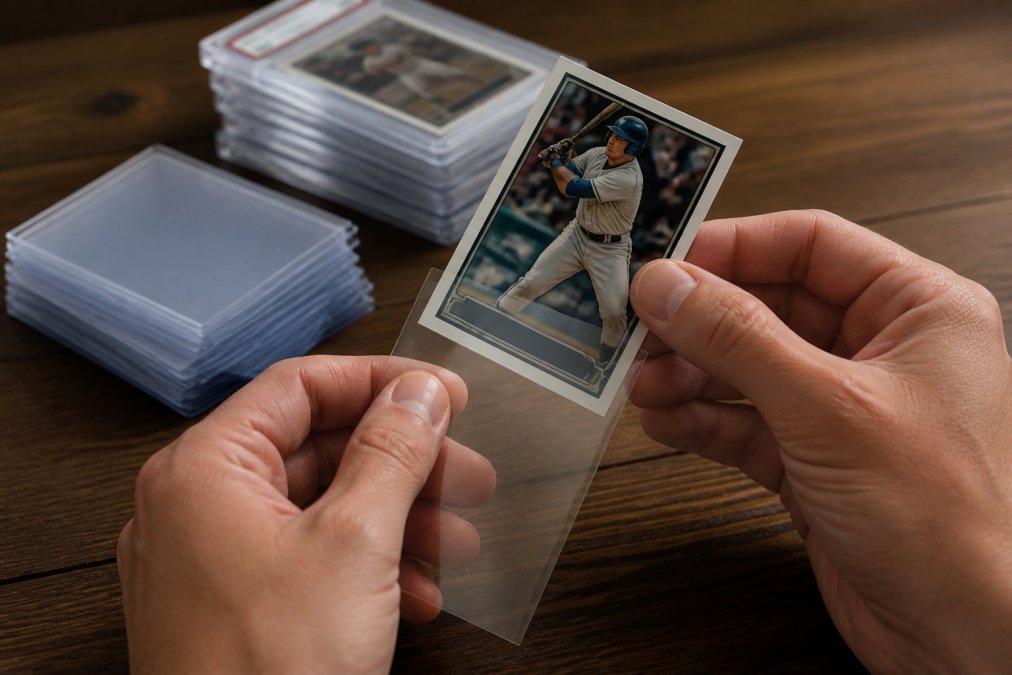
Penny Sleeves, Toploaders, and Semi-Rigid Holders Compared
Each layer solves a different problem. Penny sleeves prevent surface scratches, toploaders stop bending, and semi-rigid holders give you a middle ground that's popular for shipping cards to grading services.
| Method | Best For | Protection Level | Reusable |
|---|---|---|---|
| Penny sleeve | Raw singles, inner layer | Scratch prevention | Yes |
| Toploader | Display and shipping | Rigid bend protection | Yes |
| Semi-rigid holder | Grading submissions | Flexible rigidity | Limited |
| Magnetic case | High-end display | Premium rigidity | Yes |
For most collectors, a combo pack covers both needs. Cardboard Superstars offers a 200 Count Card Sleeve and Toploader Combo Pack at $24.99, plus a 100 Count version at $12.99 for smaller collections. If you only need rigid holders, the 3x4 Topload Card Holder by BCW runs $3.25, and the BCW Semi-Rigid Card Holder #1 at $11.99 is a solid pick for submissions.


How to Store Trading Cards to Prevent Humidity Damage
To store trading cards to prevent humidity damage, keep them in a stable, dry environment and use desiccants inside sealed storage boxes. Humidity is the quietest threat to a collection because damage builds slowly and often shows up as warping or foxing long after the cause.
Desiccants, Storage Boxes, and Climate Control Specifics
Aim for a consistent indoor range rather than chasing a perfect number. Rapid swings do more harm than a steady, slightly imperfect level. Use these steps:
- Store cards in acid-free, PVC-free boxes and binder pages.
- Add silica gel desiccant packets to each storage box and replace them on a schedule.
- Keep boxes off basement and garage floors where moisture collects.
- Monitor with a cheap hygrometer and log readings monthly.
UV Protection for Trading Cards: Blocking Light Damage Before It Starts
UV protection for trading cards means controlling both the intensity and the spectrum of light that reaches the card surface. Ultraviolet radiation breaks the chemical bonds in inks and paper coatings, and the damage is cumulative and irreversible, a card does not recover when you move it out of the light. Fading, yellowing, and brittleness are the visible results, and they show up first on the most valuable cards because those are the ones collectors tend to display.
Which Light Sources Actually Cause Damage
Not all light is equal. Ranked from most to least damaging for a displayed collection:
- Direct sunlight through a window, the worst case, because it combines high UV output with heat that accelerates the chemical reaction.
- Indirect daylight, still carries meaningful UV even when the card is not in a sunbeam.
- Fluorescent tubes, emit UV as a byproduct of how they generate light, so an office or basement display can fade a card over years.
- LED and incandescent bulbs, the lowest UV output of common household lighting, which is why most practitioners move display lighting to LED.
Materials and Ratings to Look For
When you buy a display case, binder, or sleeve, the useful spec is the UV-blocking percentage, not the word 'archival' on the label. Common ranges you will see:
- Standard clear acrylic and glass: minimal UV blocking on their own.
- UV-filtering acrylic or glass: typically rated in the 98-99% UV-blocking range, which is the practical target for a display case (loc.gov).
- UV-filtering binder pages and sleeves: lower blocking than a case, but useful as an extra layer for cards stored on a shelf.
A display case rated for UV filtering is the single highest-leverage purchase if you keep cards out. Pair it with LED lighting in the room and keep the case out of any path of direct sun.
A Display Rotation Schedule
Even with good materials, the safest approach for high-value cards is to limit exposure time. A common pattern is to rotate displayed cards every 60-90 days, returning the previous card to dark, acid-free storage. Keep a simple log of which card was out and for how long so you can spot any card that has been exposed longer than intended.
UV Protection for Slabbed Cards
A graded slab is not UV protection. The plastic holder protects against handling and bending, but standard slab material does not block UV, and the card inside is still exposed to light through the front and back. If you display graded slabs, put them in a UV-filtering case or a cabinet with UV-filtering glass, and treat the slab as a handling layer rather than a light barrier.
Grading, Encapsulation, and Grading Service Nuances
Grading and encapsulation seal a card in a tamper-evident slab with a certified grade, which locks in condition at a point in time and often increases value. The nuance most collectors miss is that raw cards and slabbed cards have different protection needs, and treating them the same is how people damage both.
Raw Cards vs. Slabbed Cards: Different Problems, Different Solutions
A raw card's threats are physical and environmental: scratches, corner wear, edge whitening, bending, humidity, and UV. A slabbed card's threats are different:
- The card inside is largely protected from handling, you cannot accidentally crease it through the slab.
- The slab itself becomes the vulnerable object, scratches, scuffs, and cracks on the holder hurt resale even when the card is pristine.
- Environmental threats still apply, a slab does not stop humidity, heat, or UV from reaching the card through the plastic.
- The certification label matters, a damaged or faded label can raise authenticity questions and complicate a sale.
So the protection plan splits: raw cards get the sleeve-and-holder layering treatment, while slabs get their own handling and storage discipline.
Handling and Storing Slabs
- Handle slabs by the edges only. Fingerprints and oils on the face are hard to remove without risking the surface.
- Store slabs upright, on edge, in a box sized for them. Stacking slabs flat puts pressure on the holder and can lead to scratches and, over time, warping.
- Never stack heavy boxes on top of slabs. The holder is rigid, but it is not load-bearing.
- Keep slabs out of hot cars and attics. Heat can soften the holder and, in extreme cases, affect the card inside.
- Use a slab sleeve or bag for slabs you handle often. It is a cheap sacrificial layer that takes the scuffs instead of the holder.
When Grading Is Worth It, and When It Is Not
Grade when the expected value jump from a certified grade clearly outweighs the submission cost, shipping, insurance, and wait time. A common pattern is to grade cards where the difference between a mid-grade and a high-grade example is large enough to matter, and to leave low-value cards raw. For high-value raw cards, consider a semi-rigid holder for submission rather than a toploader, since many grading services prefer that format and it reduces handling risk in transit.
Protecting the Grade After It Comes Back
The grade is only as good as the slab's condition. A cracked or heavily scratched holder can undermine the certified grade in a buyer's eyes, and reholdering through the grading service costs money and time. Treat the slab as a high-value object in its own right: store it upright, keep it out of UV, and document the certification number in your inventory so you can match the slab to your records if it is ever lost or stolen.
How professional grading services evaluate and encapsulate cards
Insurance, Security, and Inventory Management for Serious Collections
Insurance, security, and inventory management turn a collection into a managed asset. Most standard homeowner policies cap collectibles coverage, so serious collectors often add a rider or a dedicated collectibles policy. Before you can insure a collection, you need to document it.
Build an inventory with these details for every high-value card:
- Card name, set, year, and card number
- Condition or grade, plus slab certification number
- Purchase date and price paid
- Current estimated value with a source date
- Clear photos of the front, back, and any flaws
For security, store the most valuable cards in a locked, fire-resistant safe, keep the inventory list in cloud storage, and avoid posting real-time photos that reveal your storage setup. Inventory management also pays off at tax time and when filing a claim.
If you want a single supply that covers both raw and displayed cards, Cardboard Superstars stocks a 9-Pocket Plastic Sheets 100 Pack at $48.06, made from PVC-free material with strong welds that fit standard 3-ring binders.
Frequently Asked Questions
Should I use penny sleeves or toploaders for high value cards?
Use both. A penny sleeve prevents surface scratches and micro-scratches, while a toploader adds rigid protection against bends and corner wear. For cards worth hundreds or thousands, layer the two: sleeve first, then toploader. For graded cards, keep the slab as-is and add a slab sleeve if you handle it often. A combo pack like the 200 Count Card Sleeve and Toploader Combo Pack covers most raw singles.
How do I prevent humidity damage in my card collection?
Keep humidity between 35% and 50% using a hygrometer, and store cards in acid-free, PVC-free boxes with silica desiccant packs. Avoid basements and attics where swings are extreme. For how to store trading cards to prevent humidity damage, the key is stability: gradual changes are safer than sudden spikes. Rotate desiccant every 2-3 months and check for warping or foxing on card stock.
What is the best way to protect trading cards from UV damage?
UV protection for trading cards means blocking sunlight and fluorescent light. Store binders and boxes in a dark cabinet, use UV-filtering binder pages or display cases, and never leave slabs on a sunny shelf. Even indirect sunlight fades ink over months. If you display cards, rotate them and keep the display away from windows. UV damage is permanent and drops a near mint card to a lower grade fast.
Is it better to store cards in binders or individual hard cases?
It depends on value and access. Binders with PVC-free pages work for mid-value sets you flip through often, but pages can cause surface wear over years. High-value cards belong in rigid holders: toploaders, semi-rigid holders, or graded slabs. Many collectors use both: binders for the bulk of a set, hard cases for the top 20 cards. The 9-Pocket Plastic Sheets- 100 Pack is PVC-free and fits standard binders.
How do I safely store a collection worth thousands of dollars?
Use a layered approach: penny sleeves and toploaders for raw cards, graded slabs for key pieces, and a fire-resistant safe or locked cabinet for the top tier. Control humidity with desiccant and a hygrometer, keep everything out of sunlight, and document the collection with photos and receipts for insurance. Inventory management matters too: log cert numbers for graded cards and review values annually so your coverage keeps pace.
Do graded cards need extra protection beyond the slab?
Yes. Slabs protect the card but can scratch, crack, or fog over time. Store slabs upright in a case designed for them, avoid stacking heavy items on top, and keep them away from heat. Some collectors add slab sleeves or bags to reduce scuffs on the plastic. If a slab cracks, do not open it; contact the grading service for reholdering to preserve authentication and value retention.
Protecting high value trading card collections comes down to consistency: the right sleeves, a dry and dark storage spot, and documentation you actually maintain. Cardboard Superstars makes that easier with collector-grade supplies, authentic products, secure packaging, and clear product details before checkout, backed by 100% positive eBay feedback and more than 4,600 items sold. Browse the shop and find cards with confidence, knowing your collection is protected from the moment it arrives.