


Last Updated: October 30, 2026
Quick Summary
To ship high value cards safely, sleeve the card, seal it in a rigid toploader with painter's tape, sandwich it between cardboard, and send it in a padded box rather than an envelope. Declare the full value, choose a service whose coverage cap fits, and photograph every packing stage.
- A penny sleeve is the first layer of protection and never the only layer.
- Seal the toploader opening with painter's tape, never packing tape on the card.
- Use a shipping box with padding for high-value cards, graded slabs, and multiple cards.
- Wrap graded slabs in bubble wrap and fill all empty space so they cannot move.
- Tracking proves a package moved but does not guarantee an insurance payout.
Table of Contents
- Why Shipping High Value Trading Cards Safely Matters
- Gather Your Trading Card Shipping Supplies Before You Pack
- How to Package Trading Cards for Shipping: A Step-by-Step Walkthrough
- Choosing the Right Outer Packaging: Envelope, Bubble Mailer, or Box
- The Best Way to Ship Graded Cards and Slabs
- How to Insure Trading Cards When Shipping for Full Coverage
- Documenting Your Shipment Before It Leaves Your Hands
- Find Cards and Collector-Grade Supplies at Cardboard Superstars
- Frequently Asked Questions
Why Shipping High Value Trading Cards Safely Matters
A single crease can turn a mint card into a mid-grade one, and that drop in condition can wipe out most of its resale value. That's why knowing how to ship high value cards safely is a skill every collector and seller needs.
The stakes are simple: condition is value. A card that arrives bent, dinged, or warped is worth less than the same card that arrives flat and clean. Buyers know this.
The Three Threats: Bending, Corner Damage, and Moisture
Three things ruin cards in transit, and each needs its own defense.
- Bending comes from pressure and flex. A card packed loose in a flimsy envelope will bow under the weight of stacked mail.
- Corner damage happens when a card shifts and its edges hit the packaging. One crushed corner can kill a grade.
- Moisture warps cards and can stain or delaminate them. Rain, humidity, and damp mail rooms all pose a risk. For a deeper look, read the guide to protecting cards from humidity.
Gather Your Trading Card Shipping Supplies Before You Pack
Packing goes faster when everything sits on the desk before you start. A common mistake is hunting for tape mid-pack and rushing the final seal. Lay out your supplies first, then work through the steps.
Here's the core list:
- Penny sleeves for the first layer of scratch protection
- Rigid holders (toploaders or semi-rigid card savers)
- Cardboard backing or rigid cardstock
Sleeves, Toploaders, and Semi-Rigid Holders
A penny sleeve is a thin, soft plastic sleeve that protects a card's surface from scratches and dust. If you're choosing sleeves for valuable cards, compare the best protective sleeves for rare trading cards.
A toploader is a rigid plastic holder that keeps a card flat and resists bending. It's the standard for shipping single cards. A semi-rigid card saver is a flexible holder with firm structure, often used for grading submissions and lower-bulk shipping.
Match the holder to the card:
| Card Type | First Layer | Second Layer | Outer Layer |
|---|---|---|---|
| Low-value single | Penny sleeve | Semi-rigid saver | Envelope or mailer |
| Mid-value single | Penny sleeve | 35pt toploader | Bubble mailer |
| High-value single | Penny sleeve | Toploader, taped shut | Box with padding |
| Small stack | Penny sleeves | Team bag | Bubble mailer |
Two supply packs make this easy. The Rip & Protect Bundle includes 200 clear penny sleeves and 200 semi-rigid card savers for everyday protection and submissions. The Team Leader Supply Pack includes 100 standard 35pt toploaders and 100 card sleeves for standard-size cards.


How to Package Trading Cards for Shipping: A Step-by-Step Walkthrough
Here is a process for packaging high value cards for shipping.
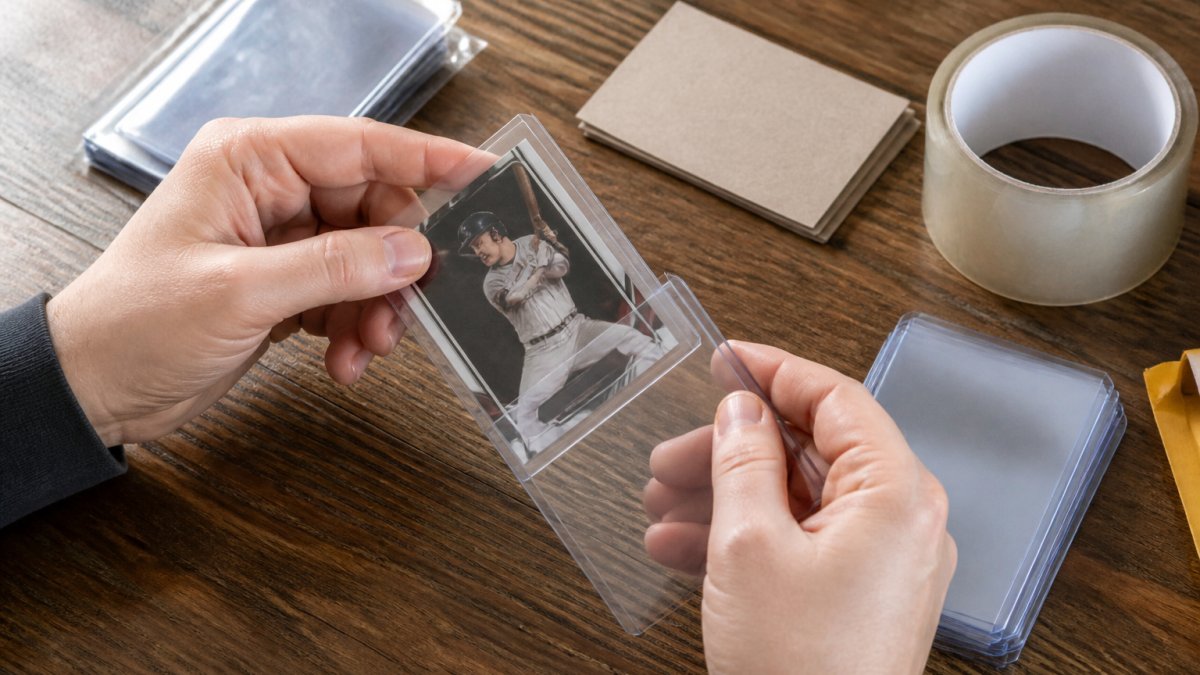
Step 1: Sleeve the Card
Hold the card by its edges and slide it into a clean penny sleeve. Push it all the way down so the sleeve covers the full surface. Never touch the face of a raw card with bare fingers, since oils can leave marks that show up under a grading light.
Step 2: Add Rigid Protection and Seal It
Place the sleeved card into a toploader or semi-rigid saver. Then seal the top opening with a small strip of painter's tape. Tape the holder, not the card. This stops the card from sliding out during transit.
Watch out: never use packing tape directly on a toploader opening and never tape a card inside a sleeve. Standard tape leaves residue and can tear the sleeve on removal.
Step 3: Sandwich with Cardboard and Immobilize
Cut two pieces of rigid cardboard slightly larger than the holder. Place one on each side to form a sandwich. Tape the edges so the card cannot shift. The goal is a package that feels solid in your hand with zero movement inside.
Choosing the Right Outer Packaging: Envelope, Bubble Mailer, or Box
The outer layer should match the card's value and the distance it travels. Cheaper packaging is fine for cheap cards. It is a false economy for expensive ones.
- Plain envelope: Only for low-value cards inside a rigid holder. No padding, so it offers the least protection.
- Bubble mailer: The workhorse for single cards and small stacks. The bubble layer absorbs impact and keeps the rigid sandwich from flexing.
- Shipping box: Best for high-value cards, graded slabs, and multiple cards. Add padding so nothing rattles.
For anything you'd hate to see damaged, use a box. A bubble mailer protects against drops. A box protects against drops, stacking, and crushing.
The Best Way to Ship Graded Cards and Slabs
Graded cards need different handling because the slab is rigid but the case can crack. The best way to ship graded cards is to wrap the slab in bubble wrap, place it in a snug box, and fill all empty space so the slab cannot move.
A few rules we follow:
Team Leader Supply Pack – 100 35pt Toploaders + 100 Sleeves →
- Never ship a slab in a plain envelope, no matter how well it's wrapped.
- Fill gaps with packing paper or air pillows so the slab sits tight.
- Seal the box on all seams with packing tape.
A cracked slab can mean a regrade, and a regrade can come back lower. Treat the case as part of the card's value.
How to Insure Trading Cards When Shipping for Full Coverage
Insurance coverage depends on the service and the value you can document. Declare the item's value accurately, choose a service whose coverage limit fits that value, and keep photos and receipts that support it.
Declared Value Is Not the Same as Payout
Declared value is the number you tell the carrier the item is worth. Coverage is tied to it, but three things usually shrink the check:
- Service caps. Many services cap coverage well below the card's value, and some cap it at a flat amount unless you buy additional coverage. A card worth more than the cap needs a service tier that actually covers it.
- Exclusions. Carriers commonly exclude or limit coverage for prohibited items, improper packaging, and items shipped in a plain envelope. A high-value card sent in an envelope can be effectively uninsured no matter what you declared.
- Proof of value. Carriers generally want evidence of what the card was worth, a sale receipt, an invoice, or documented market comparables. A declared number with nothing behind it is easy to dispute.
Check the current limits and eligible services with the United States Postal Service and the other carriers you use before you ship, because caps and rules change.
Match the Service to the Card's Value
A practical way to think about it:
- Low-value cards: standard tracked service is enough; coverage is a nice-to-have.
- Mid-value cards: use a service with tracking plus meaningful included coverage, and buy up if the card exceeds the cap.
- High-value cards: use the carrier's premium service with signature and the highest coverage you can buy, and consider a third-party collectibles policy if the carrier cap can't reach the card's value.
What a Claim Usually Requires
When something goes wrong, carriers typically ask for the same core set of evidence:
- The tracking number and proof of mailing
- Photos of the card before packing and of the packaging stages
- Proof of value (receipt, invoice, or documented comparables)
File promptly, claim windows are limited and vary by carrier and service. The USPS claims process and the equivalent pages from other carriers spell out the forms and deadlines. Keep every photo and receipt with the tracking number so a claim is a paperwork exercise, not an argument.
Documenting Your Shipment Before It Leaves Your Hands
Photos are your evidence if a claim or a dispute ever happens, and they do double duty: they prove condition at packing and they support your side if a buyer claims the package never arrived or arrived damaged. Document the card and every packaging stage, keep the photos with the tracking number, and pair that record with value-based delivery safeguards.
The Photo Sequence That Holds Up
Before sealing the outer package, photograph in this order:
- The raw card, front and back, in good light, with any visible flaws shown honestly
- The card inside its sleeve and holder
- The finished sandwich or wrapped slab
Keep the images in a folder named for the tracking number. If a buyer disputes condition, you have a timestamped record of what left your hands. For carrier claims, the USPS claims process and similar pages from other carriers explain what proof they ask for.
Tracking, Signature Confirmation, and Delivery Security
Documentation is only half the defense. The other half is controlling how the package is delivered:
- Tracking on every shipment, no exceptions. Check it daily on high-value orders and follow up the moment a scan stalls.
- Signature confirmation for cards above a threshold you set for yourself. A signature creates a delivery record and reduces disputed-delivery risk.
- Adult signature for the most expensive items, where you want a person of legal age to take possession.
Reducing Porch Theft and Disputed-Delivery Risk
Porch theft and 'never arrived' disputes are the two delivery problems that documentation alone won't solve. A few habits help:
- Ship to the address on the order and never reroute at a buyer's request without written confirmation.
- Require signature on high-value orders so the carrier records who accepted the package.
- Encourage buyers to use a secure delivery location or pickup point.
The Federal Trade Commission's guidance on shipping and delivery is a useful reference for sellers on delivery promises and buyer expectations.
Find Cards and Collector-Grade Supplies at Cardboard Superstars
Packing a card well is a habit, and the right supplies make it easy. Cardboard Superstars carries the sleeves, toploaders, and card savers that protect your cards from pack to mailbox. Every order ships in secure, collector-grade packaging, and our listings show clear condition details before you check out.
Start with a supply pack so you're never caught short before a shipment. Get started with Cardboard Superstars and find cards and supplies that arrive exactly as described.
Frequently Asked Questions
Should you ship an expensive trading card in a bubble mailer or a box?
A bubble mailer works for most single high-value cards when the card is sleeved, placed in a rigid holder, sandwiched between cardboard, and sealed inside a team bag. Choose a small shipping box instead when you are sending multiple cards, a graded slab, or a card worth several hundred dollars. The box resists bending and crushing better than any envelope. Whichever you pick, the card inside should not move when you shake the package.
How do you protect a graded card during shipping?
Graded cards need protection around the slab, not just the card. Wrap the slab in bubble wrap so the corners are cushioned, then place it in a box with padding on all six sides. Do not put a slab in a standard toploader or a plain envelope. The best way to ship graded cards is a rigid box with the slab immobilized, tracking on the label, and signature confirmation once the value climbs high enough to justify it.
Should you insure a valuable trading card shipment?
Insure any card whose replacement cost you could not absorb without real pain. Declared value coverage through the carrier typically costs a small amount relative to the card's worth, and it protects you if the package is lost or damaged in transit. Keep your receipt, photos of the packed item, and the tracking number. If a claim is needed, that documentation is what the carrier asks for first.
How do you prevent a trading card from moving inside its package?
Immobilize the card at every layer. Seal the sleeved card inside a team bag, tape the rigid holder to a cardboard sandwich so it cannot slide, and fill any remaining space in the mailer or box with bubble wrap or packing paper. Test it by shaking the package gently before you seal the outer flap. If you hear or feel movement, add more padding. A card that shifts in transit is a card that arrives with corner damage.
