


Table of Contents
- What Graded Pokémon Cards Are and Why They Matter
- Graded vs Ungraded Pokémon Cards: The Core Difference
- How Much Does Pokémon Card Grading Cost
- How Grades Directly Impact Card Value and Resale Price
- How to Compare Pokémon Card Sold Prices Across Grades
- When to Grade a Pokémon Card: A Cost-Benefit Calculation
- Buyer Confidence, Market Demand, and Why Grading Commands a Premium
- Frequently Asked Questions
Last Updated: October 6, 2026
What Graded Pokémon Cards Are and Why They Matter
A graded Pokémon card is a trading card professionally evaluated, authenticated, and encased in a protective slab by a third-party grading company, with graded pokemon cards now representing the standard for serious collectors and investors.
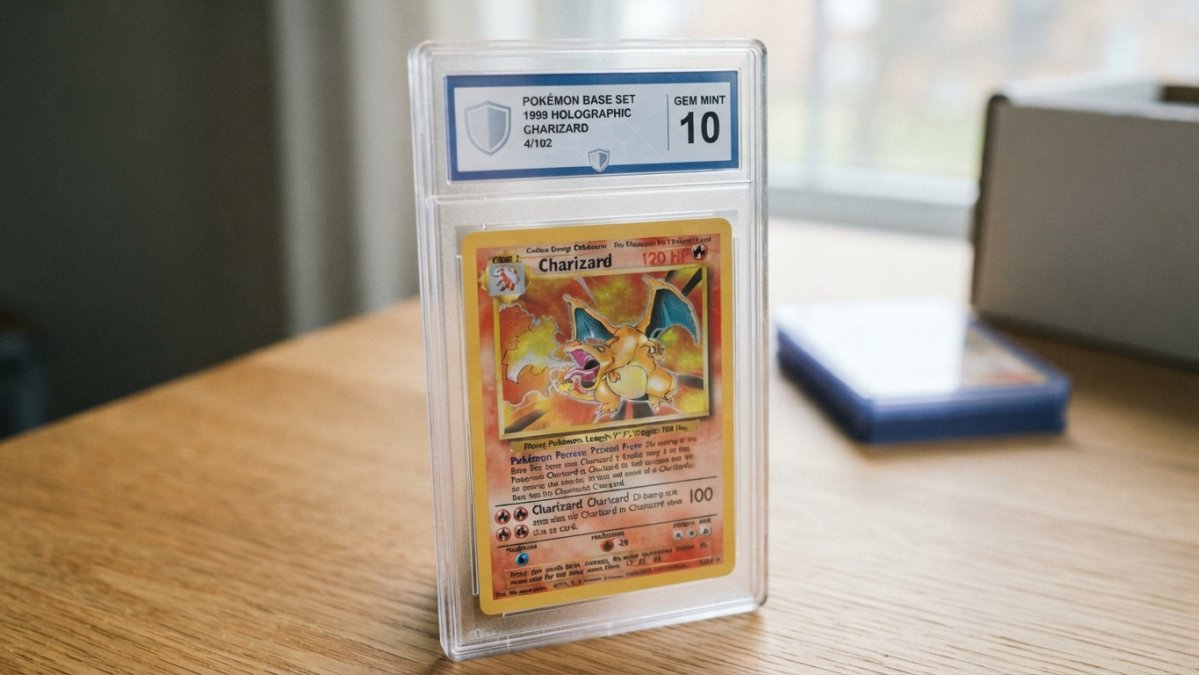
The slab protects the card from damage and verifies it is authentic and in the stated condition. Without grading, buyers can't verify condition or spot counterfeits; with grading, the slab becomes a trusted seal.
Grading companies evaluate four factors: centering, corners, edges, and surface. Sharp corners, perfect centering, and a flawless surface earn a 9 or 10; visible wear lowers the grade.
The scale is universal across most professional services. A PSA 10 or CGC 10 means gem mint. A PSA 9 or CGC 9 means mint with minor imperfections visible only under close inspection.
At Cardboard Superstars, we understand collectors need this clarity. With a graded card, the slab tells you exactly what you're getting, no surprises, no guesswork.
Graded vs Ungraded Pokémon Cards: The Core Difference
The difference between a graded card and an ungraded (raw) card comes down to trust and marketability. A raw card has no third-party assessment, relying entirely on the seller's description and the buyer's judgment.
Graded cards command higher prices because buyers know exactly what they're getting. A PSA 9 Charizard is near-mint and not counterfeit, certainty with real market value.
Raw cards are cheaper but riskier. A seller might call a card "near mint" when it has visible wear, photos can mislead, and counterfeits are hard to spot. Most serious collectors avoid raw cards for valuable Pokémon cards because the risk isn't worth the savings.
The resale market reflects this gap: graded cards sell faster and for more money because more buyers trust them.
How Much Does Pokémon Card Grading Cost
Grading fees vary by declared value and turnaround time, and most companies offer multiple service levels.
Standard turnaround (30-60 days) typically costs $10 to $50 per card. Express (7-14 days) runs $50 to $150. Rush (1-3 days) can exceed $200.
A card worth $100 to $500 might cost $20 to $50 to grade. For cards worth $1,000 or more, fees scale up but stay a small percentage of value, a $5,000 card might cost $100 to $200, or 2-4%.
The key question is whether the fee makes financial sense. A $50 raw card with a $30 grading fee spends 60% of its value on a service that might only add 10-20%, a bad trade. A $500 raw card with a $40 fee spends under 10% to potentially add 50% or more.
How Grades Directly Impact Card Value and Resale Price
The relationship between grade and price is a curve: flat at the bottom, climbing through the middle grades, then spiking sharply at the top.
Think of it in tiers:
- Raw to mid-grade (roughly PSA 5-7): The premium is usually modest. A card with visible edge wear or a soft corner may only gain 20-60% over its raw price, and sometimes less once you subtract the grading fee. Binder and player-collection buyers aren't paying much for condition certainty.
- Mid-grade to high-grade (roughly PSA 8-9): This is where the premium becomes meaningful. A PSA 8 typically sells for a clear multiple of the raw price, and a PSA 9 can sell for two to four times the PSA 8 price on popular, in-demand cards. The jump from 8 to 9 is often the largest percentage move in the entire scale.
- High-grade to gem mint (PSA 10): The premium here is driven almost entirely by scarcity. On many vintage cards, a PSA 10 can sell for five to twenty times the PSA 9 price, and on a few iconic cards the multiple is larger still. On modern cards with huge print runs, the PSA 10 premium over a PSA 9 is often much smaller because so many copies grade gem mint.
A concrete pattern: a raw popular vintage card might sell in the low hundreds, a mid-grade slab roughly double that, a high-grade example several times the mid-grade price, and a gem mint many times the high-grade price.
Two forces explain the sharp bend at the top.
First, condition scarcity. Population reports show how many copies exist at each grade.
Population also changes over time. Every submission adds to the count, so a card that looked scarce two years ago may have tripled its top-grade population, compressing the premium, a common surprise for collectors who buy a low-pop card at a premium.
Grade is the primary price driver within a single card, printing, and release, but not across different cards.
How to Compare Pokémon Card Sold Prices Across Grades
Comparing sold prices across grades requires actual sales data, not asking prices. Many cards sit with inflated prices; sold prices tell the real story.
Online marketplaces and auction sites show completed sales. A card listed at $500 might not sell, but if the same card sold for $350 last week, that's the real market price. Track sold prices across grades to see the premium structure.
For example, three sales of the same Pokémon card:
- Raw condition: sold for $120
- PSA 8: sold for $280
- PSA 9: sold for $550
Grading added significant value: the jump from raw to PSA 8 is more than double, and PSA 8 to PSA 9 is nearly double again. This pattern is typical for popular, valuable cards.
Drake Maye 2024 Topps Chrome 1974 Throwback Pink Refractor RC #197 — CGC 10 →
Condition isn't the only factor, age, rarity, and current demand matter too. A 1999 first-edition card commands higher prices than a 2020 card in the same grade. But within the same release and printing, grade is the primary price driver.
When to Grade a Pokémon Card: A Cost-Benefit Calculation
Most articles say "do the math" without showing it. Here is the calculation.
The decision isn't "does grading increase value?", it almost always does on paper.
Step 1: Establish the raw baseline. Find recent completed sales of your exact card in raw condition, not asking prices.
Step 2: Estimate the likely grade. Be honest, most raw cards that look "near mint" to an owner grade lower.
Step 4: Add up every cost. Most people undercount here. The all-in cost of grading one card includes:
- The grading fee for the service tier you choose
- Outbound shipping to the grading company, with tracking and signature
- Return shipping, which is often billed separately
- Insurance on the declared value in both directions
- Any handling or submission fees
- Selling fees if you plan to sell, which on major marketplaces commonly run in the low-to-mid teens as a percentage of the sale price
- Payment processing fees, if they are separate
- Your time, which is real even if it is not on a receipt
Step 5: Compare net proceeds. Take the expected graded sold price, subtract selling and payment fees, then subtract the all-in grading cost.
Grade only when the expected net gain justifies the risk of a lower grade.
When the math usually works:
- The card is vintage or from a limited printing with steady, documented sold volume
- The raw card is already worth several hundred dollars or more
- The card has a realistic shot at a high grade, not just a hopeful one
- You plan to hold for years, so the preservation value of the slab compounds alongside any price gain
- The all-in grading cost is a small fraction of the expected graded value
When the math usually fails:
- The card is common, recent, or from a large print run
- The raw card is worth less than a few multiples of the grading fee
- The card has visible wear that caps the likely grade
- Sold volume at the expected grade is thin, so the price you see is not a price you can reliably get
- You need to sell quickly, because grading turnaround adds weeks or months before you see a dollar
The volatility factor. Graded card prices move.
The preservation angle. For long-term holders, the slab freezes condition. A raw card handled over years accumulates wear; a slabbed card does not.
Buyer Confidence, Market Demand, and Why Grading Commands a Premium
Grading commands a premium because it solves buyer uncertainty.
Graded cards eliminate that risk, the slab is a guarantee, and buyers pay more for certainty, especially on cards worth hundreds or thousands.
Market demand reflects this trust: graded cards sell faster, attract more bidders, and command higher prices.
Authentication is another critical factor. Counterfeit Pokémon cards exist, and some fakes fool casual buyers.
The grading company's reputation matters too.
At Cardboard Superstars, we understand collectors value authenticity and condition certainty. When you buy a graded card from us, you're buying confidence.
The real reason graded pokemon cards cost more is simple: they solve problems raw cards create.
Ready to find graded cards you can trust? Cardboard Superstars offers a curated selection of authenticated graded cards with full condition details and secure packaging.
Frequently Asked Questions
Are Pokémon cards worth more if graded?
Yes. Graded Pokémon cards typically sell for significantly more than raw cards of the same age and condition. The grade itself, determined by professional grading services, signals authenticity and precise condition to buyers, reducing uncertainty. A high-grade graded card can command a 50% to 300% price premium over an ungraded version, depending on the card's rarity and demand. The premium reflects buyer confidence in the card's authenticity and long-term preservation.
How much does it cost to get a Pokémon card graded?
Grading costs vary by service and turnaround time. Standard submissions typically range from $10 to $50 per card, with faster turnaround times (24-48 hours) costing more. Economy options may be $5-$15 per card but involve longer wait times. For high-value cards, the grading fee is often justified by the price premium the grade adds. Calculate whether the expected resale increase exceeds the grading fee plus return shipping before submitting.
Does a PSA 10 Pokémon card always sell for more than a PSA 9?
Not always. While PSA 10 (Gem Mint) cards typically command higher prices than PSA 9 (Mint) cards, the exact premium depends on the card's rarity, demand, and market conditions. A low-population PSA 9 rare card may outvalue a high-population PSA 10 common card. Population reports matter: fewer graded examples of a card increase scarcity value. Always compare sold prices for the specific card and grade combination rather than assuming a single grade difference guarantees a higher price.
When should I grade a Pokémon card?
Grade a card if its estimated value after grading exceeds the grading cost plus return shipping. High-grade vintage cards, rare first editions, and cards in PSA 8 or higher condition are typically worth grading. Leave raw cards that are common, low-grade, or worth less than $50. Consider grading if you plan to sell soon, buyers pay premiums for authenticated grades. For long-term collection building, grading provides protection and preservation but may not be necessary if the card stays in your hands.