


Table of Contents
- Why Cleaning Graded Card Slabs Matters
- What You'll Need Before You Start
- Removing Dust and Smudges from Your Slab Surface
- How to Remove Fingerprints from a Card Slab
- Best Cleaner for PSA Slabs and Other Graded Cards
- How to Remove Scratches from Graded Card Slabs
- Common Mistakes to Avoid When Cleaning Slabs
- Prevention and Long-Term Storage
- Frequently Asked Questions
Last Updated: October 21, 2026
Why Cleaning Graded Card Slabs Matters
A graded card slab protects your investment, but clean graded card slabs require regular maintenance as the plastic case accumulates dust, fingerprints, and smudges that obscure the card inside.
A dirty slab distracts from the card and can make even a high-grade card look less impressive on the shelf.
Regular maintenance also prevents buildup that could eventually scratch the plastic. The sooner you address dust and smudges, the less aggressive your cleaning method needs to be.
What You'll Need Before You Start
Essential supplies for safe slab cleaning
Gather these items before you begin so you don't rush or grab whatever is nearby.
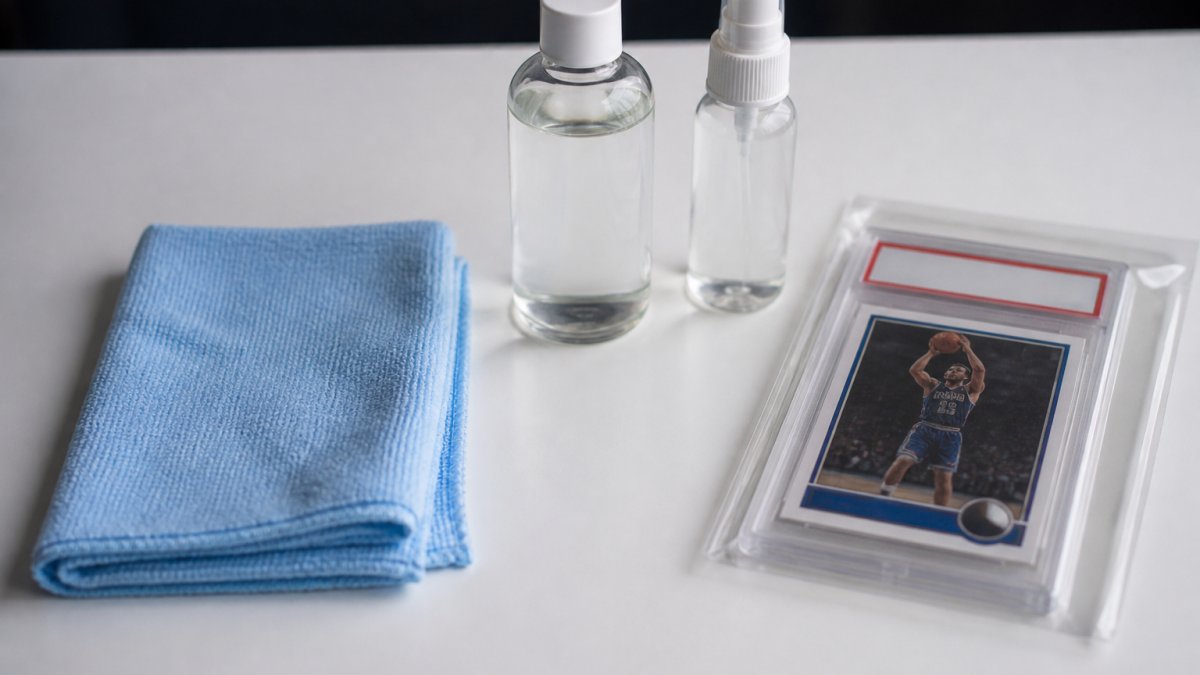
A microfiber cloth is non-negotiable. It won't scratch plastic the way paper towels or regular cloths will, and it grabs dust and oils without leaving lint.
For liquid cleaning, use isopropyl alcohol (70% is standard) or eyeglass cleaner.
Water works for light dust, but use it sparingly. A small amount on a damp cloth, not wet, prevents water spots and mineral buildup.
What to avoid
Never use paper towels, tissues, or rough cloths. These shed fibers and can scratch the plastic surface.
Avoid window spray, furniture polish, and abrasive solvents, which can degrade plastic or leave streaks harder to remove than the original dirt.
Don't use acetone, nail polish remover, or any solvent stronger than isopropyl alcohol. These dissolve or damage the slab material.
Skip compressed air: the pressure can force dust into crevices and potentially damage the card inside.
Removing Dust and Smudges from Your Slab Surface
Dust and light smudges are the most common issues and the easiest to fix.
Lay the slab on a clean, flat surface and tilt it toward a light. Dust often hides in corners and along the seams.
Use a dry microfiber cloth first, in gentle circular motions. This step alone solves the problem for many slabs.
For stubborn smudges, dampen the microfiber cloth slightly with water, just enough that it feels cool.
If water leaves spots, buff them away immediately with a second dry microfiber cloth to prevent mineral deposits.
How to Remove Fingerprints from a Card Slab
Fingerprints are oils and won't come off with water alone.
Isopropyl alcohol or eyeglass cleaner breaks down the oils fingerprints leave behind.
Apply a small amount to your microfiber cloth, never directly to the slab. A lightly dampened cloth is all you need.
Wipe gently in small circular motions; the oils should lift within seconds, and a single pass is usually enough.
Finish by buffing with a dry microfiber cloth until completely dry.
For stubborn prints, let the cleaner sit on the cloth a few seconds before wiping.
Best Cleaner for PSA Slabs and Other Graded Cards
Graded slabs are not all the same plastic, and the label and sealed edge are part of what you're cleaning. The safest cleaner removes oils without attacking the plastic, printed label, or adhesive, so choose by material compatibility, not brand loyalty or whatever is under the sink.
What the slab is actually made of
Most slabs are clear rigid plastics like acrylic or polycarbonate, with a printed label sealed inside and an ultrasonic weld or adhesive seam around the perimeter. The face is what you see, but the seam and label are most easily damaged by liquid, a cleaner fine on the face can wick into a seam, stain a label, or soften adhesive if applied too wet.
The practical rule: clean the face, protect the seam, and never let liquid pool on the slab.
Isopropyl alcohol vs. eyeglass cleaner vs. water
Isopropyl alcohol (70%) is the most common choice for fingerprints and oily smudges. It evaporates quickly, breaks down skin oils, and leaves little residue on a microfiber cloth. Higher concentrations can leave streaks, so 70% is the practical default.
Eyeglass cleaner is gentler, often formulated for coated optical plastics with anti-static or surfactant ingredients.
Water is for dust and light grime only. Use it barely damp, never wet, and dry immediately, it's the least aggressive option but most likely to leave mineral spots if it sits.
Rip & Protect Bundle 200 Penny Sleeves, 200 Semi Rigid Card Savers →
A simple decision path:
- Dry dust first with a dry microfiber cloth.
- Light smudge: barely damp cloth with water.
- Fingerprint or oily film: 70% isopropyl alcohol on the cloth.
- Valuable or unfamiliar slab: eyeglass cleaner first, then step up only if needed.
Test on an inconspicuous area first
Before any cleaner touches the face, test it on the back or a bottom edge. Apply a small amount to a microfiber cloth, wipe the test area, and wait a few minutes.
If the test area looks unchanged after drying, proceed; if anything looks off, switch to a gentler option. This 30-second step is the best protection against cleaner-induced damage.
What not to use on a slab
Avoid acetone, nail polish remover, lacquer thinner, and any solvent stronger than isopropyl alcohol, these can dissolve or permanently cloud slab plastics. Skip window sprays, furniture polish, and abrasive cleansers, which leave streaks, residue, or fine scratches. Don't use paper towels or tissues, which shed fibers and micro-scratch the face, or compressed air, which can drive dust into seams and push debris toward the card.
How to Remove Scratches from Graded Card Slabs
Scratches are where most slab-cleaning advice goes wrong. Routine cleaning removes dirt; scratch work changes the plastic surface. Mixing the two is how collectors turn a minor mark into a cloudy panel. The realistic goal is to reduce the visibility of superficial marks, not restore a slab to factory condition.
Separate cleaning from scratch repair
Cleaning removes what's on the plastic; scratch repair alters the plastic itself. If a mark comes off with a dry or barely damp microfiber cloth, it was dirt, not a scratch. Before reaching for polish, clean the slab and re-inspect under a light, many marks that look like scratches are smudges or lint.
Grade the scratch before you touch it
Check under a bright light, tilting the slab at several angles:
- Surface haze or scuff: visible only at certain angles, does not catch a fingernail. Often the safest candidate for gentle polishing.
- Light scratch: a visible line that catches light but barely registers under a fingernail. Sometimes improves with careful polishing; sometimes only fades.
- Deep scratch or gouge: clearly felt with a fingernail, visible from multiple angles, or showing a white stress line. Polishing will not remove it and can make the surrounding area look worse.
If you can feel it with a fingernail, treat it as permanent. The plastic has been displaced, and no amount of buffing puts it back.
A conservative polishing procedure
If the mark is surface-level and you proceed:
- Clean the slab first and let it dry completely.
- Use a polish made for acrylic or polycarbonate plastics, not a general-purpose abrasive.
- Apply a small amount to a clean microfiber cloth, not to the slab.
- Buff the marked area in small circular motions with light pressure.
- Check progress every 20-30 seconds under a light.
- Wipe residue with a clean dry microfiber cloth and inspect again.
Work in short passes. The goal is to see whether the mark fades, not to scrub it away in one session.
When to stop
Stop immediately if:
- The area around the scratch starts to look cloudy or hazy.
- The scratch looks more visible than when you started.
- You see fine new scratches from the cloth or polish.
- You have made several short passes with no visible improvement.
A cloudy panel is worse than a single light scratch and usually permanent. If gentle polishing doesn't improve the mark within a few short passes, accept it or consider professional re-slabbing.
Re-slabbing versus living with it
The slab's job is to protect the card, not stay flawless. If a scratch tempts you toward aggressive polishing, weigh that risk against professional re-slabbing through the grading company, the only way to get a genuinely fresh case, but it costs money and time and is only worth it when the card's value justifies it. For most collectors, a slab with a few light surface marks still displays the grade clearly and protects the card.
Common Mistakes to Avoid When Cleaning Slabs
Using too much liquid is the most common error.
Cleaning too frequently accelerates wear, once every few months is plenty for slabs in normal display.
Mixing cleaners is risky, switching from isopropyl alcohol to eyeglass cleaner mid-clean can leave streaks or residue that's hard to remove.
Don't ignore the slab edges, where dust and grime accumulate at the seams.
Using the wrong cloth ruins the slab. Cotton, paper, and rough fabrics scratch plastic. Microfiber is the only safe choice.
Prevention and Long-Term Storage
The best cleaning is the one you never need.
Store graded cards in a cool, dry place. Humidity encourages dust and condensation.
Keep slabs in protective sleeves when not on display.

Handle slabs by their edges, never the face.
Dust your display monthly with a soft brush or microfiber cloth. Slabs that stay clean don't need aggressive cleaning later.
Store graded cards away from direct sunlight, UV exposure fades the card inside and yellows the plastic over time.
Keeping clean graded card slabs preserves the visual appeal and perceived condition of the cards inside.
Frequently Asked Questions
What can I use to clean a graded card slab?
Use a soft microfiber cloth with a small amount of water, isopropyl alcohol, or eyeglass cleaner. Test any liquid cleaner on a hidden area of the slab first. Never use abrasive materials, paper towels, or harsh chemicals. For routine dust removal, a dry microfiber cloth alone is safest. When cleaning graded card slabs, always apply minimal pressure and wipe gently to avoid damaging the plastic case or the card inside.
Can you use alcohol on a PSA slab or other graded card slabs?
Yes, isopropyl alcohol can be used on most PSA slabs and other graded card cases, but test it first on an inconspicuous corner. Use a small amount on a microfiber cloth, never apply liquid directly to the slab. Isopropyl alcohol evaporates quickly and is effective for fingerprints and light residue. However, avoid excessive wetting or repeated applications to the same spot, as this may damage the label or seals over time.
How do you remove fingerprints from a card slab?
Fingerprints on a card slab can be removed by gently wiping with a slightly dampened microfiber cloth using water or isopropyl alcohol. Apply light pressure in circular motions, working from the center outward. For stubborn prints, eyeglass cleaner is effective and safe for most plastic slabs. Always test on an edge first. Avoid pressing hard or scrubbing, as this can scratch the clear plastic and make the slab look worse than the fingerprints.
When should you not try to clean or repair a graded card slab?
Avoid cleaning if the slab shows deep scratches, cracks, or separation between the plastic layers. Do not attempt to polish out deep scratches, as this risks further damage to the case and card value. If the label is peeling, lifting, or damaged, do not clean that area. For cards graded PSA 10 or other high grades, the risk of downgrading often outweighs the benefit of cleaning. When in doubt, accept the slab's current condition or consult a professional grading service before attempting any cleaning.