


Table of Contents
- Do You Actually Need Inner Sleeves for Double Sleeving?
- What Inner Sleeves Do for Card Protection
- How to Double Sleeve Cards Without Damaging Them
- Perfect Fit vs. Standard Sleeves: Which Works Best
- Best Inner Sleeves for Trading Cards
- Do Double Sleeved Cards Fit in Deck Boxes?
- Common Mistakes to Avoid When Double Sleeving
- Frequently Asked Questions
Last Updated: September 25, 2026
Do You Actually Need Inner Sleeves for Double Sleeving?
Yes, inner sleeves are essential for inner sleeves double sleeving cards. They protect your cards from moisture and dust while preventing direct contact with outer sleeves that can cause wear. At Cardboard Superstars, we recommend inner sleeves as the foundation of any serious card protection strategy.
Inner sleeves double sleeving means placing a card in an inner sleeve first, then sliding that into an outer sleeve. The inner sleeve acts as a barrier, preventing direct contact with the outer sleeve's interior that can cause scratches and friction damage.
Without inner sleeves, direct contact with outer sleeves creates friction that causes tiny scratches, damaging card condition and resale value for graded or high-value cards.
The question isn't really whether you need inner sleeves. It's which type works best for your collection and card game.
What Inner Sleeves Do for Card Protection
Inner sleeves create a moisture barrier, reduce friction, and prevent marking, functions outer sleeves alone cannot provide.
Moisture protection: Inner sleeves block humidity and prevent warping and delamination in less-than-ideal storage conditions.
Friction reduction: Outer sleeves' textured interiors rub against cards during shuffling. Inner sleeves eliminate this contact, keeping cards pristine.
Dust blocking: Inner sleeves prevent dust particles from scratching card surfaces.
Marking prevention: Inner sleeves protect cards from marking caused by bent or creased outer sleeves.
For tournament play, inner sleeves prevent marking that could make cards illegal, as marked cards provide unfair advantages.
The best inner sleeves are acid-free and PVC-free.
How to Double Sleeve Cards Without Damaging Them
Double sleeving requires careful technique. Rushing or using force damages cards. The most critical, and most overlooked, step is proper air removal, which prevents the "puffy deck" problem and long-term card warping.
Understanding air entrapment: Trapped air in sleeves creates pressure pockets that warp cards over time, especially in humid conditions. A puffy deck also fails to fit standard deck boxes.
Step-by-step process:
Step 1: Gather your materials
- Inner sleeves (acid-free, PVC-free, perfect fit size)
- Outer sleeves (standard size)
- Deck box
- Clean, dry work surface
- Optional: card sleeving mat or rubber mat (provides grip without damaging sleeves)
Step 2: Inspect your card Look for existing damage before sleeving. If a card is already bent or creased, sleeving won't fix it. Document the condition. Damaged cards should be stored separately or in rigid toploaders, not in double sleeves.
Step 3: Slide the card into the inner sleeve Hold the inner sleeve vertically with the opening facing you. Slide the card in gently, top-first. The card should slide smoothly without resistance. If it's tight, you have the wrong size. Do not force, forcing bends the card and creases the sleeve, which then marks the card.
Step 4: Remove air from the inner sleeve (critical step) Hold the inner sleeve vertically and gently tap the bottom edge 3-4 times to force air toward the top. Use your thumb to press the back of the sleeve, pushing air out the opening. Rotate 90 degrees and repeat. The card should settle flat with no air gap.
Step 5: Slide the inner-sleeved card into the outer sleeve Hold the outer sleeve opening toward you. Slide the inner-sleeved card in gently, top-first. The card should fit without forcing. If the outer sleeve is too tight, you may have chosen standard sleeves that are too narrow for your perfect-fit inner sleeves, test compatibility before sleeving an entire deck.
Step 6: Remove air from the outer sleeve (equally critical) Repeat the air-removal process: tap the bottom edge 3-4 times, use your thumb to press the back, and rotate to repeat. A properly de-aired card should feel flat and compact.
Step 7: Stack and final check Place the sleeved card on a flat surface. Look at it from the side. If you see a visible gap between the inner and outer sleeves, air is still trapped. Repeat the air-removal process. This extra step prevents the "puffy deck" problem that makes cards impossible to fit in standard deck boxes.
Step 8: Store in your deck box Place sleeved cards in your deck box. Don't overstuff. Cramming cards creates pressure and bending. A standard deck box holds about 50-60 properly de-aired double-sleeved cards. If your deck is larger, use an oversized box.
Common mistakes to avoid:
- Forcing cards into sleeves that are too small (bends the card)
- Leaving air bubbles trapped inside (causes warping and puffy decks)
- Using wet hands (moisture damages cards immediately)
- Sleeving damaged cards without documenting the damage first
- Mixing sleeve sizes or brands in the same deck (creates compatibility issues)
- Storing sleeved cards in humid environments (moisture + trapped air = warping)
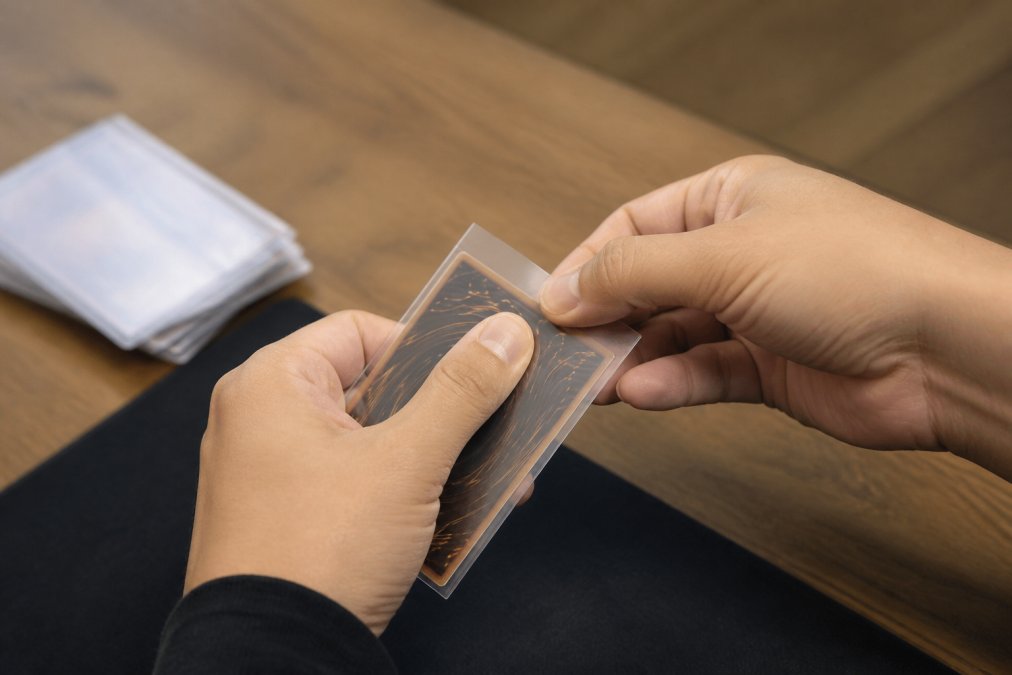
The extra time spent on air removal prevents re-sleeving and warping later.
Perfect Fit vs. Standard Sleeves: Which Works Best
Perfect fit sleeves and standard sleeves serve different purposes. Understanding the difference helps you choose correctly.
Perfect fit sleeves hug the card closely with a snug fit, minimizing air gaps. They work best as inner sleeves.
Standard sleeves are looser and work better as outer sleeves, sliding easily over perfect fit inner sleeves.
For double sleeving, the ideal combination is:
- Inner sleeve: perfect fit
- Outer sleeve: standard
This combination removes air pockets while keeping everything functional. Your deck shuffles smoothly. Cards stay protected.
Using standard sleeves for both layers works but creates more air gaps, leading to puffy decks that don't fit standard deck boxes.
Perfect fit sleeves alone offer less protection against liquid damage than double sleeving. Always double sleeve valuable cards.
Check your card game's tournament rules. Some games specify which sleeve sizes are legal. Magic: The Gathering and Pokémon have specific requirements. Follow your game's guidelines.
Best Inner Sleeves for Trading Cards
Quality inner sleeves protect cards; cheap sleeves degrade them. The difference comes down to material chemistry, not brand prestige.
Why material composition matters:
Inner sleeves are made from plastic films, typically polypropylene (PP) or polyvinyl chloride (PVC).
Within the PP category, there are two important distinctions:
Acid-free vs. acid-containing: Acid causes yellowing and brittleness in cards over decades. Always choose acid-free or archival-quality sleeves, verified on packaging.
How to identify quality sleeves:
Look for these markers on packaging or product descriptions:
- "Polypropylene" or "PP" material (not PVC)
- "Acid-free" or "archival quality"
- "PVC-free" (explicitly stated, since some manufacturers still use PVC)
- Smooth, clear plastic (not cloudy or textured)
- Consistent sizing (cards should slide smoothly, not bind)
- Manufactured by established suppliers with quality control (not generic no-name brands)
Storage conditions affect sleeve longevity:
Even good sleeves degrade faster in poor conditions:
- Heat: Temperatures above 75°F accelerate plasticizer migration in PVC and can soften PP sleeves. Store in cool conditions (60-72°F is ideal).
- Humidity: High humidity (above 60% relative humidity) causes moisture absorption in both sleeves and cards. This leads to warping and mold growth. Use silica gel packets in storage boxes if you live in humid climates.
- Light: Prolonged UV exposure yellows sleeves and cards. Store collections in opaque boxes or dark storage areas.
- Air circulation: Stagnant air in sealed boxes can trap moisture. Use breathable storage solutions or rotate silica packets regularly.
Penny sleeves vs. specialty inner sleeves:
Practical recommendation:
Do Double Sleeved Cards Fit in Deck Boxes?
Double-sleeved cards are thicker than single-sleeved cards. A standard deck box holds about 50-60 double-sleeved cards versus 75 single-sleeved cards. Air trapped in sleeves adds thickness, so removing air pockets is critical. For decks larger than 60 cards, use an oversized box. Check tournament rules for deck box requirements.
Common Mistakes to Avoid When Double Sleeving
Common mistakes:
Mistake 1: Using wrong-sized sleeves, Cards don't fit properly and bend when forced. Use the correct size for your card game.
Frequently Asked Questions
Do I really need inner sleeves if I'm already using outer sleeves?
Inner sleeves provide a critical first layer of protection against liquid damage, dust, and minor scratches that outer sleeves alone cannot prevent. While outer sleeves offer structural support, inner sleeves create a moisture barrier and protect against direct contact with the card surface. For valuable cards or tournament play, inner sleeves are worth the investment. For casual storage, they're optional but recommended for long-term preservation.
What's the difference between perfect fit and standard sleeves for double sleeving?
Perfect fit inner sleeves are snug-fitting sleeves designed to minimize air pockets around the card, while standard sleeves have more room. Perfect fit sleeves work best as inner sleeves because they reduce movement and air entrapment. Standard sleeves are typically used as outer sleeves for durability. Using perfect fit as your inner sleeve and standard as your outer sleeve is the most effective double sleeving setup for trading card games.
Can double sleeved cards actually fit in a standard deck box?
Double sleeved cards are noticeably thicker than single-sleeved cards, and standard deck boxes designed for single sleeves will be tight or won't close properly. You'll need a larger deck box or card storage box to accommodate the increased deck thickness. Check the box capacity before purchasing, many players use oversized deck boxes or card storage boxes specifically for double-sleeved decks to avoid bending or forcing cards.
Does double sleeving cause card damage over time?
Double sleeving itself does not damage cards when done correctly. The main risk is air entrapment, which creates 'puffy' decks and puts pressure on cards. To avoid damage, use acid-free, PVC-free sleeves and ensure you're removing excess air when inserting cards. Side-loading inner sleeves reduce friction and air pockets compared to bottom-loading options. With proper technique and quality sleeves, double sleeving protects cards rather than harming them.
Double sleeving protects your collection from damage that costs you money. Inner sleeves are essential for serious collectors. Cardboard Superstars provides the supplies and guidance to keep your cards in pristine condition. Browse our card protection supplies and find cards that match your collection goals. Your future self will appreciate cards stored properly today.