


Quick Summary
Graded legend cards are worth buying when the card combines lasting demand, rarity and a raw copy already close to mint, because the grade premium has to be recovered at resale. Compare recent sold prices against raw copies in similar condition before paying the premium.
- Compare sold prices, not asking prices, to find the real premium for a graded card.
- Add selling fees, shipping, insurance and sales tax to your true cost before buying.
- Build a grade ladder from sold listings to see if a PSA 9 premium is justified.
- Avoid grading obviously worn cards, since they rarely pay off.
- Check the slab label against the grading company's certification lookup before buying.
Table of Contents
- What Makes a Legend Card Worth Grading
- Graded vs. Raw Pokémon Cards: The Real Price Gap
- PSA 9 vs. Raw Card: Is the Jump Worth the Cost?
- How to Verify a Graded Card Before You Buy
- Understanding the Graded Card Price Premium
- Our Featured Graded Legends and Who Each One Suits
- Deciding Whether to Buy Your Next Graded Legend
- Frequently Asked Questions
What Makes a Legend Card Worth Grading
Last Updated: October 29, 2026
Is it worth buying graded legend cards? For most collectors, the answer depends on one thing: whether the card's value rises enough to cover the premium you pay for the slab. At Cardboard Superstars, we look at graded legends as a buying decision, not just a collectible, so the math matters as much as the hype.
A legend card is worth grading when it combines demand, rarity and a condition that can realistically hold a high grade. Demand comes from the player or character's lasting popularity. Rarity comes from print run and survival rate. Condition is where many cards fall short, because even a well-known card can grade poorly if its centering, corners or surface are off.
Think about three questions before you spend anything:
- Is the player or character still widely collected? Icons from the 1980s and 1990s tend to hold collector interest longer than short-lived stars.
- Does the card have a clean print? Off-center printing, print lines and surface wear are common reasons a card grades lower than expected.
- Would you still want it if the grade came back lower? If the answer is no, you are buying the grade, not the card.
The safest candidates are cards where the raw copy already looks close to mint. Grading an obviously worn card rarely pays off.
Graded vs. Raw Pokémon Cards: The Real Price Gap
The biggest question for most buyers is simple: how much more does a graded card cost than a raw one, and does that premium survive a resale? The honest answer is that the gap varies widely by card, grade and timing, and it is not guaranteed to pay back.
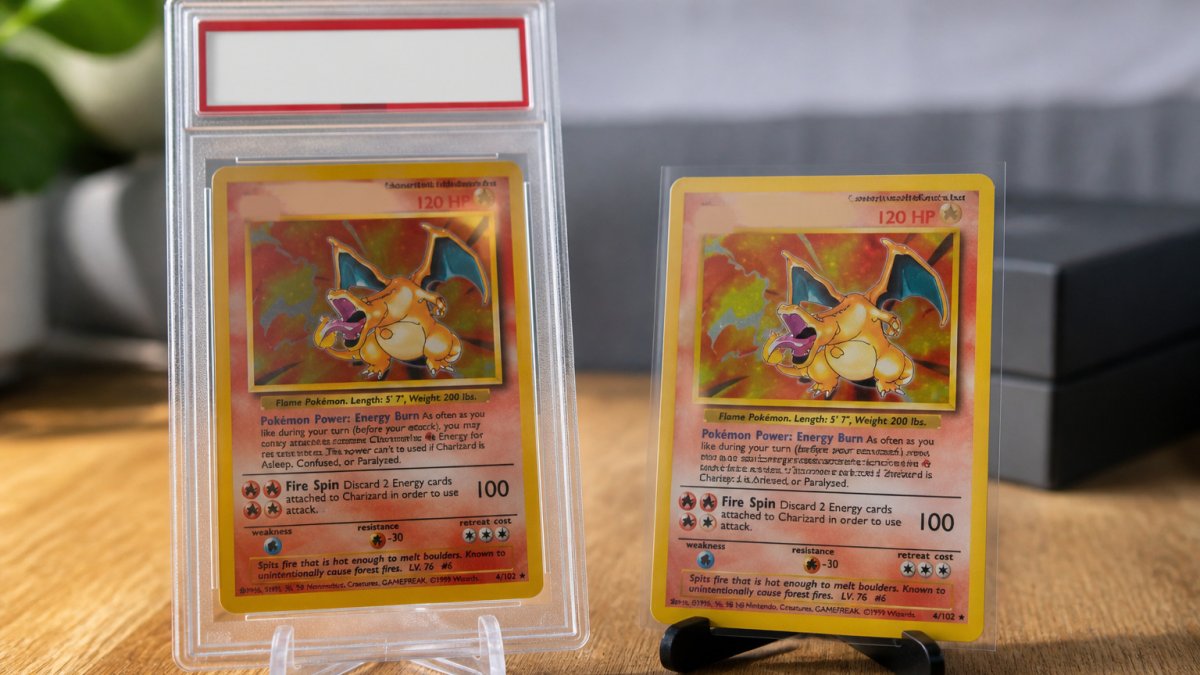
A graded card has a condition rating and a holder. A raw card carries condition risk. But the premium you pay at purchase is not the same as the premium you get back at sale.
Compare sold prices, not asking prices. The most common mistake is comparing a graded listing price against a raw listing price. Ask prices are wishes; sold prices are evidence. Pull recent sold listings for the same card in the same grade, then pull recent sold listings for raw copies in comparable condition. The difference is your real premium.
Do the break-even math before you buy. Your true cost is not just the purchase price. Add:
- The graded-card premium over a raw copy
- Marketplace selling fees if you plan to resell (typically a percentage of the sale price plus a fixed amount on major platforms)
- Shipping and insurance both ways if you ever submit a card yourself
- Sales tax where applicable
A simple break-even check: compare the purchase price with recent sold prices and account for any costs you expect to incur.
Liquidity matters as much as price. Before paying a premium, search sold listings for the same grade and note the dates.
For a beginner, raw cards in strong condition may be an option. Graded copies may suit collectors who want a showpiece.
The table below summarises the break-even costs to check before paying a graded premium.
| Cost item | What to add | Note |
|---|---|---|
| Graded premium | Graded price minus raw price | Compare sold prices, not asking prices |
| Selling fees | Percentage plus fixed amount | Applies if you plan to resell |
| Shipping and insurance | Both ways | Only if you submit a card yourself |
| Sales tax | Where applicable | Varies by location |
PSA 9 vs. Raw Card: Is the Jump Worth the Cost?
Moving from a raw card to a PSA 9 is a common upgrade decision, and it deserves a careful look. A PSA 9 means excellent condition with only minor flaws, a meaningful step up from a typical raw copy, but not the top of the scale. The question is whether the step-up price is justified by the sold-price evidence.
Build a grade ladder from sold listings. For the specific card you want, pull recent sold prices at each grade you can find: raw, PSA 8, PSA 9, PSA 10. Write them down with dates. Your job is to see where the price curve steepens for that card, and whether the grade you are considering sits on the steep part.
Check the population count. Grading companies publish population reports showing how many copies exist at each grade. Use the population count as context, not as a guarantee of value.
Mario Lemieux 1987-88 Topps Hockey #15 PSA 8.5 NM-MT+ – Pittsburgh Penguins →
Apply a simple decision rule.
- If the sold-price gap between raw and PSA 9 is small relative to the card's total price, buy the raw copy in excellent condition and keep the difference.
- If the gap is large, the card is scarce at that grade, and recent sales are frequent, the PSA 9 premium can make sense.
- If the gap is large but sales are sparse or scattered, treat the premium as unproven and negotiate or wait.
Consider the grade you actually want. Some collectors are satisfied with a PSA 8 at a fraction of the PSA 9 price; others want the 9 specifically. Be honest about which camp you are in before you pay the step-up. Buying a PSA 9 only because it is 'better' than a raw card, without checking whether the price difference is supported by sold listings, is how buyers overpay.
When comparing cards, consider the sold-price gap and whether the card fits your collection.
How to Verify a Graded Card Before You Buy
Verification is a step to consider when buying a graded card.
Check the slab label and compare its details with the grading company's certification lookup. For a step-by-step guide to spotting fake graded cards before committing, follow these checks.
Next, compare the card with images of the same card.
Finally, consider a seller's track record. Cardboard Superstars shows 100% positive eBay feedback and more than 4,600 items sold, and provides clear product details before checkout.
Understanding the Graded Card Price Premium
The graded card price premium is the extra amount a buyer pays for a graded copy over a raw copy of the same card.
To compare prices, calculate the total cost and compare it against recent sold prices.
Collector enjoyment also has value. If you love the card, consider whether it fits your collection.
Our Featured Graded Legends and Who Each One Suits
Not every graded legend fits every collector. Here is how we would match our featured cards to buyers:
- 1987-88 Topps Hockey #15 Mario Lemieux, PSA 8.5, $55.99: A graded Mario Lemieux card from 1987-88.
- 1989 Topps #1 Mario Lemieux HOF, PSA 8, $24.99: A graded Mario Lemieux Hall of Fame card.
- 1969 Topps #61 Gordie Howe, PSA 7, $249.99: A graded vintage Gordie Howe hockey card.
- 1996-97 Pinnacle Summit in the Crease Dominik Hasek, PSA 9.5, $99.95: A graded Dominik Hasek goalie card limited to 6,000 copies.
- 1992 Bowman Wayne Gretzky Foil #207, PSA 8, $35.00: A Wayne Gretzky card with a foil finish.
Check the current listing before buying.


Deciding Whether to Buy Your Next Graded Legend
Consider whether a graded legend card fits your collection and budget before buying.
If the card fits your collection, it may be a satisfying purchase. Browse our current graded hockey cards.
Frequently Asked Questions
Are graded cards worth more than raw cards?
Whether a graded card is worth more than a raw card depends on the card and the price. Compare recent sold listings for the exact card and grade before deciding.
Should I buy a PSA 9 or a raw card?
Whether to buy a PSA 9 or a raw card depends on your preferences and budget. Compare the total price before deciding.
How can I tell whether a graded card is authentic?
Check the slab label and compare its details with the grading company's certification lookup.
How much of a premium should I pay for a graded card?
The price difference depends on the card and grade. Compare recent sold listings for the same card and grade before deciding.
