


Table of Contents
- What You'll Need for Safe Card Shipping
- Step 1: Sleeve and Secure Your Cards
- Step 2: Build the Cardboard Sandwich
- Step 3: Preventing Card Damage During Transit
- Step 4: How to Ship Cards on eBay and Other Platforms
- Step 5: Weigh, Label, and Track Your Package
- Common Shipping Mistakes to Avoid
- Conclusion: Ship With Confidence
- Frequently Asked Questions
Last Updated: September 6, 2026
What You'll Need for Safe Card Shipping
The safest way to ship trading cards combines rigid protection, moisture barriers, and a tracked delivery service. A single bent corner can erase hundreds of dollars in value, so the packaging method matters more than the shipping speed.
Before you seal anything, gather these supplies:
- Penny sleeves (soft, non-PVC plastic sleeves) to prevent surface scratches
- Toploaders (rigid plastic holders) to prevent bending
- Cardboard pieces cut slightly larger than the toploader
- A rigid or padded mailer that won't flex in transit
- Painter's tape (never standard shipping tape on the card itself)
- A team bag or small poly bag for moisture protection
The one item collectors consistently underestimate is the outer mailer. A toploader protects against bending but does nothing against crushing if the envelope gets folded by sorting machinery.
Step 1: Sleeve and Secure Your Cards
Proper card protection starts with layering: the penny sleeve first, then the toploader, then the outer protection. Skipping any layer increases the risk of damage a buyer will notice immediately.
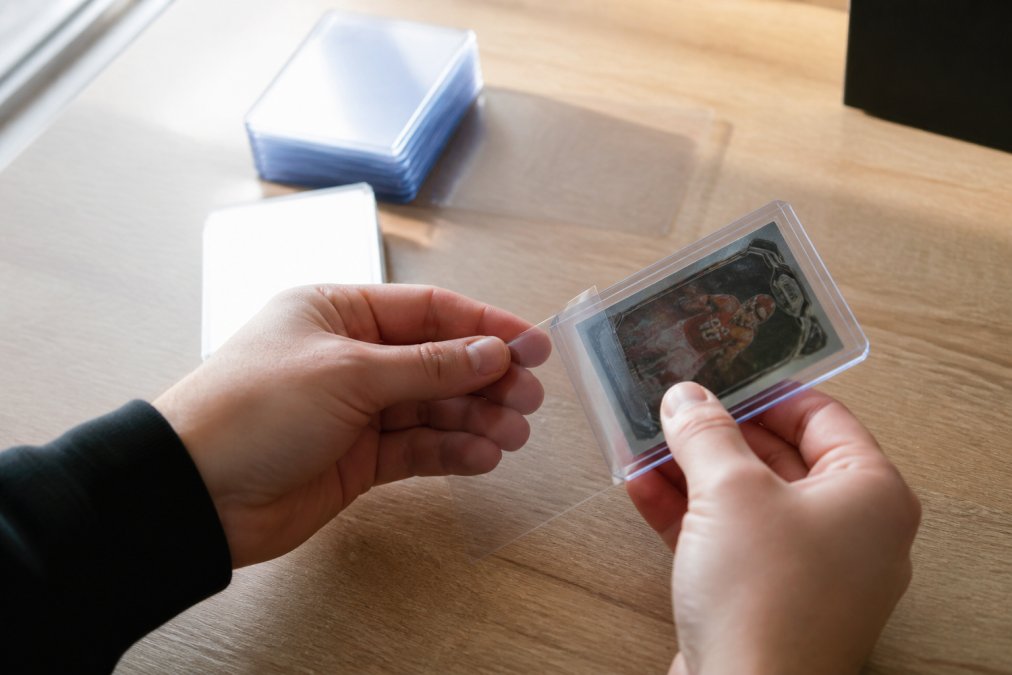
Penny Sleeves and Toploaders
A penny sleeve is a soft plastic sleeve that protects the surface from scratches and dust but offers zero rigidity. The toploader provides that rigidity: a thick, clear plastic holder that prevents bending under pressure.
Place the card in the penny sleeve first, then slide both into the toploader, making sure the card sits fully inside so the top edge is protected. For cards you plan to ship, seal the toploader opening with a small piece of painter's tape, which removes cleanly without residue or damage if the buyer needs to inspect the card.
The USPS guidelines on mail preparation recommend keeping all mail flat and rigid to avoid damage during automated sorting, which is exactly what this layering achieves.
Best Protective Sleeves for Graded Cards
Graded cards require different handling than raw cards because the slab is larger and heavier. The best protective sleeves for graded cards are rigid slab holders or semi-rigid sleeves designed specifically for grading cases.
For graded cards, wrap the slab in a soft sleeve first to prevent scratches on the case, then place it in a rigid slab holder. Cardboard Superstars carries the BCW Semi-Rigid Card Holder #1 and standard toploaders for everyday protection. The key is that the holder must fit snugly, with no room for the card to shift during transit.

Step 2: Build the Cardboard Sandwich
The cardboard sandwich is the single most effective method for preventing bending damage: place the sleeved and toploaded card between two flat pieces of corrugated cardboard, then tape the cardboard together.
Here's the process:
- Cut two pieces of corrugated cardboard slightly larger than the toploader
- Place the toploaded card between the two cardboard pieces
- Tape the edges of the cardboard together with packing tape
- Make sure the card cannot slide out from between the cardboard
The cardboard sandwich works because it distributes pressure across a wide surface area. If a package gets crushed or folded, the cardboard absorbs the force instead of the card.
For multiple cards, stack up to five toploaded cards between the cardboard pieces. Beyond that, you're better off splitting into multiple shipments or using a dedicated card shipping box.
Step 3: Preventing Card Damage During Transit
Card damage during transit falls into three categories: bending, crushing, and moisture. The cardboard sandwich handles bending, the mailer choice handles crushing, and moisture requires a separate layer of protection.
Choosing the Right Mailer
A rigid mailer is a cardboard envelope that doesn't flex when pressed; a bubble mailer offers padding but can still bend. For cards worth more than $20, use a rigid mailer with the cardboard sandwich inside.
The test is simple: if you can bend the mailer with one hand, it's not rigid enough. Cardboard Superstars uses collector-grade packaging on every order.
Moisture Protection Essentials
Water damage is permanent and instantly destroys card value. Rain, condensation, and even humidity can warp a card during a multi-day shipment. The solution is a team bag: a small resealable poly bag that fits the toploaded card.
Place the toploaded card inside a team bag and seal it before putting it into the cardboard sandwich. This creates a moisture barrier that keeps the card dry even if the outer packaging gets wet. For international shipments, where transit times are longer and handling is less predictable, moisture protection is essential.
Step 4: How to Ship Cards on eBay and Other Platforms
Shipping on eBay, TCGplayer, and other marketplaces isn't just about packaging, it's about matching the service to the platform's buyer-protection rules and the card's value.
Carrier-by-Carrier Comparison
USPS First-Class Package Return Service is the default for most single-card shipments under 13 ounces. It includes tracking, takes 2-5 business days, and costs roughly $4.50-$6.00 for a 3-ounce rigid mailer. This is the baseline for cards valued between $20 and $200.
USPS Priority Mail becomes relevant when you need speed or when the package exceeds 13 ounces. A flat-rate Priority Mail envelope costs around $9-$10 and includes $100 of insurance.
UPS and FedEx are rarely the best choice for single cards. Their minimum rates start around $10-$12 and they don't offer the same lightweight, low-cost tracking options as USPS. They become viable only for bulk shipments of 50+ cards or when shipping a heavy graded-card collection.
eBay Standard Envelope is a unique option for cards under $20. It costs around $1.25 and includes tracking through eBay's system, but it does not include insurance and has a 3-ounce weight limit. This service is only available to eBay sellers who meet the platform's performance standards.
Platform-Specific Requirements
eBay requires sellers to upload tracking within the handling time to qualify for eBay Seller Protection. For cards under $20, eBay Standard Envelope provides a tracking number, but it's not a USPS-tracked service in the traditional sense. For anything above $20, use First-Class Package Return Service or Priority Mail.
TCGplayer has stricter requirements. Direct sellers must ship within 24 hours and provide tracking for orders over $50. For orders under $50, TCGplayer allows untracked shipping, but that exposes you to false claims.
PayPal Goods and Services transactions outside of marketplaces follow the same logic: if you can't prove delivery with tracking, you have no protection in a dispute. A $3 tracking upgrade is cheaper than a full refund plus the card you'll never get back.
The $50 Insurance Threshold
USPS First-Class Package Return Service includes no insurance by default. You can add coverage at the counter or through Click-N-Ship for roughly $2-$3 per $100 of declared value.
The Real Cost of an Untracked Shipment
Step 5: Weigh, Label, and Track Your Package
Accurate weight and dimensions are the difference between paying $4.50 and $9.00 for the same shipment. Carriers price by actual weight or dimensional weight, whichever is larger.
How Dimensional Weight Works
USPS calculates dimensional weight for Priority Mail packages larger than 1 cubic foot (1,728 cubic inches) (usps.com). The formula is: length × width × height, divided by 166.
A standard rigid mailer measuring 9" × 6" × 1" has a dimensional weight of just 0.3 pounds, far below its actual weight. But a box measuring 12" × 9" × 3" has a dimensional weight of 1.9 pounds, which means you're paying for a 2-pound package even if the cards inside weigh only 4 ounces.
Staying Under the 13-Ounce Threshold
USPS First-Class Package Return Service is capped at 13 ounces. A single toploaded card in a cardboard sandwich inside a rigid mailer typically weighs between 2 and 4 ounces. The risk comes when you add extra cardboard, bubble wrap, or use a heavier mailer.
Weigh your package on a digital scale after it's fully sealed. If you're at 12.5 ounces, you're one piece of tape away from being forced into Priority Mail pricing.
The 1/4-Inch Thickness Rule
USPS automated sorting machines process mail under 1/4-inch thick as letter mail. Anything thicker is classified as a package and requires package pricing. A cardboard sandwich with two layers of corrugated cardboard easily exceeds 1/4-inch, which is why you're paying package rates, and that's correct.
Label Placement and Scanning
A wrinkled or poorly placed label causes scanning failures that delay delivery and void tracking updates. Print labels on a thermal printer or a laser printer, inkjet labels can smear in humid conditions. Keep the barcode clear of tape, because tape over a barcode can cause reflections that prevent scanning.
Tracking and Buyer Communication
Once the carrier accepts the package, share the tracking number immediately. Most marketplaces automate this, but for direct sales, send it manually. For high-value cards, consider requiring a signature on delivery; USPS adds signature confirmation for about $3, and it eliminates the "package was left on my porch" claim entirely.
The Weight Optimization Checklist
- Use a digital scale, not a kitchen scale that rounds to the nearest ounce
- Weigh the fully sealed package, including the label
- Stay under 13 ounces to qualify for First-Class Package Return Service
- Keep packages under 1 cubic foot to avoid dimensional weight pricing
- Use the thinnest rigid mailer that still provides adequate protection
- For bulk shipments, split into multiple packages rather than upgrading to a box
Common Shipping Mistakes to Avoid
Even experienced sellers make mistakes that damage cards or delay delivery. The most common ones to see:
- Using standard envelopes for valuable cards: A standard envelope offers no rigidity and no tracking. If the card is worth more than the postage cost, use a mailer with tracking.
- Skipping the penny sleeve: The toploader protects against bending, but the card can still get scratched inside the toploader if it shifts. The penny sleeve prevents this.
- Using too much tape: Tape that touches the card or sleeve can leave residue or tear the sleeve when removed. Use painter's tape on the toploader and packing tape only on the cardboard.
- Ignoring dimensional weight: Carriers charge by dimensional weight for large, lightweight packages. If you're shipping a box that's mostly air, the cost may exceed your expectations.
- Forgetting insurance on high-value cards: For cards worth hundreds or thousands of dollars, insurance is not optional. The USPS declared value coverage protects you financially if the package is lost or damaged.
The biggest mistake is treating every card the same. Different cards may require different packaging, shipping services, and insurance levels.
Conclusion: Ship With Confidence
Shipping trading cards safely is a skill every collector develops over time. The method is straightforward: sleeve the card, add a toploader, build a cardboard sandwich, protect against moisture, choose a rigid mailer, and always include tracking.
At Cardboard Superstars, we apply these same standards to every order we ship. Our collector-grade packaging ensures that the cards you buy arrive in the condition you expect, and our 200 Count Card Sleeve and Toploader Combo Pack gives you the supplies to protect your own collection. With clear product details and fast shipping, we make it easy to collect with confidence.

Get started with Cardboard Superstars and find cards worth protecting.
Frequently Asked Questions
What is the cheapest way to ship trading cards?
For a single card under 1 ounce, USPS First-Class Mail with a tracking number is an option. However, you must use a rigid mailer to prevent bending. For lots of cards weighing over 1 ounce, USPS Ground Advantage includes tracking and $100 of insurance. Always prioritize protection over the few cents you might save by using a plain standard envelope.
Do I need tracking when shipping trading cards?
Yes. Always purchase tracking for any card shipment. For higher-value cards, consider a service with signature confirmation. Tracking is important for safely shipping trading cards, especially when selling on platforms like eBay, where it is a requirement for seller protection.
What packaging materials are best for preventing card bending?
The most reliable method is the 'cardboard sandwich.' Place your card in a penny sleeve, then a rigid toploader. Next, tape this between two pieces of stiff cardboard. Finally, place this entire assembly inside a rigid or padded mailer. Never ship trading cards in a standard paper envelope alone, as they are easily bent by postal sorting machines.
How should I ship expensive trading cards?
For high-value cards, use the same basic method but add layers of security. Use a new, rigid cardboard mailer rather than a bubble mailer for maximum protection. Declare the full value and purchase additional insurance coverage through your shipping carrier. For cards worth hundreds or thousands of dollars, consider using a service that requires a signature upon delivery to ensure the package reaches the right hands.