


Table of Contents
- Best Protective Sleeves for Rare Trading Cards: Quick Comparison
- Rip & Protect Bundle: Everyday Protection and Submission-Ready Storage
- Standard Card Sleeves - BCW: Clear, Snug Fit for Daily Handling
- Rookie Supply Pack: Starter Bundle for New Collectors
- Trading Card Sleeve Sizes and Compatibility Guide
- Penny Sleeves for Sports Cards and Standard Trading Cards
- Double Sleeving Trading Cards for Maximum Protection
- How to Protect Rare Trading Cards: Layered Storage and Safe Handling
- Frequently Asked Questions
Last Updated: October 17, 2026
Best Protective Sleeves for Rare Trading Cards: Quick Comparison
Rare trading cards demand more than basic storage. A single scratch, bend, or dust exposure can slash the value of a card worth hundreds or thousands of dollars, so the right sleeves and a layered storage approach matter.
At Cardboard Superstars, we help collectors protect their most valuable pulls with supplies designed for preservation and safe handling. Below are the best protective sleeves for rare trading cards across protection levels, card types, and budgets.
Comparison Table
| Product | Price | Best For | Key Features |
|---|---|---|---|
| Rip & Protect Bundle | $32.00 | New collectors and submissions | 200 penny sleeves + 200 semi-rigid card savers |
| Standard Card Sleeves - BCW | $2.25 | Daily handling and display | Clear, snug fit for standard cards |
| Rookie Supply Pack | $13.75 | Beginners building a collection | 100 sleeves + 50 toploaders |
| Team Leader Supply Pack | $16.00 | Growing collections | 100 35pt toploaders + 100 sleeves |
| All-Star Supply Pack | $29.99 | Bulk storage and organization | 200 toploaders + 200 penny sleeves |
| BCW Semi-Rigid Card Holder #1 | $11.99 | Transport and grading submissions | Flexible protection for standard cards |
| Mixed Case of Thick Card Topload Holders - BCW | $134.00 | Premium and thick cards | Rigid protection for relics, patches, and high-value cards |
Rip & Protect Bundle: Everyday Protection and Submission-Ready Storage
The Rip & Protect Bundle combines 200 penny sleeves for immediate protection when opening packs with 200 semi-rigid card savers for secure storage and submissions, a practical starting point for protecting rare cards from the moment they're pulled.

Penny sleeves offer fast, lightweight protection during sorting and handling, while the semi-rigid savers prevent bending during shipping or long-term storage. This two-tier approach saves money and space without over-protecting every card in rigid holders.
The bundle suits collectors preparing cards for grading, since grading companies often recommend semi-rigid holders before final encapsulation. At $32.00, it delivers both layers of protection for new and experienced collectors alike.
Standard Card Sleeves - BCW: Clear, Snug Fit for Daily Handling
For collectors who handle cards regularly, Standard Card Sleeves - BCW deliver reliable everyday protection without bulk. The snug fit keeps cards secure during shuffling, sorting, or display, and the clear plastic lets you check condition at a glance.

Use them as a first layer with toploaders or semi-rigid holders for long-term storage, or alone for display organization. At $2.25, they're affordable enough to buy in bulk and sleeve every card.
Rookie Supply Pack: Starter Bundle for New Collectors
The Rookie Supply Pack brings together 100 card sleeves and 50 toploaders in one ready-to-ship set, designed for collectors building a protection routine or preparing for a card show or trade event.

At $13.75, it's an affordable entry point for beginners who want layered protection without bulk quantities.
The included 35pt toploaders fit most trading cards, including sports cards, Pokémon, and other standard-size TCGs. For graded cards or submissions, choose the semi-rigid option from the Rip & Protect Bundle instead; for raw cards, this pack covers the essentials.
Trading Card Sleeve Sizes and Compatibility Guide
Not all trading cards are the same size, and for rare cards a wrong fit costs corner wear and grade points, not just wasted sleeves. The table below gives the working dimensions collectors use to match sleeves and holders to a card.
| Card type | Nominal dimensions (W x H) | Typical thickness | Sleeve/holder fit notes |
|---|---|---|---|
| Standard TCG (Pokémon, Magic: The Gathering, Yu-Gi-Oh!) | 2.5 x 3.5 in (63 x 88 mm) | ~0.012 in | Fits standard penny sleeves and 35pt toploaders; leave 1/16 in of play at the top |
| Standard sports cards (baseball, basketball, football) | 2.5 x 3.5 in | ~0.012-0.020 in | Same footprint as TCG; vintage stock can run thicker, so check before using a 35pt holder |
| Thick/relic/patched cards | 2.5 x 3.5 in | ~0.025-0.060 in | Needs 55pt, 75pt, 100pt, or 130pt holders; a 35pt holder will bow the card |
| Tall-boy/oversized promos | Varies (often 2.5 x 5 in or larger) | Varies | Standard sleeves will not fit; source oversized sleeves or rigid holders by exact measurement |
| Graded/slabbed cards | Slab dimensions vary by grader | n/a | Use slab bags or sleeves sized to the slab, not the raw card |
How to measure a card for sleeve fit. Lay the card flat and measure width at the middle and 1/4 inch from each edge, plus height the same way. Cards aren't perfectly rectangular, so use the largest readings. Measure thickness at the center and at one corner, where a too-tight holder does its damage. Add roughly 1/16 inch to width and height so the card slides in without force but doesn't rattle.
The fit test. A correctly sized sleeve lets the card slide in with a gentle push and holds it without visible side-to-side movement when turned upside down. If you must flex the card to insert it, the sleeve is too small; if it shifts more than about 1/8 inch, it's too loose and edges will abrade.
Thick cards and point (pt) sizing. Toploader thickness is sold in points, where 1 point equals 0.001 inch: a 35pt holder has about 0.035 inch of interior clearance, a 55pt holder about 0.055 inch, and so on. Relics, patches, memorabilia cards, and some premium inserts commonly need 55pt to 130pt. Forcing a thick card into a 35pt holder bows the card and can crack the seam. The Mixed Case of Thick Card Topload Holders - BCW exists because one thickness won't cover a mixed collection.
Oversized cards. Jumbo promos and box-toppers don't fit standard sleeves. Measure the card and buy oversized sleeves or rigid holders by dimension; never trim a standard sleeve, because a cut edge is a scratch waiting to happen.
Penny Sleeves for Sports Cards and Standard Trading Cards
Penny sleeves are the workhorse of card protection: inexpensive, lightweight, and the first layer most collectors reach for after opening a pack or receiving a shipment. They fit standard 2.5 x 3.5 inch cards snugly and keep dust and fingerprints off during sorting.
For rare cards, though, the material matters as much as the price. Not all penny sleeves are archival. Check the packaging for PVC-free and acid-free (sometimes labeled archival or inert). Polyvinyl chloride (PVC) is the plastic to avoid for long-term storage. Polyethylene and polypropylene are common archival-safe alternatives, and most modern penny sleeves from established suppliers use one of those.
Rip & Protect Bundle 200 Penny Sleeves, 200 Semi Rigid Card Savers →
When a penny sleeve is enough, and when it is not. A penny sleeve alone is fine for short-term handling, sorting, and bulk storage of low-value cards, but not for a rare card kept long-term: with no rigidity, cards can bend under stack pressure, and thin plastic offers no defense against a dropped box or crowded bin. The practical pattern is penny sleeve first for surface protection, then a semi-rigid holder or toploader for structure. For a card worth hundreds of dollars, that two-layer setup is the minimum, and a team bag over the toploader keeps dust off the outer holder.
Penny sleeve quality signals. Look for uniformly clear sleeves with no haze, no visible seams or weld lines across the card face, and no chemical smell when you open the pack; a strong plastic odor signals plasticizer or low-grade resin. Avoid sleeves that feel tacky or leave residue on your fingers. Crystal-clear sleeves also let you inspect edges and corners without removing the card, which reduces handling.
The trade-off is durability, not just cost. Penny sleeves are designed for handling, not years of storage; cheap ones can cloud, scratch, or take a set (a permanent crease where the card pressed against the plastic). Treat the penny sleeve as a replaceable first layer: inspect it periodically and swap it if it looks cloudy, scratched, or yellowed. Replacing a sleeve is cheap; replacing a card is not.
Double Sleeving Trading Cards for Maximum Protection
Double sleeving means placing a card in two sleeves for redundant protection, common among serious collectors storing high-value cards, graded cards awaiting submission, or any card worth protecting twice.
The typical setup is a penny sleeve first, then a semi-rigid holder or toploader. The penny sleeve protects the card's surface from the outer holder's plastic, while the holder provides structural support and prevents bending.
How to Protect Rare Trading Cards: Layered Storage and Safe Handling
The best protective sleeves for rare trading cards work as part of a complete storage system; handling technique and environmental conditions matter just as much as the sleeve itself.
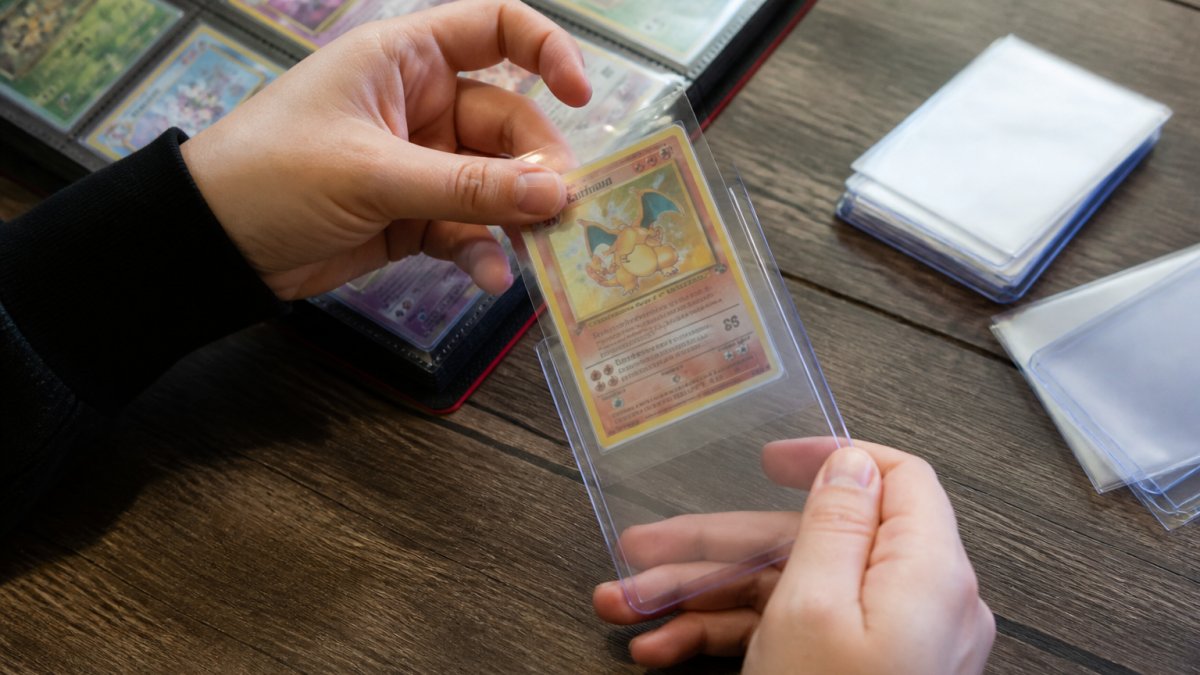
Start with a penny or inner sleeve to protect the surface, then place the sleeved card into a semi-rigid holder or toploader for structural support. For cards worth over $100, add a team bag around the toploader to prevent dust accumulation.
Keep your collection cool, dry, and out of direct sunlight; extreme temperatures and humidity degrade plastic and warp cards.
Safe Sleeving and Removal Technique
Inserting a card into a sleeve seems simple, but improper technique can scratch or bend a rare card immediately.
Hold the card by its edges only.
Environmental Storage Conditions
Use acid-free storage boxes for long-term storage (Standard Archival Manuscript Collections - Stabilizing Special Collections for...).
Protecting rare trading cards comes down to choosing the right sleeves and following consistent storage practices. The Rip & Protect Bundle from Cardboard Superstars gives you the two essential layers every collector needs: penny sleeves for immediate handling and semi-rigid card savers for secure, submission-ready storage. Start there, add environmental controls, and your collection will stay pristine for years. Find cards and protective supplies at Cardboard Superstars today.
Frequently Asked Questions
Should rare cards use penny sleeves or premium sleeves?
Rare cards benefit most from layered protection. Start with a penny sleeve for surface protection, then place the sleeved card in a semi-rigid holder or toploader for structural support. Penny sleeves alone ($2.25 per pack from Cardboard Superstars) work for everyday handling, but high-value cards deserve the added rigidity of semi-rigid holders or thick toploaders to prevent bending and edge wear during storage and shipping.
What is the difference between trading card sleeve sizes for different card games?
Standard trading cards like Pokémon, Magic: The Gathering, and sports cards all use the same dimensions and fit standard sleeves and toploaders. Specialty games may use slightly different sizes, so verify your card dimensions before purchasing. Most sleeves sold for trading cards are designed for the standard size, making them compatible across Pokémon, Yu-Gi-Oh!, and sports cards. Check your specific card's measurements if you're unsure.
How do you put a trading card in a sleeve without damaging it?
Hold the card by its edges only, never touching the face or back. Angle the card slightly and slide it into the sleeve opening with a smooth, deliberate motion. Avoid forcing it, the card should enter with minimal resistance. For semi-rigid holders, use the same technique. Remove cards by gently pulling from the bottom edge rather than yanking from the top. Proper insertion prevents creasing, bending, and surface scratches that reduce card value.
Is double sleeving trading cards worth it for valuable cards?
Yes, double sleeving is worth it for high-value cards. The Rip & Protect Bundle ($32.00) provides both penny sleeves and semi-rigid card savers, enabling this two-layer approach. The inner penny sleeve protects against surface damage, while the outer semi-rigid holder prevents bending and edge wear. This combination is especially important before shipping, submitting cards for grading, or long-term storage of rare collectibles.
What protection level do thick card toploaders provide for premium inserts?
Thick card toploaders from BCW provide rigid, hard-plastic protection designed for cards thicker than standard. They prevent bending, dust accumulation, and edge wear, critical for patch cards, relics, autographed cards, and premium inserts. The Mixed Case of Thick Card Topload Holders ($134.00) is ideal for high-value collectibles that need maximum structural support and are display-ready. These rigid holders are much stronger than standard toploaders.