


Table of Contents
- Why Fake Booster Boxes Are Getting Harder to Spot
- Counterfeit, Resealed, or Factory Error: Know the Difference
- Shrink Wrap, Wrapper Condition, and Loose Wrapping Clues
- How to Tell if a Pokémon Booster Box Is Resealed
- Authentic Pokémon Booster Box Packaging: Seams, Crimps, and Print Quality
- How to Verify Pokémon Cards Inside the Box
- A Risk-Weighted Inspection Checklist and Seller Checks
- Frequently Asked Questions
Last Updated: October 18, 2026
Why Fake Booster Boxes Are Getting Harder to Spot
Counterfeiters have gotten better. That's why knowing the common signs of fake booster boxes matters more than ever, whether you're chasing a vintage wax box or a modern Japanese release.

At Cardboard Superstars, we've learned that most fakes fail on small details, not big ones. The FTC guidance on counterfeit goods makes clear that counterfeit merchandise is illegal to sell, but that doesn't stop bad actors from listing resealed or fake boxes online.
Below, we'll walk through exactly what to inspect, from wrapper condition to card texture. We'll also separate three things most guides blur together: counterfeit, resealed, and factory error. That distinction changes how you inspect a box.
Counterfeit, Resealed, or Factory Error: Know the Difference
Counterfeit means the box was never made by the official manufacturer. Resealed means a genuine box was opened and repackaged, often with lower-value packs inside. Factory error means a real box left the plant with a cosmetic flaw.
That third category trips up a lot of collectors. A crooked label or a loose wrapper isn't automatically a fake booster box. Real factories produce imperfect boxes all the time.

Here's how the three compare:
| Type | What It Is | Key Clue | Risk Level |
|---|---|---|---|
| Counterfeit | Fake box made to mimic the real thing | Wrong print quality, off-color wrapper | High |
| Resealed | Real box, opened and repacked | Glue residue, loose wrap, mismatched seal | High |
| Factory error | Genuine box with a cosmetic flaw | Minor print or wrap imperfection, otherwise sound | Low |
A common mistake is treating every flaw as proof of fraud. In practice, you need several clues pointing the same direction before you call a box fake.
Shrink Wrap, Wrapper Condition, and Loose Wrapping Clues
Factory shrink wrap is applied by a machine that heats and stretches a continuous film around the box under consistent tension.
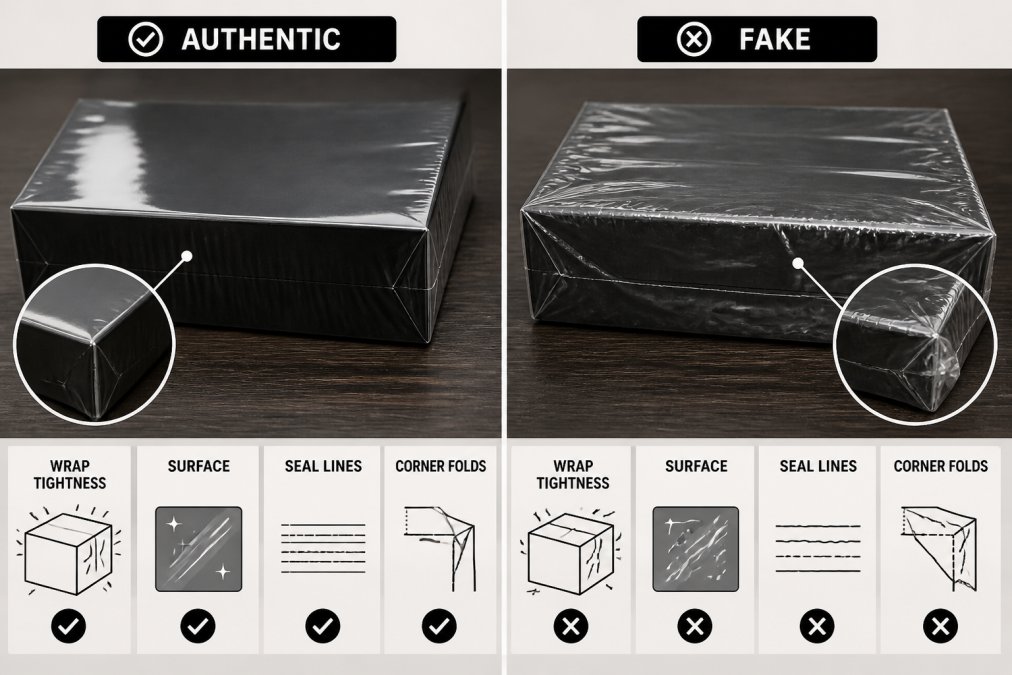
That difference is the mechanism behind most wrapper clues.
Look for these wrapper issues, ranked by how strongly they point to tampering:
- Strong evidence, heat marks or scorching. A heat gun leaves faint cloudiness, ripples, or a slightly melted look near the seal. Factory tunnels do not scorch film.
- Strong evidence, a second seam. Genuine wrap usually has one continuous seam line. A second seam, or a seam that runs in an unexpected direction, suggests the original wrap was opened and reclosed.
- Moderate evidence, loose or baggy wrapping. Sagging plastic that does not hug the box can mean hand rewrap, but it can also occur on older or poorly stored genuine product.
- Moderate evidence, wrinkled or cloudy plastic where the rest of the wrap is clear and glossy.
- Weak evidence, uneven tension where one side is tight and another is slack. This is a clue, not proof; genuine boxes sometimes ship with minor tension differences.
- Weak evidence, tape or stickers on the wrap. Some retailers add their own security tape, so treat this as a question to ask, not a verdict.
A genuine factory seal also tends to sit flush at the edges.
The practical takeaway: treat wrapper clues as one input, not a verdict. A single loose corner means little. A heat-scorched seam plus a second seam line plus a baggy fit is a pattern worth walking away from.
How to Tell if a Pokémon Booster Box Is Resealed
The fastest way to tell if a Pokémon booster box is resealed is to check the seams and crimps. A factory seal runs in a straight, even line with a clean crimp pattern. A resealed box often shows a wavy seam, uneven crimping, or glue residue along the edges.
Walk through these steps in order:
- Check the seam line. It should be straight and continuous. Waviness is a red flag.
- Inspect the crimps. Factory crimps are uniform. Hand crimps look irregular.
- Look for glue residue. Sticky patches or cloudy marks near the seal suggest tampering.
- Check the box lid. A lid that lifts too easily or shows wear at the fold can mean it was opened.
- Compare wrapper tension. Tight and even is good. Loose and baggy is not.
What most guides miss is that resealers often reuse the original wrap. They open the box, swap the packs, and reheat the seal. That's why the seam and crimp check matters more than the plastic itself.
Authentic Pokémon Booster Box Packaging: Seams, Crimps, and Print Quality
Authentic Pokémon booster box packaging has three things fakes struggle to match: clean seams, consistent crimps, and sharp printing. Printing quality is where most counterfeits fall apart. Text alignment, color accuracy, and font weight are hard to copy at scale.
1985 Donruss BASEBALL Factory Sealed Hobby Box - BBCE Certified →
Run this visual inspection:
- Text alignment: Logos and set names should sit straight and centered.
- Print quality: Edges of letters should be crisp, not fuzzy or bleeding.
- Color match: Compare against official images. Off-shade colors are a clue.
- Factory markings: Batch codes and copyright lines should be present and legible.
- Packaging details: Cardboard thickness and box rigidity should feel solid.
If you're comparing boxes in person, hold two side by side. Fakes often look slightly lighter, or the cardboard flexes more than it should. For a deeper look at how official product details are presented, the official Pokémon TCG product pages show the exact packaging and set branding to compare against.
How to Verify Pokémon Cards Inside the Box
Most guides stop at "check the texture and weight." That advice is directionally right but hard to act on, because texture and weight mean nothing without a baseline.
Here is a comparison-based process that works with tools most collectors already own:
- Set a baseline first. Pull one card you are certain is genuine from the same set and era. Every check below compares the suspect card to that baseline, not to a memory of what a card should feel like.
- Weigh both cards on the same digital scale. Use a scale that reads to 0.01 g. Weigh the known genuine card, then the suspect card. A consistent mismatch across several suspect cards is a stronger signal than a single reading, because genuine print runs vary slightly.
- Compare the light test side by side. Hold both cards up to a bright light. Genuine cards show an even internal layer structure; many fakes show uneven layers, dark patches, or a visible core line that does not match the baseline.
- Check the back color across the whole box. Fan out several cards and compare the blue border. Genuine cards from one print run match closely. Fakes often drift in shade from card to card because they are printed in smaller, less controlled batches.
- Run a fingernail or thumb across the surface. Genuine cards have a fine, even grain. Fakes tend to feel slick, waxy, or uniformly rough. Compare the feel to the baseline card, not to a generic expectation.
- Inspect print sharpness at the edges of text. Look at small type and the copyright line. Genuine printing holds crisp edges; many fakes show fuzzy or bleeding letters.
A common pattern practitioners report is that fakes fail on consistency rather than on any single card. One suspect card might pass a quick look.
It is equally important to be honest about the limits. At-home checks cannot conclusively authenticate a card or a box. A convincing counterfeit can pass a weight check, a light test, and a visual inspection.
A Risk-Weighted Inspection Checklist and Seller Checks
Not every clue carries the same weight. Rank your checks by how strongly each one points to fraud, and inspect in that order. This risk-weighted process saves time and catches the worst fakes first.
Use this checklist before you buy:
- Seam and crimp: Straight and uniform? (High weight)
- Glue residue: Any sticky or cloudy patches? (High weight)
- Wrapper tension: Tight and glossy, not loose? (High weight)
- Print quality: Crisp text, correct color? (Medium weight)
- Box lid and folds: Clean, no wear at the hinge? (Medium weight)
- Seller history: Long track record and clear return policy? (High weight)
- Payment protection: Can you dispute the charge if something's wrong? (High weight)
Seller and payment checks matter as much as the box itself. Our own listings show exact product details before checkout, and our BBB accreditation profile reflects the accountability we hold ourselves to.
If a box arrives and something feels off, document everything. Photograph the seam, the wrap, and the box from multiple angles before you open anything.
At Cardboard Superstars, every sealed box ships in collector-grade packaging, and we stand behind what we sell. Browse our factory-sealed Pokemon Korean Ruler Of The Black Flame Booster Box or our Ninja Spinner M4 Japanese Booster Box and see the product details up front.

Frequently Asked Questions
How can I tell if a Pokémon booster box is real?
Start with the shrink wrap: genuine factory seals sit tight, reflect light evenly, and show clean crimp lines at the edges. Check the box printing for sharp text alignment and consistent color across panels. Look for a factory seal that has not been cut or reglued, and inspect seams for glue residue. If the box came from a sealed case, ask the seller for the case break photo. When buying, favor sellers who show clear condition photos and offer buyer protection, since at-home checks catch most fakes but not every one.
What does authentic booster box shrink wrap look like?
Factory shrink wrap on a genuine booster box is tight against the cardboard, with a consistent gloss and no sagging between panels. The crimp line runs straight and even along the edges, and the wrap corners fold cleanly rather than bunching. Resealed boxes often show loose wrapping, cloudy patches, or a second layer of film over the original. Hold the box under a lamp: genuine wrap reflects a single, even highlight, while tampered wrap shows ripples, wrinkles, or a dull matte patch where heat was applied.
How do I know if my booster box has been resealed?
Resealing leaves physical traces. Check the bottom flaps for glue residue, a slightly offset box lid, or a seam that peels instead of tearing. Look at the crimp: a factory crimp is uniform, while a resealed one is uneven or double-pressed. Weigh the box if you can, since a resealed box often runs light after packs are swapped. Open the box and inspect wrapper condition on the packs themselves; loose or unusual wrapping inside a supposedly sealed box is a strong warning sign. If anything looks off, stop and contact the seller before opening further.
What should I do if I think my booster box is fake?
Do not open it further. Photograph the box from every angle, including the shrink wrap, seams, crimps, and any printing inconsistencies. Contact the seller with the photos and ask for a return or replacement. If you paid by credit card or a marketplace with buyer protection, open a dispute within the stated window and include your photos as evidence. Report the listing to the platform. For high-value boxes, a grading or authentication service can confirm the verdict. Keep the packaging intact, since it is your main evidence if the dispute escalates.
Spotting fake booster boxes takes practice, but the clues are consistent once you know where to look. Seams, crimps, wrapper tension, and print quality catch most fakes before you ever open the box. When you want sealed product you can trust, Cardboard Superstars offers authentic boxes with clear product details, secure collector-grade packaging, and fast shipping. Find your next sealed box with confidence and skip the guesswork.