


Last Updated: November 7, 2026
Quick Summary
Yes, a player injury can move card value, often quickly, because collectors reprice the player's expected performance and playing time as soon as the news breaks. Short-term drops are common, but how deep and how long the dip lasts depends on the injury's severity, the recovery timeline, and the card's category. Some cards recover once the player returns healthy.
- Prices often react within hours, before any completed sales show the change.
- Short absences usually cause a shallow, brief dip that often recovers.
- Season-ending and chronic injuries tend to produce deeper, longer-lasting drops.
- Check whether comparable cards from other players moved too before blaming the injury.
- Subtract platform fees, shipping and grading costs before deciding to sell after an injury.
Table of Contents
- How Player Injuries Move Sports Card Values
- Sports Card Value Factors Beyond the Injury
- Injury Severity, Recovery Timeline, and Injury Type
- Sports Card Price History: Reading Recent Sales Data
- Injured Player Rookie Card Value by Card Category
- Sell or Hold Sports Cards After Injury: A Decision Framework
- Choosing Your Next Rookie or Singles Purchase
- Frequently Asked Questions
How Player Injuries Move Sports Card Values
Yes, a player injury can move sports card values, often quickly. Collectors often react when a player goes down: the market responds first to the news, then to what the news means for the player's future.
Here is the short version. An injury hits a player's expected performance and playing time, and collectors price those expectations into their bids.
Immediate market reaction after an injury announcement
The first reaction usually shows up within hours of the news. Sellers rush to list cards, buyers hold back, and asking prices shift before anyone has sold a thing.
Expect the biggest swings on the most popular players and the most recognizable cards. A thinly traded rookie with a small following may barely move at all.
Short-term price drops versus long-term recovery
The short-term drop and the long-term recovery are two different stories. Right after an injury, cards often sell below their pre-injury value. If the player returns healthy and performs well, prices can climb back, and sometimes past the old level.
If the injury is serious or the recovery drags on, the drop can stick. Watch the trend over several months, not just the first week.
Sports Card Value Factors Beyond the Injury
An injury is only one of many forces on a card's price. A card can fall after an injury and still be worth more than it was a year ago, simply because the broader market rose. Before you blame the injury for a price change, check what else moved.
Separating injury effects from other market factors
Use this quick checklist to sort out what actually caused a price change:
- Season performance: Did the player's stats drop before the injury?
- Market-wide trends: Did comparable cards from other players move the same way?
- Set and product supply: Did a new release flood the market with similar cards?
If the drop shows up only in one player's cards while similar players hold steady, the injury is the likely cause. If everything in the category dropped, look elsewhere.
Injury Severity, Recovery Timeline, and Injury Type
Not all injuries are equal in the market's eyes, and the biggest mistake collectors make is treating "injured" as one condition. The market prices four distinct injury profiles differently, and each one calls for a different read on a card's value.
Short absences (days to a few weeks)
A hamstring strain, a minor sprain, or a day-to-day designation usually produces a shallow, brief dip. The price reaction is often driven more by the news cycle than by any real change in the player's outlook. Sellers list, buyers wait a few days, and prices often recover once the player is back in the lineup.
Season-ending injuries
A torn ACL, a fractured bone that ends the season, or a surgery with a multi-month recovery changes the calculus. The player's expected performance for the current season drops to zero, and the market reprices the card against next season's uncertainty. The drop tends to be deeper and lasts longer than a short-absence dip, and recovery depends on how the player looks when they return, not on the injury itself.
Recurring and chronic injuries
The market treats a pattern of injuries differently from a single event. A player with a history of the same soft-tissue issue, or a chronic condition that management has to work around, carries a persistent discount because buyers cannot assume a clean return. This is the injury profile most likely to produce a permanent step down in value rather than a temporary dip, and it is the one collectors most often underestimate.
Uncertain return timelines
When the team will not commit to a return date, or the timeline keeps slipping, uncertainty itself becomes the price driver. Collectors dislike unresolved questions more than they dislike bad news, because a known absence can be planned around and an unknown one cannot. A vague timeline often produces a sharper initial drop than a serious but clearly defined injury.
What to weigh
Collectors generally weigh three things: how serious the injury is, how long the player is expected to be out, and whether the injury is the type that tends to linger. A recovery timeline that is clear and short usually limits the damage. An unclear or long timeline creates uncertainty, and uncertainty is what drives prices down.
Watch out: a player's return date is often announced optimistically. Do not assume a quick comeback until the player is back on the field and performing, and do not treat a team's first timeline as the final one.
The market prices each injury profile differently, so the table below sets out how each one tends to affect a card's value.
| Injury profile | Typical market reaction | Practical takeaway |
|---|---|---|
| Short absence (days to weeks) | Shallow, brief dip | Often a modest buying window |
| Season-ending injury | Deeper, longer drop | Recovery depends on the player's return |
| Recurring or chronic | Persistent discount | Most likely to cause a lasting step down |
| Uncertain return timeline | Sharper initial drop | Uncertainty drives prices down |
Sports Card Price History: Reading Recent Sales Data
Price history is the most useful tool you have for judging injury effects. Look at completed sales, not just asking prices, and compare the same card in the same grade before and after the news.
Online prices can vary widely for the same card. Differences in condition, grade, seller reputation, and shipping costs all shift the final number.
Transparent card-level price analysis
To judge one card, pull its last several completed sales and note the date, grade, and final price. Then compare the average before the injury with the average after. Be honest about small sample sizes: two or three sales tell you very little. A larger set of sales gives you a clearer picture.
Injured Player Rookie Card Value by Card Category
An injury does not hit every card the same way. The same news that knocks 15 percent off one card can leave another almost untouched, and the difference usually comes down to card category rather than the player. Here is how the main categories tend to behave.
Rookie cards
Rookie cards carry the most long-term speculation, so they are the most sensitive to injury news. Buyers are paying for a career that has not happened yet, and an injury adds risk to that projection. A rookie of an injured player often sees buyers wait for a clearer picture before paying up.
Rare parallels and numbered cards
Low-numbered parallels and short-print cards have thinner supply, which cuts both ways. Fewer listings mean each sale carries more weight, so a single motivated seller can move the visible price more than the injury itself would justify. On the other hand, scarcity supports the price once the panic passes, because there are only so many copies for buyers to compete over.
Autographs
Autographed cards sit between base and rare parallels. The signature adds collector demand that is somewhat independent of on-field performance, so autograph cards often hold steadier than base rookies after an injury. That said, a serious injury to a player whose autograph demand is tied to star status can still produce a meaningful drop.
Base cards
Base cards of injured players usually move the least in percentage terms, but they also have the least room to recover. A base card that drops from a few dollars to slightly less is not a meaningful loss, and the same card is unlikely to become a meaningful gain on return.
Graded examples
Graded cards add a condition premium on top of the player premium, and the two do not always move together. A high-grade example of a desirable card can hold value better than a raw copy because the grade itself is scarce. At the same time, graded cards are less liquid, there are fewer buyers at any given price, so a seller who needs to move a graded card quickly after an injury may have to accept a deeper discount than the raw market suggests.
Why category matters
Cards in a flagship set usually draw deeper demand than cards from a niche insert. The same injury can move one category sharply and barely touch another. Before you react to injury news, check which category you actually hold, the headline price move you see may belong to a different part of the market than the card in your collection.
Sell or Hold Sports Cards After Injury: A Decision Framework
Use this framework to decide what to do with a card after an injury:
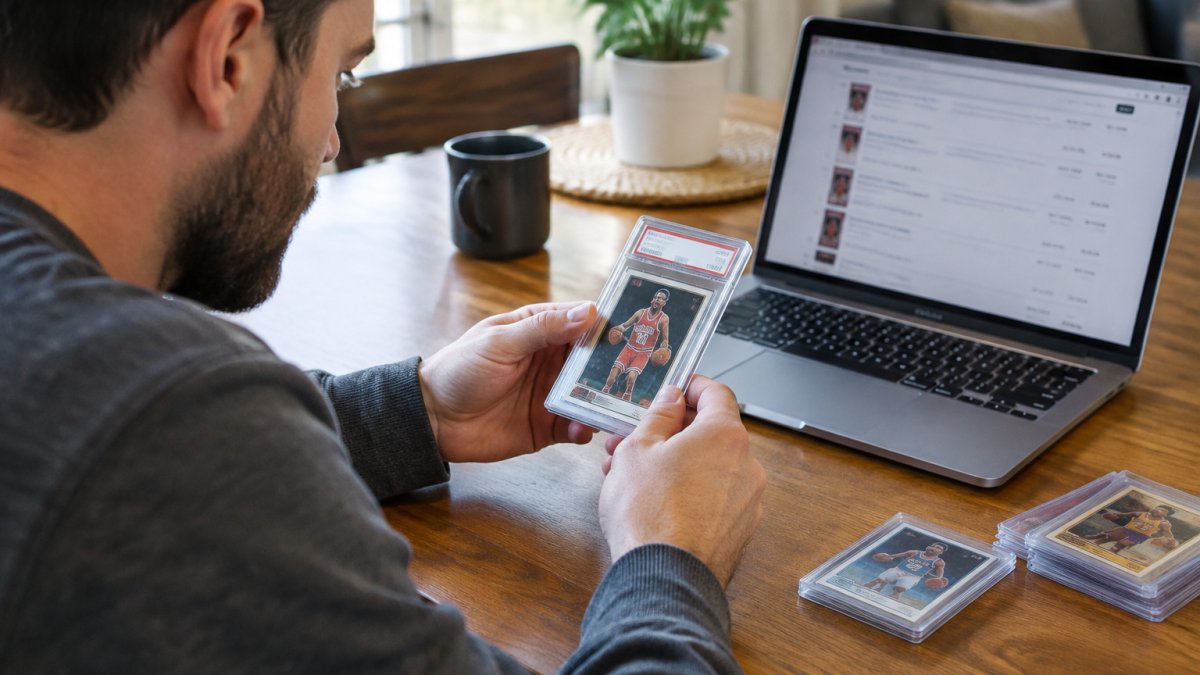
- Check the injury: Is it short-term or serious? A short absence often favors holding.
- Check the recovery timeline: Is there a clear return date? An unclear timeline often favors selling if you need liquidity.
- Check the market: Is the price still falling, or has it stabilized?
- Check your goal: Are you collecting for enjoyment or buying for resale value?
- Check your position: Does selling now lock in a loss you would avoid by waiting?
If the injury is minor and the market has already dropped, holding may make sense. If the injury is serious and prices keep falling, selling may limit the loss.
Risk management and transaction costs
Remember the costs of selling. Platform fees, shipping, insurance, and grading fees all reduce what you keep.
If you sell graded cards online, use tracked, insured shipping for high-value cards. If you ship a card yourself, confirm the buyer's shipping and tracking options before you agree to a sale.
For a step-by-step look at selling, see our guide on how to sell graded cards online safely and profitably. If you are shipping a valuable card, our seven steps to ship high-value trading cards safely cover packaging and insurance in detail.
Choosing Your Next Rookie or Singles Purchase
Injuries are a good reason to slow down, not to panic.
For a broader view of whether these cards are worth buying at all, read our guide on whether investing in sports cards is a good idea. If you are weighing a rookie purchase specifically, see whether rookie cards are a good investment in 2026.
The Marcus Lattimore 2013 Topps Turkey Red Rookie #11 is listed at $3.00, and the Robert Griffin III 2013 Topps Chrome Mojo Refractor #125 is listed at $2.50.


Find cards that fit your plan at Cardboard Superstars, where every listing shows clear condition details before checkout and every order ships with collector-grade packaging.
Frequently Asked Questions
Does a player injury affect sports card value?
Often, yes, but usually in the short term. Injury news tends to lower demand for a player's cards right after the announcement, especially for serious injuries that suggest a long absence. Prices can recover if the player returns to form. The size and duration of the drop depend on injury severity, the card's category and grade, and whether the player's performance holds up. Check recent sales for the exact card rather than relying on headlines or asking-price listings.
Do rookie cards lose value when a player gets injured?
Rookie cards can drop after an injury, particularly if the player was a high-profile prospect whose career now looks less certain. Common rookie cards of players with minor, short-term injuries often see little lasting change. Cards in higher grades or rare parallels may hold value better because scarcity supports demand. Compare pre-injury and post-injury sales of the same card, condition and grade to see the actual movement.
How long does it take for card prices to recover after an injury?
There is no fixed timeline. Some cards recover within a season once a player returns and performs well. Others stay lower for years if the injury affects long-term performance or the player never regains prior form. Track sales over several months after the injury and after the return to see whether prices are stabilizing or still falling before deciding whether to sell, hold or buy.
Should I sell or hold a player's card after an injury?
It depends on your goals and the injury details. If you need liquidity or expect a long absence with uncertain recovery, selling may limit losses. If you collect for the long term and the injury is minor or short, holding may make sense. Factor in grading and shipping costs, platform fees and the time you can wait. Base the decision on recent sales data for the specific card, not on a single news headline.
