


Table of Contents
- Why Fake Pokémon Cards Are Harder to Spot Than Ever
- Print Quality, Color Saturation, and Typography Errors
- How to Tell If Pokémon Cards Are Fake: The Light Test
- The Pokémon Card Texture Test: Surface Finish and Flexibility
- Card Back Design and Holographic Pattern Analysis
- How to Identify Fake Booster Packs Before You Open Them
- Advanced Methods: Macro Photography, UV Light, and Graded Card Verification
- How to Spot Fake Pokémon Cards When Buying Online
- Frequently Asked Questions
Last Updated: August 30, 2026
Why Fake Pokémon Cards Are Harder to Spot Than Ever
Fake Pokémon cards have become a genuine problem for collectors. Counterfeiting operations have improved dramatically, replicating surface finish, color saturation, and holographic foil with enough accuracy to fool a casual eye. High-quality printing equipment and card stock are no longer prohibitively expensive for bad actors.
This guide covers every reliable method for identifying fake Pokémon cards, from basic visual checks to advanced authentication techniques: print quality analysis, the light test, texture evaluation, booster pack inspection, and digital verification tools. Whether you're protecting a single high-value pull or evaluating a bulk lot, these methods apply.
The market for counterfeit trading cards is tracked by organizations like the International AntiCounterfeiting Coalition, which notes that collectibles are among the fastest-growing categories for physical counterfeits.
Print Quality, Color Saturation, and Typography Errors
Authentic Pokémon cards are produced by The Pokémon Company using commercial-grade printing processes that achieve precise color accuracy and sharp detail. Counterfeits almost always fall short somewhere in this chain.
Start by comparing color saturation. Authentic cards have rich, consistent color with no visible banding or muddy tones. Fakes frequently appear washed out, oversaturated, or slightly off-hue. Typography errors are one of the most reliable tells, counterfeit producers often work from scanned images rather than original print files, causing text to degrade through reproduction.
| What to Check | Authentic Card | Fake Card |
|---|---|---|
| Font weight | Consistent, clean edges | Blurry, thin, or uneven |
| Color saturation | Rich, accurate tones | Washed out or oversaturated |
| Border width | Uniform on all sides | Uneven or misaligned |
| Set number / rarity symbol | Sharp, correctly positioned | Pixelated or misaligned |
| Ink bleed | None | Visible under magnification |
Rosette Pattern and Pixelation Under Magnification
Authentic Pokémon cards are offset-printed, which means the ink is applied in a rosette pattern of tiny dots. This is visible under a loupe or jeweler's magnifier at 10x or higher. The pattern should be tight, regular, and consistent across the entire card face.
Counterfeit cards are typically inkjet or laser-printed. Under magnification, the dots appear irregular, pixelated, or absent entirely. This is one of the most definitive tests available without specialized equipment. A 10x loupe costs very little and is worth keeping in any collector's toolkit.
Font Weight, Alignment, and Border Width
Authentic Pokémon cards use licensed typefaces applied with precise specifications. Fake cards often use approximated fonts that differ in letter spacing, weight, or height. The border on an authentic card is uniform on all four sides. Counterfeits frequently show uneven borders, with one side noticeably wider or narrower than the others, a result of imprecise cutting equipment.
How to Tell If Pokémon Cards Are Fake: The Light Test
Hold the card up to a bright light source and observe how light passes through the card stock. Authentic Pokémon cards are manufactured with a black layer sandwiched between the front and back printing layers. This layer blocks light transmission almost entirely, so the card appears opaque or very dark when held to a light source.
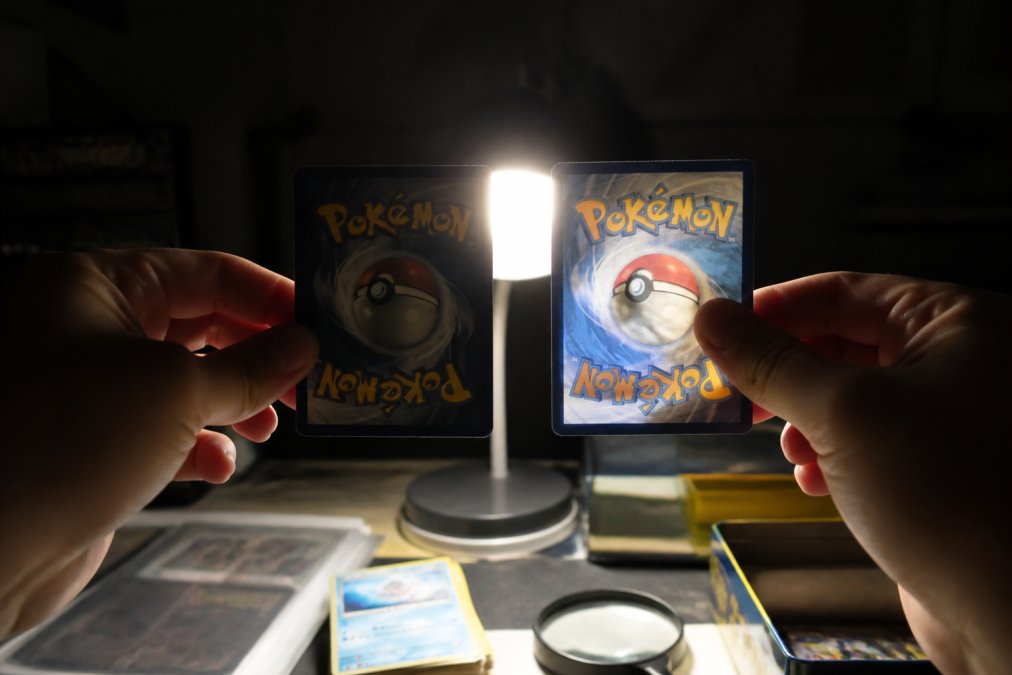
Fake cards typically lack this internal black layer. When held to light, they appear significantly more translucent, and you can often see the silhouette of the artwork through the card back. This is a fast, non-destructive test that works on any card you can physically handle.
The Pokémon Card Texture Test: Surface Finish and Flexibility
Authentic cards have a specific surface finish that is difficult to replicate without access to the same manufacturing materials. The front face of a standard card has a slight gloss, while the back has a more pronounced, consistent sheen. Holo cards have a distinctive foil texture that catches light in a specific way.
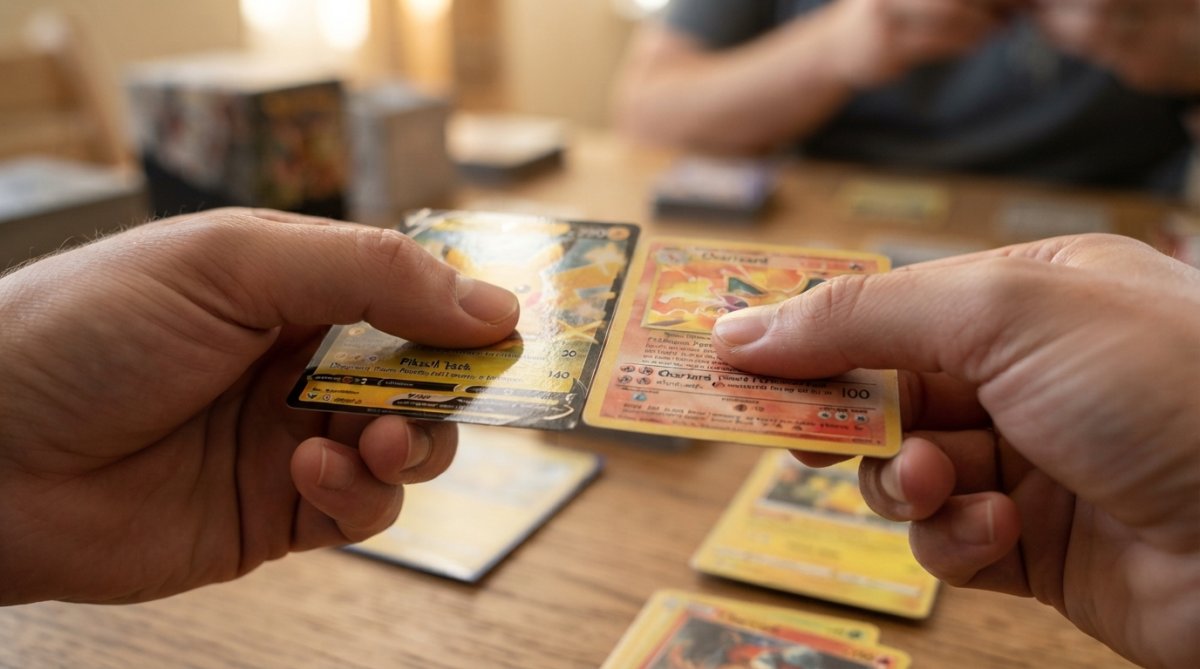
Fake cards frequently feel wrong immediately. Common problems include a surface that is too smooth, too rough, or that has a plasticky feel inconsistent with genuine card stock.
Card Thickness, Snap Back, and the Rip Test
Card thickness is measurable with a digital caliper. Authentic Pokémon cards fall within a consistent thickness range produced by official manufacturing. Fakes are often thinner, occasionally thicker, and rarely hit the exact specification.
Flexibility and snap back are related indicators. Authentic card stock has a specific rigidity and returns to flat when gently bent. Many fake cards either feel too stiff, too floppy, or fail to snap back cleanly.
The rip test is destructive and should only be used on a card you're willing to sacrifice. Authentic cards reveal a black inner layer when torn. If the torn edge shows no black layer, only white or grey paper, the card is a fake.
Card Back Design and Holographic Pattern Analysis
The card back is where many fakes make their most obvious mistakes. The Pokémon TCG card back has a specific design with defined proportions, color values, and border characteristics. The blue used on authentic card backs is a specific shade. Fakes frequently miss this, producing a back that reads as too bright, too dark, or with a slightly wrong hue.
Holographic pattern analysis is particularly useful for identifying fake rare and ultra-rare cards. Authentic holo cards use a specific foil pattern beneath the printed artwork. The pattern catches light in a characteristic way, producing a rainbow shimmer that moves predictably as you tilt the card. Counterfeit holo cards often use generic holographic film sourced from non-Pokémon suppliers, producing a shimmer that looks different and doesn't match the official release.
How to Identify Fake Booster Packs Before You Open Them
Fake booster packs are a growing problem because they're often filled with counterfeit cards arranged to mimic the weight and feel of a genuine pack. Start with the packaging itself. Authentic booster packs have a specific foil texture on the exterior, consistent printing, and a defined weight. Fakes often feel lighter or heavier than genuine packs.
Check the set logo, expansion symbol, and legal text on the pack exterior. Counterfeit packs frequently have typography errors in these areas. The color accuracy of the pack art is another indicator: fakes often show the same saturation and hue problems visible on counterfeit cards.
A common approach among experienced collectors is to purchase booster packs only from established sources with verifiable supply chains. Buying sealed product from an unknown seller at a significant discount is the highest-risk scenario for receiving fake booster packs.
Advanced Methods: Macro Photography, UV Light, and Graded Card Verification
For high-value cards, basic visual checks aren't enough. Macro photography reveals print quality details invisible to the naked eye. Photographing a card at high magnification with a macro lens or clip-on macro attachment reveals the rosette pattern, ink bleed, font edges, and holographic texture. Comparing macro photographs of a suspected card against verified authentic cards of the same set is a powerful authentication method.
UV light testing reveals details about card stock and printing that normal light cannot. Under UV illumination, authentic card stock fluoresces in a specific way. Some counterfeit stocks fluoresce differently, revealing their non-standard composition. UV flashlights are inexpensive and widely available.
Digital Verification Tools and Grading Services
Professional grading is the gold standard for high-value card authentication. Services like Professional Sports Authenticator's card grading division and Beckett Grading Services employ trained authenticators who examine every card submitted against known authentic examples. A graded card in a sealed slab from a recognized grading service is authenticated by definition.
For graded card verification, always check the grading service's online registry. PSA and Beckett both maintain searchable databases where you can verify that a specific certification number matches the card described on the label. Counterfeit slabs exist, and cross-referencing the cert number against the official registry is essential when buying high-grade examples.
How to Spot Fake Pokémon Cards When Buying Online
Buying online creates specific challenges because you're working entirely from photographs and seller information. Request high-resolution photographs of both the card front and card back before purchasing. Specifically ask for images under different lighting conditions, including angled shots that reveal the holographic pattern and surface finish. A seller unwilling to provide detailed photographs of a high-value card is a significant red flag.
Examine seller feedback carefully. Positive feedback history on verified platforms, particularly for trading cards specifically, is meaningful. Price is a reliable signal, fake Pokémon cards almost always appear at prices significantly below market value.
For significant purchases, ask whether the card has been graded or whether the seller will accept a return if a third-party authenticator identifies it as a fake. Reputable sellers of authentic product have no reason to refuse either request.
The collector community is also a resource. Forums and communities maintain lists of known counterfeit sellers and discuss emerging fake card types as they appear in the market. The Pokémon TCG community resources and official play information provide guidance on official card characteristics that collectors can use as reference points.
Identifying fake Pokémon cards consistently takes practice and the right reference points. The most reliable protection is buying from sellers with documented authenticity records, transparent product listings, and a track record collectors can verify. Cardboard Superstars offers authentic products, clear product details before checkout, and collector-grade packaging on every order, backed by 100% positive eBay feedback across thousands of transactions. Find cards you can trust at Cardboard Superstars.
Frequently Asked Questions
What do fake Pokémon cards look like?
Counterfeit Pokémon cards typically show washed-out or oversaturated colors, blurry text, and misaligned borders. The card back often has incorrect color saturation or a slightly off rosette pattern visible under magnification. Typography errors are common: fonts may appear too thin or too bold compared to authentic cards, and the set number or rarity symbol may be poorly printed. Holding a fake next to a genuine card makes most of these differences immediately obvious.
Can you tell if a Pokémon card is fake by the back?
Yes. The card back is one of the most reliable indicators. Authentic Pokémon cards have a consistent deep blue color with a sharp, symmetrical Poké Ball design and clean borders. Counterfeits frequently show faded or overly dark blue tones, blurred details in the center design, and uneven border widths. The holographic foil pattern on certain cards also differs noticeably on fakes, often appearing as a flat, uniform sheen rather than the shifting, structured foil of an official release.
Do fake Pokémon cards have texture?
Most counterfeits feel noticeably different from authentic cards. Genuine Pokémon cards have a specific surface finish, slightly smooth with a controlled gloss, and a defined flexibility that causes them to snap back when gently bent. Fake cards often feel flimsy or overly rigid, and their surface may feel slick, sticky, or completely matte. Running a fingernail lightly across the card face can reveal ink bleed or an uneven coating that is absent on cards from an official release.
How do you verify a Pokémon card is authentic?
Run through several checks: hold the card up to light to test transparency, inspect print quality and color accuracy under good lighting, check font weight and text alignment with a loupe or macro photo, and compare the card back design against a known authentic card. For high-value singles, submit the card to a professional grading service. Graded card slabs from established grading companies include authentication as part of the process, giving collectors the strongest available verification for rare cards.
This article was written using GrandRanker