


Table of Contents
- How to Check the Value of Individual Pokémon Cards
- Pokémon Card Condition and Value: Why Grading Matters
- Using a Pokémon Card Value Spreadsheet to Track Your Collection
- Best Apps for Tracking Pokémon Card Collection Value
- Finding Pokémon Card Sold Prices Across Online Marketplaces
- Scanning Cards to Identify Them and Track Variants
- Building a Repeatable Valuation Workflow for Your Entire Collection
- Protecting Your Collection Data and Managing Uncertainty
- Frequently Asked Questions
Last Updated: October 9, 2026
How to Check the Value of Individual Pokémon Cards
To track pokemon card collection value, you first need to know what each card is worth, you can't build an accurate total otherwise.
Start by identifying your card: the set symbol on the bottom right tells you which set it's from, and the card number appears as a fraction (like "25/102") on the bottom left. These two details are your foundation.
Using Recent Sold Listings and Market Comps
Sold listings tell you what collectors actually paid, not what sellers are asking.
Search your card on major marketplaces, filter by "sold" listings, and record at least three sales from the past 30 days (expand to 60 days if needed). Average those prices for your realistic market value.
Match the card's condition to the sold listings you compare against, a near-mint card shouldn't be compared to a heavily played copy.
Understanding Asking Prices vs. Completed Sales
Sellers list at whatever price they hope to get; buyers pay what the market supports. The gap can be massive, especially for low-demand cards.
A common mistake is using asking prices as your collection value.
Watch trends over 2-3 months: climbing sold prices signal real momentum, while high asking prices with no sales mean the card isn't moving at that price.
Pokémon Card Condition and Value: Why Grading Matters
Condition is the single biggest factor in price, a near-mint card can be worth 3 to 5 times more than the same card lightly played. Grading services assign an official grade buyers trust.
Condition Grades and Their Impact on Price
Grading uses a 1-10 scale. Here's what each grade means for your collection value:
- Gem Mint (9-10): Near-perfect cards with minimal wear. These command premium prices.
- Mint (8): Slight imperfections visible only under close inspection. Still high value.
- Near Mint (7): Light wear but no major damage. Good value for most collectors.
- Lightly Played (6): Visible wear from handling. Noticeably less valuable.
- Played (5): Clear wear from regular use. Significantly lower value.
- Heavily Played (4 and below): Heavy damage, creasing, or staining. Minimal collector value.
A single grade point can shift a card's value by 20-40 percent. This is why grading matters for valuable cards.
Raw vs. Graded Cards
Raw cards are ungraded; graded cards have been assessed by a third-party service and encased in a slab with a visible grade.
Raw cards sell for less because buyers can't verify condition in person; graded cards command a premium because the grade removes uncertainty.
Consider grading high-value cards; track bulk and lower-value singles as raw cards in your spreadsheet.
Using a Pokémon Card Value Spreadsheet to Track Your Collection
A spreadsheet is your most flexible tracking tool: you control the format, add custom fields, and own your data completely.
Setting Up Your Tracking Spreadsheet
Create columns for these essential fields:
- Card Name: The full card name
- Set Name: Which set it's from (e.g., "Base Set")
- Card Number: The set number and total (e.g., "25/102")
- Condition Grade: Raw or the official grade (e.g., "7" or "Near Mint")
- Current Market Value: Price per card based on recent sold listings
- Quantity: How many copies you own
- Total Value: (Market Value × Quantity)
- Last Updated: Date you checked the price
- Notes: Any special details (holo variant, printing error, etc.)
Start with cards you know are valuable and add bulk commons later. Use a free tool like Google Sheets for access from any device.
Updating Values and Portfolio History
Update your spreadsheet every 30 days by checking sold listings and adjusting the market value column, creating a reviewable price history.
Keep a separate "History" sheet recording your total collection value on the first of each month.
Don't update prices daily. Market fluctuations are normal. Monthly updates capture real trends without creating noise.
Best Apps for Tracking Pokémon Card Collection Value
Apps offer convenience spreadsheets don't, with built-in price databases and automatic updates.
Key Features to Look For in a Collection App
The best collection apps include:
- Automatic price updates: The app pulls current market data so you don't have to search manually.
- Card scanning: Use your phone camera to identify cards instead of typing details.
- Condition tracking: Record each card's grade or condition status.
- Portfolio history: See how your collection value changes over time.
- Export options: Download your data as a backup or to use elsewhere.
- Offline access: Use the app without an internet connection.
Not every app includes all these features. Prioritize the ones that matter most to you.
Building and Organizing Your Digital Collection
Start by scanning your cards: most apps use image recognition to identify them automatically, then you confirm details and add condition information.
Organize by set, then sort by card number, mirroring how collectors store physical cards, making cross-referencing easy.
Use tagging or filtering to flag valuable cards, recent acquisitions, or cards you're considering selling.
Finding Pokémon Card Sold Prices Across Online Marketplaces
Checking several marketplaces gives you a complete picture of market value.
Where to Find Reliable Price Data
Major marketplaces for Pokémon cards each have a completed sales section.
Cross-check across marketplaces, a card might sell for $35 on one platform and $42 on another. Average recent sales across all platforms.
Prefer sales from the past 30 days, since older ones become less relevant as conditions shift. If nothing sold in 30 days, expand to 60.
Accounting for Fees, Shipping, and Net Resale Value
If you plan to sell, remember fees and shipping cut your profit: marketplace fees typically run 10-15 percent, and shipping costs $3-8 depending on packaging.
Rip & Protect Bundle 200 Penny Sleeves, 200 Semi Rigid Card Savers →
A card that sold for $40 might net only $30 after fees and shipping.
Track full market value for cards you're keeping long-term and net value for cards you might sell, this distinction helps you decide which to hold and which to move.
Scanning Cards to Identify Them and Track Variants
Card scanning saves time when cataloging hundreds or thousands of cards.
Using Card Databases for Set Name and Card Number Lookup
This works best with cards in good condition; heavily worn cards may not scan, so enter those manually using the set symbol and card number.
The database also shows variants, regular holo, reverse holo, shadowless, or first edition, helping you identify which version you own.
Handling Variants and Hard-to-Identify Cards
When scanning fails, use the set symbol and card number to narrow possibilities, then compare details to database variants, checking printing differences, holo patterns, and edition stamps.
If unsure, record the card as "variant unclear" and research later, don't guess on high-value cards.
Building a Repeatable Valuation Workflow for Your Entire Collection
A systematic approach keeps your entire collection valued consistently and easy to update.
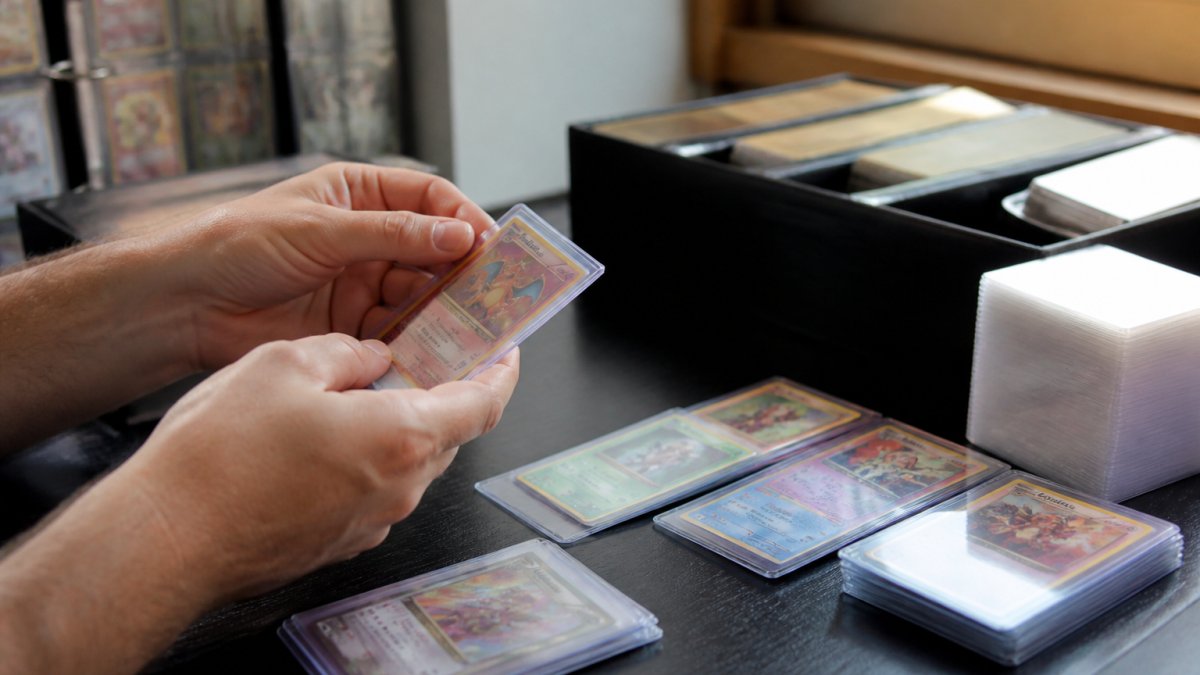
Step 1: Organize and Catalog Your Cards
Sort your physical collection by set, then by card number, this makes the next steps faster.
Create a master list of every card with set name, card number, and quantity, noting condition for high-value cards. You don't need perfect details yet, just a complete inventory.
Step 2: Research Current Market Values
For each card, find at least three sold listings from the past 30 days, record the prices, and average them for your current market value.
Prioritize valuable cards first; once cards worth $20 or more are valued, move to bulk commons, which often sell for $0.25-$1 each and can be estimated in bulk rather than priced individually.
Step 3: Document Condition and Grading Status
Note whether each card is raw or graded. Record the official grade if graded; if raw, assess honestly as near mint, lightly played, or played.
For high-value cards, consider professional grading at $10-20 per card, it can significantly increase value for cards worth $50 or more.
Step 4: Calculate Collection Total and Track Over Time
Multiply each card's market value by quantity, sum everything for your total collection value, and record the total and date.
Repeat monthly, updating market values for recently sold cards and recalculating your total. This creates a portfolio history showing whether your collection is growing in value.
Step 5: Monitor Price Fluctuation and Market Trends
Review monthly totals to spot trends, is your collection gaining, losing, or flat?
Watch for cards appreciating quickly (gaining collector interest) and cards dropping in value (oversupplied or losing popularity).
Use these insights to guide purchases: buy undervalued cards and consider selling cards that have peaked.
Protecting Your Collection Data and Managing Uncertainty
Your collection data is valuable, protect it with backups and account for valuation uncertainty.
Backups and Data Portability
If using an app, export your data regularly as a spreadsheet or PDF and store it on cloud storage like Google Drive or Dropbox.
If using a spreadsheet, enable version history, Google Sheets keeps automatic backups you can recover if something goes wrong.
Never rely on a single source: if an app shuts down or your account is compromised, you still have your backup.
Accounting for Valuation Uncertainty
Your collection value is an estimate, not a guarantee. A card worth $50 today might be worth $35 next month if similar cards sell lower.
Note the date you checked each price, prices older than 60 days become less reliable, so update regularly.
To protect your collection while you're building it, consider investing in proper storage supplies. The Cardboard Superstars Rip & Protect Bundle provides 200 penny sleeves and 200 semi-rigid card savers for $32, giving you essential protection for handling and storing cards safely as you catalog and value them.

For larger collections, the All-Star Supply Pack offers 200 toploaders and 200 penny sleeves for $29.99, ideal for organizing and protecting cards as you work through your valuation process.
Tracking your Pokémon card collection value takes time, but becomes routine once you establish a system.
Frequently Asked Questions
How do I find the worth of my Pokémon cards?
Start by identifying each card's set name, card number, and condition. Then check recent sold listings on online marketplaces to see what similar cards actually sold for, not asking prices. Use apps or spreadsheets to organize your findings. For high-value cards, consider professional grading, which significantly impacts market value. Always compare multiple sales to get an accurate average sale price rather than relying on a single listing.
Should I use sold listings or asking prices to value Pokémon cards?
Always use sold listings and completed sales over asking prices. Asking prices reflect what sellers hope to get, but sold listings show what buyers actually paid. This difference is critical, a card listed at $500 might consistently sell for $300. Track recent sales across multiple marketplaces over the last 30-90 days to establish a realistic market value. Condition, grading, and variants all affect final prices, so compare cards with matching specifications.
What is the best app for tracking Pokémon card collection value?
The best collection tracker app depends on your needs. Look for apps that let you scan or manually add cards, automatically pull market prices, store condition notes, and generate portfolio reports. Ensure the app backs up your data and lets you export your collection. For beginners, a simple spreadsheet works well; serious collectors often prefer dedicated apps that update prices automatically and track portfolio history over time.
How does card condition and grading affect Pokémon card value?
Card condition dramatically affects value. Raw cards (ungraded) are valued based on visible wear: near mint cards command premium prices, while heavily played cards sell for a fraction of the cost. Professional grading assigns a numerical score (1-10 scale) that buyers trust and pay premiums for. A graded gem mint card can be worth 5-10 times more than the same card in poor condition. When tracking collection value, always note condition and whether a card is graded, as this determines its realistic market price and resale potential.