


Last Updated: October 22, 2026
Quick Summary
To verify graded pokemon cards, type the certification number from the slab's front label into the grading company's own online database and confirm the record matches the card name, set, card number, year, and grade. A record that exists is not proof, because scammers copy real numbers onto fake slabs, so always compare the record to the physical card in hand.
- The certification number sits on the front label of the slab, usually near the bottom or under the grade.
- PSA is the largest grading service in the hobby, so its database is the most commonly faked.
- Photograph the label and the database record side by side before you buy as evidence for disputes.
- A barcode that resolves to a different number than the printed text is a serious red flag.
- Walk away when a seller pressures you to skip the lookup or dismisses a clear mismatch as a database error.
Table of Contents
- Step 1: Look Up the Certification Number in the Grading Company's Online Database
- Step 2: How to Check a PSA Certification Number
- Step 3: How to Verify CGC Graded Pokémon Cards
- Step 4: How to Spot Fake PSA Slabs and Counterfeit Holders
- Step 5: Match the Database Record and Card Details to the Item in Hand
- Step 6: What to Do When a Certification Number Is Missing, Duplicated, or Mismatched
- Step 7: Safe Buying and Seller-Verification Checklist
- Frequently Asked Questions
Step 1: Look Up the Certification Number in the Grading Company's Online Database
To verify graded Pokemon cards, start with one simple action: type the certification number into the grading company's own database. That lookup is the fastest way to confirm a slab exists in the official records.
A certification number is the unique serial number a grading service assigns to each card it grades. The number ties the physical slab to a database record. No record, no proof.
Where to Find the Certification Number on the Label
The number sits on the front label of the slab, usually near the bottom or under the grade. It is printed in plain text, often with a barcode beside it. Read it digit by digit and write it down before you search.
What a Valid Database Record Should Show
A real record should display the card name, set, card number, year, grade, and often a photo of the card. If the record loads but the details look wrong, stop. A record that "exists" is not the same as a record that matches.
Step 2: How to Check a PSA Certification Number
To check a PSA certification number, go to PSA's official site and use its certification lookup tool. Enter the full number exactly as printed.
Here is what we look for on a PSA record:
- The card name and set match the physical card
- The grade matches the number on the label
- The card number and year match
- The label style fits the era of the grade
PSA is the largest grading service in the hobby, so its database is the most commonly faked. A duplicated or reused number is a red flag. If a seller rushes you past the lookup, walk away.
Step 3: How to Verify CGC Graded Pokémon Cards
To verify CGC graded Pokémon cards, use CGC's own certification lookup and confirm the record matches the slab in your hand (Verify CGC Certification | Resources). CGC grades a huge share of Pokémon cards, and its database works the same way: number in, record out.
CGC slabs have their own label layout and font. Compare the label text to the record carefully. Watch for cards where the label says one grade but the record shows another.
Step 4: How to Spot Fake PSA Slabs and Counterfeit Holders
Spotting a fake PSA slab comes down to three checks: the label, the plastic, and the seal. Counterfeiters copy the look of a slab but rarely get all three right. Slow down and inspect each one, and treat any single mismatch as a reason to pause rather than a reason to walk, then confirm with the grading company.
Label Fonts, Text Alignment, and Holographic Security Features
Real labels use consistent fonts and clean alignment. Fake labels often have blurry text, uneven spacing, or a hologram that looks flat or off-color. Hold the slab under light and tilt it. The security features should shift and catch the light.
A practical label inspection sequence:
- Font consistency: Compare the card name, set, and grade against a known-good label from the same grading era. Counterfeiters often mix fonts across lines.
- Alignment: Check that text baselines sit level and that the grade is centered in its field. Crooked or drifting text is a common fake tell.
- Hologram behavior: Tilt the slab slowly. A real holographic element shifts color and depth; a printed or flat sticker does not.
- Barcode and number: Confirm the barcode scans to the same certification number printed in text. A barcode that resolves to a different number is a serious red flag.
Case Condition: Cloudy Plastic, Cracks, and Tampering Signs
A cloudy case, hairline cracks near the edges, or a label that looks lifted are all tampering signs. Scratches are normal wear. Glue residue or a loose label is not.
Use this tampering inspection checklist on every slab:
Mewtwo ex SAR 128/103 Special Art Rare 30th Celebration M6a Japanese Pokemon →
- Check the seams for gaps or uneven sonic welds
- Look for foggy, yellowed, or chemically hazed plastic
- Confirm the label sits flat with no bubbles, lifting, or residue
- Tilt the case under light to check for resealing marks or clamp lines
Visual inspection has limits. A slab can pass every visual check and still be a counterfeit or a swap. Treat the checklist as a filter, not a verdict, and confirm anything suspicious with the grading company before money changes hands.
What Visual Checks Cannot Prove
No checklist replaces the grading company's records. A clean-looking slab with a matching number can still contain a swapped card. Use the visual pass to decide whether to keep investigating, then rely on the database match and, when needed, direct confirmation from the grading service. If a seller discourages either step, that is the strongest signal in the entire inspection.
Step 5: Match the Database Record and Card Details to the Item in Hand
When you verify graded Pokemon cards, matching the record to the card is where most buyers get lazy. The database can be real while the card inside is a swap.
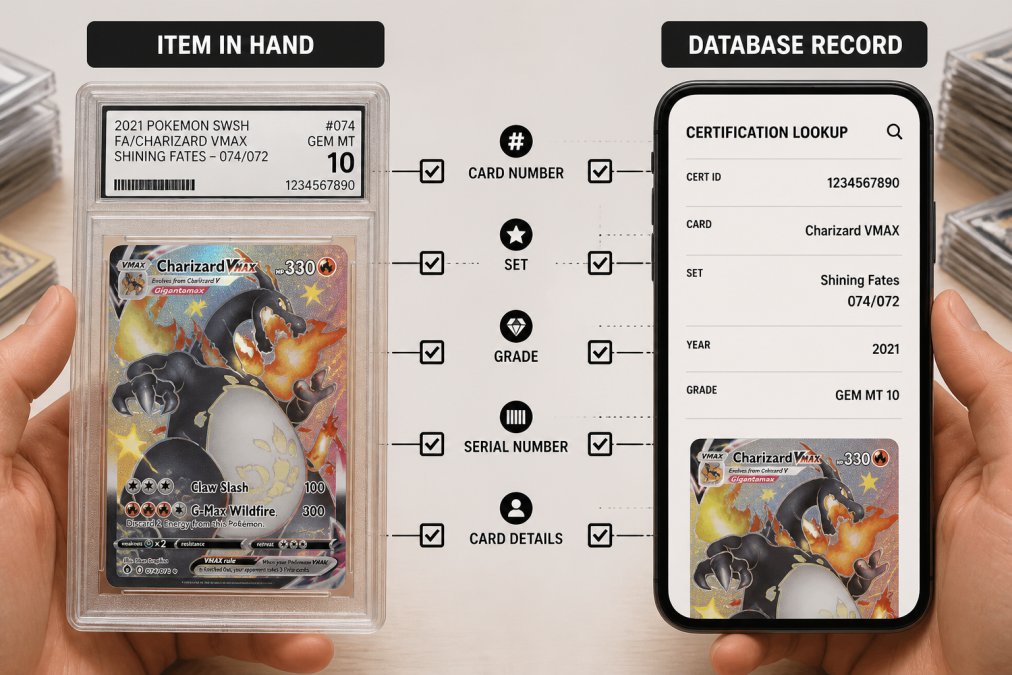
Check the holo pattern on holographic cards. Fakes often miss the exact shine. Verify the card surface and edges against the photo. If the record has no photo, ask the seller for clear close-ups before you commit.
Step 6: What to Do When a Certification Number Is Missing, Duplicated, or Mismatched
A missing, duplicated, or mismatched number means you stop and ask questions. No number on the label is a serious red flag. A number that returns two different cards is worse. The table below turns each outcome into a concrete next step, because the right response depends on which failure you are looking at.
Decision Path by Lookup Result
- Missing number on the label: Ask the seller for the original grading submission paperwork and a clear photo of the full label. If they cannot produce either, treat the slab as unverified and skip the sale.
- Number not found in the database: Re-check the digits against the label, including leading zeros and letter prefixes. If it still fails, ask the seller to confirm the number in writing. A record that does not exist is not proof of a fake by itself, older submissions and data migrations can create gaps, but it is not proof of authenticity either.
- Duplicated number (returns two different cards): Report it to the grading company with photos of the slab and the record. Do not buy until the company resolves which record is legitimate. A duplicated number is one of the clearest signs of a copied label.
- Mismatched details (name, set, card number, year, or grade differ): Treat the slab as suspect until proven otherwise. Compare each field one at a time to isolate what differs. A single mismatch in grade or card number is enough to pause; multiple mismatches are enough to walk away.
Evidence to Collect Before You Escalate
Contact the grading service directly with a complete evidence package. Their team can confirm whether a record is legitimate, and a complete package gets a faster, clearer answer:
- Photos of the front and back of the slab under even lighting
- A close-up of the label showing the certification number and barcode
- A screenshot of the database record with the URL visible
- A photo of the card itself, including any visible centering or surface issues
- The seller's listing text and any written claims about the card
Save the evidence package even if the sale falls through. If the same number or slab resurfaces in another listing, you already have the record to compare against.
When to Walk Away
Never let a seller talk you out of a second opinion. Walk away when the seller refuses to provide label photos, pressures you to skip the lookup, cannot explain a duplicated number, or dismisses a clear mismatch as a database error. A legitimate seller will welcome the check because it protects both sides of the transaction.
Step 7: Safe Buying and Seller-Verification Checklist
Safe buying starts before checkout. Use this checklist every time you buy a graded card online:
- Seller has strong, long-term feedback history
- Listing shows clear photos of the label and slab
- Certification number is visible and matches the record
- Card details match the database entry
- Slab shows no tampering signs
At Cardboard Superstars, we list clear product details before checkout and ship in collector-grade packaging, so you know what you are getting.
When you are ready to add to your collection, browse our graded cards and Mewtwo ex SAR 128/103 Special Art Rare and other authentic singles.

Frequently Asked Questions
Can a real certification number appear on a fake Pokémon slab?
Yes. Counterfeiters often copy a legitimate certification number from a real graded card and print it on a fake label. The number will pull up a valid database record, but the card, label, or holder won't match the record's details. Always compare the card's set, card number, year, grade, and any database images to the item in hand. A valid number alone does not prove the slab is genuine, so treat it as one step in a larger verification process.
How do I check a PSA certification number online?
Go to PSA's official website and open its certification verification tool. Enter the serial number printed on the label, usually an 8- or 9-digit figure. The lookup should return the card's set, card number, year, grade, and often a scan or image of the card. Compare every detail to the physical slab. If the record is missing, the number is duplicated across listings, or the card details don't match, treat the item as suspect and ask the seller for more documentation.
What should I inspect on a graded Pokémon card slab?
Check the label first: fonts should be crisp, text should be aligned, and the holographic security element should reflect light correctly. Then inspect the holder for cloudy plastic, cracks, scuffs, or signs of resealing. Look at the card inside for surface damage, off-centering, or corners that don't match the assigned grade. Finally, compare the card's set symbol, card number, and year to the database record. Any mismatch is a red flag.
Who can authenticate Pokémon cards?
Third-party grading services are the standard authenticators for Pokémon cards. PSA, CGC, and Beckett each issue a grade and encapsulate the card in a tamper-evident holder with a certification number. Their online databases let you verify that record. For raw or ungraded cards, no single authority exists, so collectors rely on expert inspection, provenance, and seller reputation. When buying graded cards, always run the certification lookup yourself rather than trusting a screenshot.
Verifying graded cards takes a few minutes and saves you from costly mistakes. Cardboard Superstars makes it easier with authentic products, clear product details, and secure collector-grade packaging backed by our 100% positive eBay feedback. Find cards with confidence and collect with peace of mind.