


Table of Contents
- Is Sports Card Investing a Viable Investment?
- The Real Risks of Sports Card Investing
- Vintage vs. Modern Sports Cards: Which Holds Value?
- Understanding Sports Card Grading Services
- How to Store Sports Cards for Investment Protection
- Market Liquidity and Exit Strategies
- Authentication, Counterfeiting, and Security
- Conclusion: Is Sports Card Investing Right for You?
- Frequently Asked Questions
Last Updated: September 21, 2026
Is Sports Card Investing a Viable Investment?
Sports card investing sits between hobby collecting and legitimate alternative asset allocation, with genuine returns possible on vintage cards and rare modern hits, but significant depreciation risk on others.
Success depends on risk tolerance, investment horizon, and whether you're speculating or holding long-term. A 1952 Mickey Mantle sold for over $5 million and a pristine 1986 Michael Jordan rookie for six figures, but these represent the extreme tail end. The median card will likely appreciate modestly, if at all.
Sports cards function as a tangible alternative asset class offering portfolio diversification, but unlike publicly traded assets, they operate with less transparency, higher transaction fees, and liquidity constraints.
The Real Risks of Sports Card Investing
The biggest risk is overpaying for cards that never appreciate, often by entering after hot streaks when prices are inflated by speculation.
Card condition is everything, and it degrades over time. Environmental factors like humidity, temperature fluctuations, and light exposure accelerate deterioration, potentially dropping a Mint 9 to Excellent 7.
Counterfeiting is a real threat on high-value cards. Grading services like PSA, BGS, and SGC combat this, but authentication can be disputed and grades may vary between services.
Liquidity risk is substantial. You can't instantly convert a sports card into cash like stocks. During downturns, bid-ask spreads widen dramatically, a $500 card might fetch only $300 in a rushed sale, and auction houses charge 10-20% commission.
Market saturation affects modern cards especially. Manufacturers produce millions annually, so cards without documented scarcity, low population reports, or genuine rookie status will struggle to appreciate against inflation.
Vintage vs. Modern Sports Cards: Which Holds Value?
Vintage cards have a structural advantage: scarcity is fixed. No new 1980s cards are being printed. Supply only decreases as cards are lost or damaged. This creates genuine scarcity supporting long-term appreciation.
Well-preserved vintage cards from the 1950s-1980s have proven track records, appreciating steadily over decades and often outpacing inflation, though authentication is challenging since they predate modern grading standards.
Modern cards face different dynamics. Manufacturers intentionally produce multiple versions, base cards, parallels, serial-numbered variants, and autographed versions, suppressing appreciation potential. A 2024 rookie card might be exciting today, but if the player underperforms, it becomes one of millions with minimal demand.
The exception is modern cards with documented low population, like a rookie autograph graded PSA 10 with a population of 3, though predicting which rookies become stars is speculation, not investing.
For most collectors, vintage cards aged 40+ years offer better appreciation potential than modern cards. The trade-off is higher entry cost and greater authentication risk.
Understanding Sports Card Grading Services
Professional grading services assign a condition grade and create a permanent record in a population report. Few collectors understand how to use population reports to identify undervalued cards and avoid overpaying.
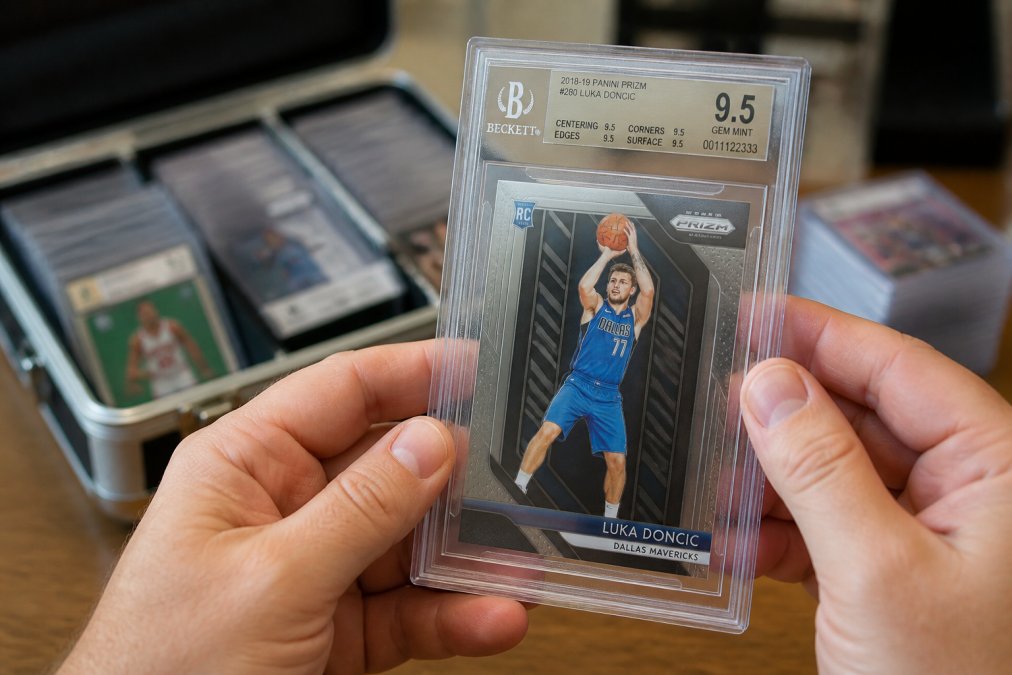
The Three Dominant Services and Their Market Position
PSA, BGS, and SGC control approximately 95% of the high-value card market. PSA leads for modern cards and post-1980s vintage, BGS appeals to collectors valuing precise condition assessment, and SGC dominates pre-1980 vintage cards.
Grading costs vary by service and turnaround time: standard service $50-150, expedited $200-400, rush $500-1,000+. For a $100 card, a $100 grading fee requires 100% appreciation just to break even, so professional graders are selective.
How Condition Grades Drive Pricing
The grading scale runs from 1 (Poor) to 10 (Gem Mint). Adjacent grades can represent 50-200% price variance.
A PSA 8 indicates light wear visible only under close inspection, while PSA 9 shows virtually no wear. A 1986 Michael Jordan rookie graded PSA 8 might sell for $15,000-20,000, while PSA 9 could fetch $40,000-60,000, since condition is the primary scarcity driver for high-volume cards.
Graders evaluate centering, corners, edges, and surface; weakness in one category determines overall grade. Grading is not perfectly consistent across different graders.
Population Reports: The Secret Weapon for Smart Investors
Each grading service publishes population reports showing how many copies of each card have been graded at each grade level, critical for investment decisions.
A PSA 9 with a population of 312 is far more common than one with a population of 12. The card with 312 copies competes against 311 other identical cards.
2026 Topps Series 1 Baseball Hobby Box →
For modern cards, population reports reveal genuine versus false scarcity. A 2024 rookie autograph with a population of 500 at PSA 9 isn't scarce, while a population of 5 at PSA 10 is genuinely rare, with price differences reaching 10x or more.
Population growth is equally important. If the population of your card at PSA 9 grows from 50 to 200 in six months, scarcity is declining and prices will follow.
Using Population Data to Avoid Overpaying
Professional investors use this framework:
-
Identify the population threshold for genuine scarcity. Vintage cards (pre-1980) under 100 at any grade are genuinely scarce; modern cards under 50 at PSA 9+ are worth considering.
-
Compare population across grades. If a card has 5 copies at PSA 10 and 50 at PSA 9, the PSA 9 is better value. If it has 5 at PSA 10 and 5,000 at PSA 9, the PSA 10 premium is justified.
-
Track population growth over time. Stable population means scarcity is real; growing 20%+ annually means scarcity is declining.
-
Cross-reference with price history. If a card's price gap versus lower grades is narrowing despite stable population, demand is declining.
-
Avoid inflated populations. A modern card with 10,000+ copies at any grade is a commodity and will appreciate only if the player becomes a superstar.
The Grading Service Hierarchy and Market Perception
PSA 9 commands a higher price than SGC 9 for most modern cards because PSA is the market standard, creating arbitrage opportunities. Older slabs sometimes trade at 10-20% discounts because grading standards have tightened.
How to Store Sports Cards for Investment Protection
Storage determines whether your cards appreciate or deteriorate. Ideal conditions are 65-70 degrees Fahrenheit with 40-50% relative humidity. Basements and attics fluctuate wildly with seasons.
Raw cards need sleeves and top loaders at minimum. For valuable raw cards, consider one-touch magnetic cases or screw-down holders.
Slabbed cards are more protected but not invulnerable.
Market Liquidity and Exit Strategies
Exit strategy is where most sports card investors fail. The difference between a well-planned exit and a forced sale can easily be 20-30% of your collection's value.
Understanding the Fee Structure Across Sales Channels
Timing Risk and Market Cycles
Building Your Exit Plan Before You Buy
The Liquidity Penalty During Market Stress
Authentication, Counterfeiting, and Security
Counterfeiting has become sophisticated. High-value vintage cards attract counterfeiters, though fakes fail under expert scrutiny.
Conclusion: Is Sports Card Investing Right for You?
Is investing in sports cards a good idea? It depends on your actual goals.
| Consideration | Vintage Cards | Modern Cards |
|---|---|---|
| Scarcity | Fixed (no reprints) | High supply (ongoing production) |
| Authentication Risk | Higher (pre-grading era) | Lower (modern standards) |
| Entry Cost | Higher ($500-$5,000+) | Lower ($10-$500) |
| Appreciation Potential | Proven long-term | Speculative, dependent on player performance |
| Liquidity | Moderate (established market) | High (volume but lower prices) |
| Storage Requirements | Strict (environmental control) | Moderate (standard protection) |
Frequently Asked Questions
What are the primary risks associated with investing in sports cards?
Sports card investing carries several significant risks. Market volatility can cause sudden price drops, especially for modern cards and speculative purchases. Counterfeiting remains a persistent threat, making authentication critical. Liquidity risk means you may struggle to sell cards quickly without accepting below-market prices. Additionally, condition deterioration, market saturation, and shifting collector preferences can erode value. Unlike traditional assets, sports cards lack regulatory oversight and transparent pricing mechanisms, making fair valuation difficult.
How does card grading affect the long-term value of a sports card?
Professional grading services like PSA, BGS, and SGC authenticate cards and assign grades (1-10 scale) that directly impact resale value. A slabbed card in mint condition (grade 9-10) commands premium prices and sells more easily than raw cards. Grading provides buyer confidence and protects against counterfeits, which is essential for high-value purchases. However, grading fees ($10-$100+ per card) reduce profit margins on lower-value cards, and market demand for specific grades fluctuates. Cards graded in the 7-8 range often offer better value-to-liquidity ratios than premium grades.
Is it better to invest in modern rookies or vintage sports cards?
Modern rookies offer lower entry costs and faster market feedback but face higher volatility and counterfeiting risk. Vintage cards typically show steadier long-term appreciation and greater scarcity, but require substantial upfront capital and depend on condition. Modern cards are easier to authenticate and grade, while vintage cards may lack grading history. The best choice depends on your risk tolerance, budget, and time horizon. Diversification across both categories, allocating capital to established vintage cards and selective modern rookies, reduces concentration risk.
What role does liquidity play in the sports card market?
Liquidity determines how quickly you can convert cards to cash and at what price. High-liquidity cards (popular players, iconic sets, high grades) sell within days at fair market value. Low-liquidity cards may take months to sell or require steep discounts. Market corrections and shifts in collector demand can instantly reduce liquidity for entire categories. Exit strategy planning is critical: build a portfolio with at least 60-70% highly liquid holdings if you need flexible access to capital. Illiquid cards should represent speculative positions only, not core holdings.