


Table of Contents
- Where to Buy Authentic Japanese Trading Cards Online
- Japanese Trading Card Booster Boxes: What to Expect
- Japanese Pokémon Cards Online: Finding Rare Singles
- How to Spot Fake Japanese Pokémon Cards
- Japanese Card Seller Reviews and Buyer Protection
- Shipping, Customs, and Total Cost Breakdown
- Choosing the Right Option for Your Collection
- Frequently Asked Questions
Last Updated: October 19, 2026
Where to Buy Authentic Japanese Trading Cards Online
Finding authentic Japanese trading cards online requires knowing where to look and what to verify before you buy. The market for sealed booster boxes, rare singles, and collectible card games has exploded, but so has the risk of counterfeits.
Authentic Japanese trading cards are available online when you know how to spot legitimate retailers and verify product authenticity. Whether you're hunting a Pokémon booster box, One Piece singles, or other TCGs, these strategies will help you buy with confidence.

| Retailer Type | Best For | Key Consideration |
|---|---|---|
| Established online shops | Sealed boxes, singles, variety | Transparency in product details |
| Marketplace sellers | Competitive pricing, rare finds | Seller verification and feedback |
| Brand direct sources | Official releases, authenticity guarantee | Limited selection, higher prices |
| Specialty collectors | Graded cards, high-value pulls | Authentication documentation required |
Japanese Trading Card Booster Boxes: What to Expect
A Japanese trading card booster box is a sealed case of booster packs, typically 20 to 30 depending on the set and manufacturer. Each pack holds 5 to 6 cards, so a box yields roughly 100 to 180 cards.
Sealed vs. Opened Boxes
Sealed boxes command premium prices because they guarantee unopened packs with unknown contents, offering investment potential and the thrill of fresh pulls. An opened box costs less but carries risk: the seller may have removed the best packs first.
When buying sealed, verify intact shrink wrap, undamaged corners, and matching serial numbers on all packs where applicable. Reputable sellers photograph both the front and back to show condition.
Popular Sets and Price Range
Japanese Pokémon sets dominate the market. The Pokémon 30th Celebration Japanese Booster Box at Cardboard Superstars runs $225.25 for 20 packs with nostalgic 30th anniversary artwork. The Ninja Spinner M4 Japanese Booster Box costs $95.00, an accessible entry point for sealed collectors, while premium editions like the Pokémon Black Bolt Deluxe Booster Box reach $300.00.
One Piece Card Game boxes offer diversity: the One Piece OP-17 Japanese Booster Box, 4th Anniversary edition, costs $140.00 for 24 packs, appealing to competitive players and collectors diversifying beyond Pokémon.

Japanese Pokémon Cards Online: Finding Rare Singles
Not every collector wants to open booster boxes. Many prefer buying individual cards, especially high-value rares, special art cards, and graded legends, targeting specific Pokémon or card effects without the gamble of sealed product.
Japanese Pokémon cards online range from bulk cards under $1 to special art rares commanding hundreds or thousands. The Mewtwo ex SAR 128/103 from the 30th Celebration set at Cardboard Superstars costs $50.00 with intricate geometric artwork, while the Pikachu Japanese #018/103 with glitter finish runs just $5.00, ideal for themed collections or beginners.

Serious collectors hunt for cards graded by third-party authentication services. Graded cards come in protective slabs with a numerical score (typically 1-10); higher grades like 8.5 or 9 command premium prices.
How to Spot Fake Japanese Pokémon Cards
Counterfeit Japanese Pokémon cards are sophisticated enough to fool casual buyers but fail scrutiny under close inspection. Knowing what authentic cards look like, and what bootlegs reveal, is your best defense.
Print Quality and Card Stock
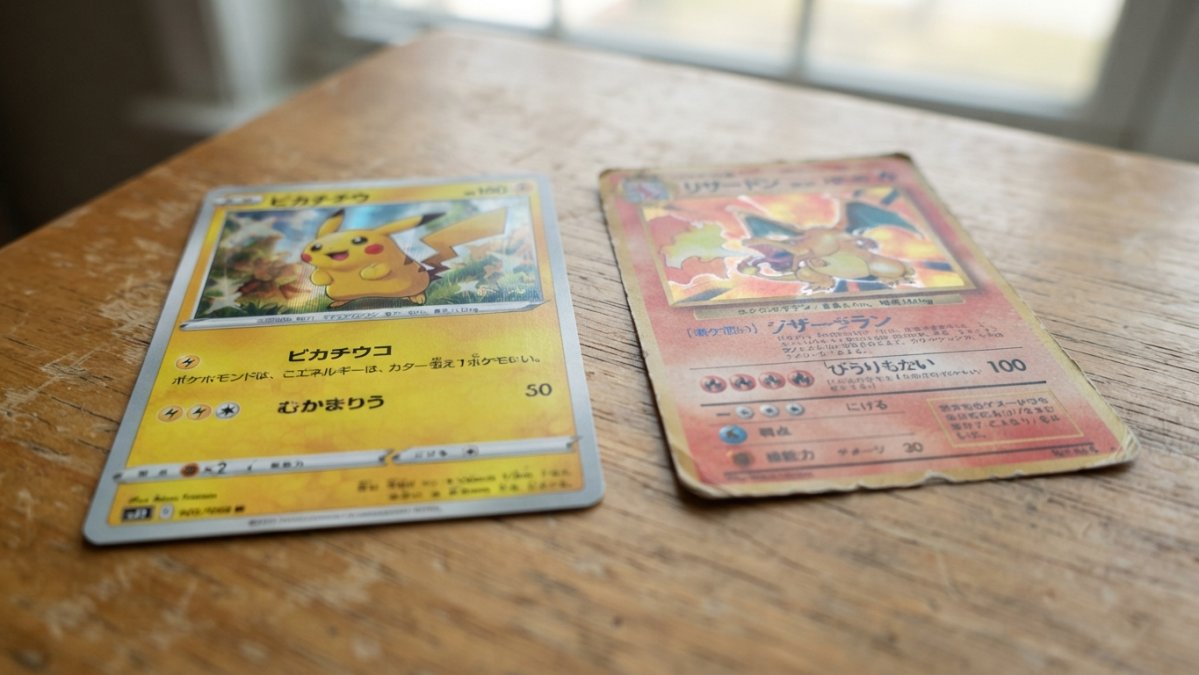
Authentic Japanese Pokémon cards feature sharp, clean text and vibrant colors that don't bleed or blur, on smooth, consistently weighted card stock.
Check the back: the Pokédex entry text should be perfectly centered and legible, and any holofoil should shimmer evenly. Fakes often show misaligned text, poor contrast, or dull foil spots.
Packaging and Serial Numbers
Japanese booster packs include printed set codes and pack identifiers on the back. Authentic packs have consistent font sizing, proper spacing, and correct color matching; counterfeits often show smudged printing, misaligned codes, or color variations.
Some Japanese sets include QR codes or holographic security features. If a QR code doesn't work or links to an unfamiliar site, the pack is likely counterfeit.
Seller Verification and Documentation
The seller's reputation matters as much as the product. Buy from retailers with transparent feedback, clear return policies, and detailed product photography, including multiple angles of sealed boxes and close-ups of pack printing.
For high-value graded cards, ask for authentication documentation. Legitimate grading companies like PSA, BGS, or CGC issue certificates with unique serial numbers you can verify online. If a seller can't provide verification, walk away.
Japanese Card Seller Reviews and Buyer Protection
Reputation systems reveal patterns, but reading them well takes practice. Look for sellers with 100+ positive feedback and consistent ratings over years, not weeks.
Cardboard Superstars maintains 100% positive eBay feedback and BBB accreditation, backed by over 4,600 items sold. This track record reflects our commitment to authentic products and collector-grade packaging that ensures your cards arrive in the condition you expect.
Pokémon 30th Celebration Japanese Booster Box →
A Side-by-Side Seller Comparison
The table below compares the trade-offs that matter most across seller types.
| Seller Type | Shipping Origin | Typical Product Mix | Fees & Add-Ons | Buyer Protection | Best For |
|---|---|---|---|---|---|
| Established US online shop | Domestic warehouse | Sealed boxes, singles, deck sets | Sales tax where required; flat or free shipping thresholds | Store return policy plus card-network chargeback rights | Beginners and buyers who want predictable delivery |
| US marketplace seller (eBay, TCGplayer) | Domestic, varies | Singles, sealed, graded | Platform fees baked into price; shipping varies by listing | Platform money-back guarantee and chargeback rights | Price comparison and rare finds |
| Japan-based proxy or forwarder | Japan | Japan-exclusive sets, singles | Service fee, domestic Japan shipping, international shipping, consolidation fees | Limited; proxy terms usually restrict returns | Japan-exclusive products unavailable domestically |
| Japan-based direct retailer | Japan | Sealed cases, new releases | International shipping; customs paid by buyer | Retailer policy; card-network chargeback as backstop | Collectors chasing day-one releases |
| Graded-card specialist | Domestic or Japan | Slabbed singles | Insured shipping often required | Grading-company population and cert verification | High-value singles buyers |
Platform Protections You Can Actually Use
Buyer protection is a set of deadlines and evidence requirements. Key mechanisms:
- Card-network chargebacks. If you paid with a credit card and the item never arrives or is materially not as described, you generally have a dispute window measured in months from the statement date. This is your backstop when a seller goes silent.
- Marketplace money-back guarantees. eBay and similar platforms publish resolution windows (commonly around 30 days from delivery) during which you can open a case for 'item not as described' or 'item not received.' Open the case inside the window, not after.
- Grading-company certificate verification. For graded cards, look up the certification number on the grading company's website (PSA, BGS, CGC all offer public lookup). A slab whose cert does not match the card pictured is a hard stop.
What to Do When an Order Goes Wrong
A simple evidence sequence protects you in almost every dispute:
- Film the unboxing. A continuous video from sealed mailer to opened product is the single most persuasive piece of evidence in a 'not as described' case.
- Photograph the shipping label and box condition before opening, especially if the outer box is crushed or re-taped.
- Keep all messages in the platform's messaging system, not text or email, so the platform can review them.
- Open the case inside the platform window and state the specific remedy you want (replacement, partial refund, full refund).
- Escalate to the card network only after the platform process stalls, and include the platform case number.
Shipping, Customs, and Total Cost Breakdown
Shipping Japanese trading cards internationally involves more than delivery time: cards from Japan face customs inspection and potential import duties. Understanding total landed cost, the final price after shipping, taxes, and fees, prevents sticker shock at checkout.
Domestic US sellers like Cardboard Superstars ship from US warehouses, eliminating customs delays and import taxes. A $140.00 booster box arrives with predictable shipping and no surprise duties, while Japan-based shipments often add 15-30% in duties, taxes, and forwarding fees.
A Worked Landed-Cost Example
To compare a domestic listing against a Japan-based one, build the full stack. Here is a realistic example using a $140.00 sealed booster box, with placeholder numbers to replace with live quotes at checkout:
| Cost Line | Domestic US Seller | Japan-Based Seller (Direct or Proxy) |
|---|---|---|
| Item price | $140.00 | $140.00 |
| Domestic shipping (US) | $0.00-$10.00 | n/a |
| Japan domestic shipping to proxy/forwarder | n/a | $5.00-$15.00 |
| International shipping to US | n/a | $20.00-$45.00 (varies by weight and speed) |
| Proxy or consolidation fee | n/a | $0.00-$10.00 |
| Customs duty (if assessed) | $0.00 | 0%-25% of declared value, varies by classification |
| Sales tax / use tax | State rate where required | State use tax may be owed by buyer |
| Illustrative landed total | $140.00-$150.00 | $165.00-$210.00+ |
The lesson is the structure, not the exact number: on a mid-priced sealed box, international shipping and fees alone can erase a 10-15% price advantage, and customs can erase more. On a Japan-exclusive set with no domestic equivalent, the premium may still be worth it, but pay it knowingly.
Shipping Methods and What They Cost You
Standard ground shipping takes 5-10 business days and costs less; expedited delivers in 2-3 days at premium rates. For sealed boxes, standard is usually sufficient.
Carriers handle customs differently: some postal services hand off to the US Postal Service with minimal buyer action, while private couriers often charge a brokerage fee on top of duty. Ask which carrier the seller uses before you commit, since that fee doesn't appear in the listing price.
Customs Duties and Declaration Rules
Some sellers undervalue shipments to reduce duties, which violates customs law and can result in seizure with no refund to you. Honest sellers declare true values, ensuring legal compliance and a clean paper trail if a package is lost.
Choosing the Right Option for Your Collection
Your buying strategy depends on your collecting goals.
Intermediate collectors seeking specific cards benefit from single-card purchases, targeting special art rares and full-art cards that appeal to them personally.
Serious investors prioritize graded cards with authentication documentation, which hold value long-term and command premium prices.
Buying authentic Japanese trading cards online is entirely achievable when you verify seller reputation, inspect product details, and understand total cost.
Frequently Asked Questions
Where can I buy authentic Japanese trading cards online?
Cardboard Superstars offers a curated selection of authentic Japanese trading cards, including sealed booster boxes and graded singles. All products ship from a verified US-based seller with 100% positive feedback and BBB accreditation. Look for sellers with transparent product descriptions, clear condition ratings, and buyer protection policies when shopping for authentic Japanese trading cards online.
How can I tell if a Japanese Pokémon card is authentic?
Check the print quality first: authentic cards have sharp, crisp text and images with proper color saturation. Examine the card stock texture by running your thumb across it; genuine cards feel slightly textured, not smooth. Look at the holographic pattern, authentic holos display consistent, uniform patterns. Verify the set symbol and card number match official databases. Finally, purchase from reputable sellers who provide detailed photos and condition descriptions before checkout.
What are the best Japanese trading card booster boxes to start with?
For beginners, the Pokémon 30th Celebration Japanese Booster Box ($225.25) offers nostalgic packaging and solid pull rates. The One Piece OP-17 Japanese Booster Box ($140.00) is a budget-friendly option if you're exploring other TCGs. The Storm Emeralda M6 ($105.00) and Ninja Spinner M4 ($95.00) are excellent entry points for sealed collectors. Each box contains randomized cards, so pull results vary, but all are factory-sealed from verified sources.
How do I avoid counterfeit Japanese trading cards?
Buy exclusively from sellers with verified feedback and transparent authenticity claims. Request high-resolution photos of both card fronts and backs before purchasing. Counterfeit cards typically show blurry printing, incorrect font weights, or misaligned borders. Verify seller credentials through BBB ratings or platform reviews. Never purchase significantly below-market prices. Reputable sellers like Cardboard Superstars provide detailed condition information and secure collector-grade packaging to protect your investment.