


Last Updated: October 27, 2026
Quick Summary
The best tools for inspecting pokemon cards are a centering gauge, a 10x jeweler's loupe, a bright daylight LED lamp, and a clean handling surface, which cover most of what you need. These tools check centering, corners, edges, and surface flaws before you grade, sell, or keep a card.
- A 10x jeweler's loupe with a glass lens beats a plastic magnifier for spotting scratches and edge whitening.
- Position a diffused lamp at roughly 30 to 45 degrees to the card to reveal scratches and dents.
- Measure each border three times; if numbers drift by more than a millimeter, your technique needs work.
- Check corners, edges, surface, and centering in that order, since your grade estimate is capped by the weakest subgrade.
- Treat a card as suspect if it fails two or more fake-detection checks under your tools.
Table of Contents
- Quick Comparison: Tools by Inspection Task and Budget
- Pokémon Card Centering Tool: Measuring Borders Accurately
- The Best Magnifying Glass for Pokémon Cards: Magnification and Optical Zoom
- Lighting Cards to Reveal Surface Flaws and Print Defects
- Pokémon Card Grading App: What Digital Tools Can and Cannot Do
- How to Spot Fake Pokémon Cards With Inspection Tools
- A Complete Pre-Grading Workflow: Corners, Edges, Surface, Centering
- Protecting Your Cards Before Grading Submission
- Frequently Asked Questions
Quick Comparison: Tools by Inspection Task and Budget
Inspecting Pokémon cards is the practice of checking a card's centering, corners, edges, and surface under controlled light and magnification before you decide whether to grade, sell, or keep it, and the best tools for inspecting pokemon cards are not the most expensive ones.
Here's the short version: a centering gauge, a loupe or magnifier, a bright daylight lamp, and a clean handling surface cover most of what you need.
| Tool | Inspection Task | Budget Tier | What It Does |
|---|---|---|---|
| Centering gauge or ruler | Border measurement | Under $20 | Measures left/right and top/bottom borders |
| Jeweler's loupe (10x) | Surface, corners, edges | Under $20 | Reveals scratches, whitening, print lines |
| Daylight LED lamp | Lighting flaws | $20-$60 | Even, color-accurate light across the card |
| Smartphone + macro mode | Quick inspection, photos | Free (phone you own) | Close-up shots and zoom for records |
| Grading app or scanner | Pre-grade estimate | Free to paid | Digital centering and condition scoring |
| Penny sleeves and semi-rigid savers | Handling and protection | Low cost | Keeps cards safe before submission |
The apps are useful, but they're a second opinion, not a first one.
Pokémon Card Centering Tool: Measuring Borders Accurately
A Pokémon card centering tool measures the border width on opposite sides of the card so you can judge alignment. Centering is one of the four subgrades every major grading company scores, and it's the one collectors most often misjudge by eye.
The simplest option is a clear centering gauge: a card-sized overlay with printed measurement lines. You drop the card in, line up one edge, and read the opposite border.
- Place the card face-up on a clean, flat surface.
- Align the card's edge with the zero mark on your gauge or ruler.
- Measure the border on the left and right at the same height.
- Repeat for the top and bottom borders.
- Compare the two numbers. A 60/40 split means one border is noticeably wider.
Accuracy depends on repeatability. Measure the same card three times.
The Best Magnifying Glass for Pokémon Cards: Magnification and Optical Zoom
The best magnifying glass for Pokémon cards is a 10x jeweler's loupe with a glass lens, not a plastic magnifier.
Why a loupe over a flat magnifier? A loupe lets you hold the card and the lens at a fixed distance, which keeps the image sharp.
For surface inspection, work in a slow, overlapping pattern:
- Start at the top-left corner and move across in strips.
- Tilt the card toward the light to catch scratches that disappear head-on.
- Check the holo pattern for print lines and "shooting star" holo bleed.
- Flip the card and repeat on the back, where whitening shows up most.
Higher magnification isn't automatically better. Above 15x, the field of view gets so small that you lose context and miss larger flaws. For most collectors, 10x is the sweet spot.
Lighting Cards to Reveal Surface Flaws and Print Defects
Surface flaws hide in bad light. A bright, even, color-accurate lamp reveals scratches, dents, and print defects that flat overhead lighting washes out.
The diffuser matters: bare LEDs create hot spots that glare off the card's gloss and hide the very flaws you're hunting.
What to look for under good light:
- Scratches: fine lines on the holo or gloss that catch the light.
- Print defects: roller lines, ink dots, or uneven color on the border.
- Whitening: light blue or white spots on the back edges.
- Dents: shallow impressions that show as shadows at a low angle.
Avoid direct sunlight. It's bright, but it's inconsistent, it heats the card, and it fades ink over time. A $30 desk lamp beats a sunny windowsill every time.
Pokémon Card Grading App: What Digital Tools Can and Cannot Do
A Pokémon card grading app uses your phone's camera and software to estimate centering and condition.
The unique angle here is accuracy and repeatability.
What apps do well: centering measurement when lighting is even and the card is flat, condition scoring against a rubric, and keeping a photo record of every card.
BCW Semi-Rigid Card Holder #1 →
To get repeatable app results, standardize your setup:
- Use the same lamp at the same angle for every card.
- Place the card on a matte, neutral-gray surface so edge detection has contrast.
- Hold the phone parallel to the card, not tilted.
- Photograph the same card three times and compare the centering readings. If they drift by more than a percentage point or two, your setup, not the card, is the variable.
Use an app as a second opinion, not a verdict. If an app says a card is a strong candidate and your loupe agrees, that's a green light to submit.
For a deeper look at how to weigh grading companies against each other before you commit, our guide on how to evaluate card grading services walks through the criteria that actually matter.
How to Spot Fake Pokémon Cards With Inspection Tools
Fake Pokémon cards fail inspection in predictable ways, and your tools catch them faster than a gut check. Counterfeits usually show wrong colors, soft print, off-center cuts, and a different card stock feel.
Run this checklist on any card you're unsure about, and note which tool does the work:
- Light test (lamp): hold the card up to a bright, diffused lamp. Genuine cards use an opaque core that blocks most light; many fakes are noticeably translucent and let the lamp glow through the back. This test is fast but not definitive, some legitimate cards with thin stock pass more light than others, so use it as a screen, not a verdict.
- Loupe check (10x): look at the print under magnification. Genuine cards show clean rosette dot patterns and crisp text edges; fakes often show blurry or solid ink, jagged lettering, or a visible dot grid that doesn't match the rosette. On holo cards, check whether the holo pattern sits under a clean gloss layer or looks printed on top.
- Centering and cut (gauge): fakes are often cut off-center or have rough, fuzzy edges from a dull die. Measure borders with a centering gauge and run a fingertip along the edge, genuine cuts feel clean, fakes feel ragged.
- Back color (known genuine card): compare the blue back to a known genuine card under the same lamp. Fakes skew lighter, more saturated, or slightly green. Color drift is easiest to see side by side, not from memory.
- Texture and stock (fingertip and flex): run a fingertip across the surface. Fakes feel slick or overly glossy, and some feel stiffer or flimsier than genuine stock. A gentle flex test, never a sharp bend, can reveal a different card-stock feel, but stop at the first sign of creasing.
- Holo behavior (tilt under lamp): tilt a holo card under a daylight lamp. Genuine holo patterns shift and sparkle with the angle; many fakes have a flat, printed rainbow that doesn't move the same way. Watch for "holo bleed" that looks painted on rather than embedded.
If a card fails two or more checks, treat it as suspect. For a full breakdown of the tells, our guide on how to spot fake Pokémon cards goes deeper than this section can.
A Complete Pre-Grading Workflow: Corners, Edges, Surface, Centering
A pre-grading workflow for inspecting pokemon cards checks each of the four subgrades separately, in the same order every time. Consistency is what turns a hobby into a reliable pre-grade evaluation.
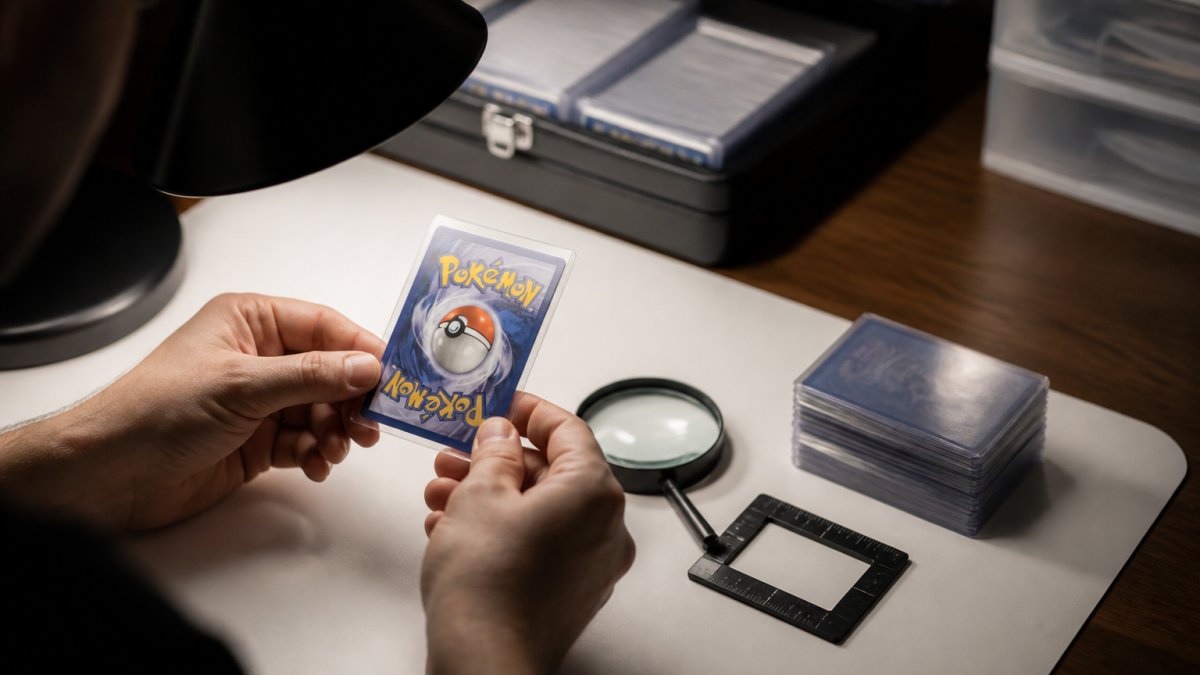
- Corners. Under the loupe, check all four corners for nicks, bends, and whitening. Corners are the easiest subgrade to damage and the hardest to hide.
- Edges. Run your eye along each edge. Look for chipping, whitening, and rough cuts.
- Surface. Tilt the card under the lamp and scan in strips, front and back.
- Centering. Measure borders with the gauge and record the split.
Score each category on a simple 1-to-10 scale and note the weakest one. Your grade estimate is capped by the weakest subgrade, not the average. A card with perfect centering and a bent corner is not a gem mint candidate.
For the full condition criteria behind each subgrade, our guide on what to look for in card condition breaks down every category in detail.
Protecting Your Cards Before Grading Submission
Protection starts before inspection, not after.
For submission prep, semi-rigid card savers are the standard. Our guide on how to use semi-rigid holders for submission walks you through using them correctly.
If you want the supplies in one order, the Rip & Protect Bundle pairs 200 penny sleeves with 200 semi-rigid card savers, which covers both everyday handling and submission prep.

Cardboard Superstars stocks supplies, including semi-rigid holders, penny sleeves, and storage bins, with clear product details provided before checkout. Get started with Cardboard Superstars.
Frequently Asked Questions
What tools do you need to inspect Pokémon cards?
A basic inspection kit covers four jobs: a centering tool or gauge for border measurement, a magnifier with 10x to 30x optical zoom for surface inspection, a bright LED light for raking glare across the surface, and a phone camera for close-up photos of the front and back. Add penny sleeves and semi-rigid card savers so you never handle a raw card bare-handed. Total cost for a practical starter kit runs well under $50, and you can upgrade the magnifier later if you grade often.
What is the best tool for checking Pokémon card centering?
A dedicated Pokémon card centering tool beats eyeballing every time. These are clear overlays or gauges with printed border lines that sit directly on the card, so you can compare left-to-right and top-to-bottom borders against a known ratio. Measure both sides, write the numbers down, and repeat on the back. Repeatability matters more than a single reading: if two measurements disagree by more than a millimetre, remeasure before you assume the card is off-center.
Can an app accurately grade Pokémon cards?
A Pokémon card grading app can estimate centering and flag obvious surface issues from a scan, but it cannot feel corner sharpness, detect subtle scratches at an angle, or judge print defects the way a human with a loupe can. Treat app output as a second opinion, not a grade. Use it to screen a stack quickly, then confirm any card you plan to submit with manual inspection under bright light. No app replaces professional grading, and none should be treated as a guarantee of the final grade.
How do you inspect Pokémon cards before sending them for grading?
Work through four checks in order: centering with a gauge on front and back, corners under magnification for whitening or dings, edges for chipping and rough cuts, and surface under angled LED light for scratches and print lines. Photograph each card front and back on a plain background. Cards that pass all four checks are worth the submission fee; cards with visible flaws usually are not. Sleeve the keepers in penny sleeves and place them in semi-rigid card savers before packing.
Can card inspection tools tell if a Pokémon card is fake?
Tools help, but they are not decisive on their own. A magnifier reveals print dot patterns, blurry text, and missing texture that counterfeits often show. A bright light held at an angle can expose a card that is too glossy or too thin. Compare suspected cards against a known-authentic copy of the same card: check font weight, energy symbol sharpness, and the back's blue border color. When a card still looks off after all of that, buy from a seller who verifies authenticity rather than gambling on a raw listing.
