


Last Updated: October 23, 2026
Quick Summary
Graded sports cards are verified by looking up the unique certification number on the grading company's official website and matching the returned record to the physical card. You then inspect the holder and label for tampering, font errors, and security features, and vet the seller before paying.
- Enter the 7 to 10 digit certification number directly on the grading company's own site, never through a seller's link.
- A database match alone is not a verdict; the physical card must match the record detail by detail.
- Fake slabs often show cloudy plastic, hazy seams, glue residue, or cards that sit crooked.
- Security features vary by company and era, so compare a slab only to a genuine example from the same production window.
- Pay with a method that offers buyer protection and get the year, set, card number, grade, and cert number in writing.
Table of Contents
- Why Verification Matters for Graded Sports Cards
- Sports Card Certification Number Lookup: Your First Step
- How to Spot a Fake Graded Card Slab
- Graded Card Label and Holder Security Features
- What to Do If a Graded Card Certification Number Does Not Match
- Safe Buying and Seller Verification Steps
- Conclusion
- Frequently Asked Questions
Why Verification Matters for Graded Sports Cards
Graded sports cards are trading cards that a third-party grading service has examined, assigned a numeric grade, and sealed inside a tamper-evident holder.
A grade can multiply a card's market value, and counterfeiters know it.
At Cardboard Superstars, we are committed to providing authentic products. This guide walks through the verification process, from certification lookup to physical inspection.
Below, we'll show you how to verify a card step by step, spot a fake slab, and handle a certification number that doesn't match.
Sports Card Certification Number Lookup: Your First Step
A sports card certification number lookup is the fastest way to confirm a graded card exists in the grading company's system. Every legitimate slab carries a unique certification number, usually printed on the label and often encoded in a barcode or QR code. Before inspecting anything else, pull up the grading company's records and confirm the number is real. If you are unsure which companies to trust, read our guide to evaluating card grading services.
Using the Grading Company's Online Database
Each major grading service publishes a public lookup tool on its website. You type in the certification number, and the database returns a record for that card. For a concrete example, see this step-by-step graded card verification walkthrough. The workflow is the same across services, but the field names and detail returned differ.
Here is the unified process:
- Find the certification number on the front of the label. It is usually 7 to 10 digits, and some services prefix it with letters.
- Go directly to the grading company's official website, not a link the seller sent you.
- Enter the number in the lookup field.
- Review the returned record: card year, set name, card number, player or character name, grade, and any qualifiers.
- Save a screenshot of the record with the date visible.
A service-by-service walkthrough of what the lookup returns:
- PSA: The lookup returns the set, card number, player name, grade, qualifier if any, and often a front image. PSA labels carry the cert number on the front and a barcode on the back of the label on newer holders.
- Beckett (BGS/BVG): The lookup returns the subgrades (centering, corners, edges, surface) in addition to the overall grade, plus the set and card number. Beckett slabs show the cert number on the front label and a barcode on the back.
- CGC: The lookup returns the set, card number, grade, and often front and back images. CGC labels include a QR code on newer holders that resolves to the record.
Matching Database Records to the Physical Card
A database record proves a number exists. It does not prove the card in your hand is the one that record describes. Match these details one by one:
- Year and set name on the label versus the database
- Card number printed on the card itself versus the label
- Player or character name and any variation notes
If any detail is off, stop. A mismatch between the record and the physical card is the single strongest sign of a fake.
When the record is incomplete, which happens with older submissions and some services, compare the label text to the card itself, check the card number against a set checklist, and ask the seller for photos of the card back and edges.
What to Do When the Certification Number Is Missing, Duplicated, or Mismatched
A lookup that fails or returns the wrong card is a decision point. Use this decision tree:
- No record returned: Recheck the digits for typos, confirm you are on the correct company's site, and confirm the label belongs to that company. If it still fails, treat the slab as unverified and walk away.
- Record shows a different card: The number has been copied onto a fake slab. Do not buy. Report the listing to the platform.
- Same number appears on multiple listings: The number is being reused across fakes. Treat every listing with that number as suspect.
A database match is one input, not a verdict. Treat it as the first gate, then let the physical inspection confirm or override it.
How to Spot a Fake Graded Card Slab
A fake graded card slab usually fails on physical details, not the database check. For a deeper checklist, see how to spot fake graded cards.
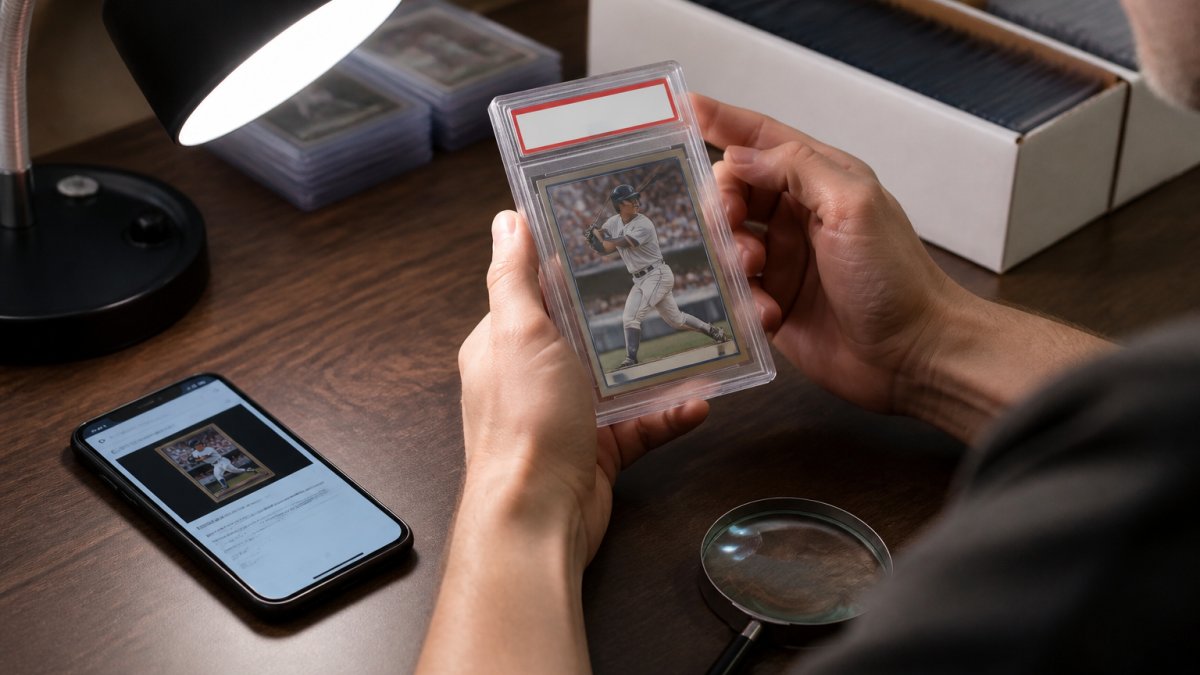
Inspecting the Holder and Case
Run your eyes and fingers over the holder first. Look for:
- Cloudy or scratched plastic that suggests the case was opened, sanded, or resealed
- Frosting or hazy seams along the edges, a common sign of tampering
- Loose cards that shift or rattle inside the holder
Hold the slab up to a light. Genuine holders are clear and consistent; a cloudy case or a seam that catches the light differently deserves a closer look.
Checking Label Fonts, Text, and Alignment
The label is where most fakes give themselves away. Compare it to a known genuine example from the same grading company and era.
Drake Maye 2024 Topps Chrome 1974 Throwback Pink Refractor RC #197 — CGC 10 →
Check for:
- Font consistency: weight, spacing, and letter shapes should match the company's standard
- Text alignment: lines should sit square, not drift or crowd the edge
- Print quality: crisp edges, no blurring, no ink bleeding
A label that looks "almost right" is a red flag. Counterfeit labels tend to be slightly too bold, misaligned, or printed on stock that feels different from a genuine label.
Graded Card Label and Holder Security Features
Graded card label and holder security features vary by company and have changed over time. Older slabs may carry fewer features, so always compare like with like. Calling an older genuine slab fake because it lacks a newer feature is a common mistake.
Common security elements to look for, by company and era:
- PSA: Newer holders carry a holographic label element and a barcode on the back of the label. Older PSA slabs may have simpler labels with fewer overt features. PSA has updated its label design and holder style over the years, so confirm the expected features for the specific era.
- Beckett (BGS/BVG): Beckett slabs use a distinctive holder with a label that includes the cert number and a barcode. The subgrade breakdown on the label is itself a check: counterfeiters often struggle to reproduce the subgrade layout accurately.
- CGC: Newer CGC holders include a QR code on the label that resolves to the record. Older CGC slabs may not have the QR code, so absence alone is not proof of a fake.
General security elements to check across companies:
- Holographic foil or a hologram sticker on the label or holder
- Barcodes or QR codes that resolve to the correct database record
- Embedded security threads or microprinting on newer labels
- Tamper-evident seals that show damage if the holder is opened
Security features get updated, and a slab from several years ago may legitimately lack a feature newer slabs carry.
What to Do If a Graded Card Certification Number Does Not Match
A certification number that fails the lookup, returns a different card, or shows up on multiple listings is a serious problem. Here is how to handle each case.
| Problem | What It Usually Means | What to Do |
|---|---|---|
| Number returns no record | Typo, wrong database, or fake label | Recheck digits, confirm the correct company, then walk away if it still fails |
| Record shows a different card | Copied number on a fake slab | Do not buy; report the listing to the platform |
| Same number on multiple listings | Number is being reused across fakes | Treat every listing with that number as suspect |
| Record matches but the card does not | Reholdered or swapped card | Request better photos, then decline the sale |
| Label details are close but off | Counterfeit label | Compare fonts and alignment against a known genuine slab |
If a seller pushes back on your questions, that is your answer. Honest sellers expect verification and will send extra photos without complaint.
Safe Buying and Seller Verification Steps
Safe buying means vetting the seller as carefully as the card. Our guide to buying rare cards from collectors expands on these steps. A genuine slab from a careless or dishonest seller is still a risk.
Run this checklist before you pay:
- Confirm the certification number on the grading company's own site
- Ask for clear photos of the front, back, and all four edges of the holder
- Request a close-up of the label and any hologram
- Check the seller's feedback history and how long they have been active
For high-value purchases, ask for a short video of the slab under direct light. A clean, consistent holder is hard to fake on video.
Conclusion
Verification is a habit, not a one-time task. Look up the certification number, match the record to the card, inspect the holder and label, and vet the seller.
When you are ready to add to your collection, buy from a source that shows the details up front. You can shop graded sports cards at Cardboard Superstars.
Browse authenticated graded sports cards at Cardboard Superstars and start your next pickup with total peace of mind.
Frequently Asked Questions
How do I check a graded sports card certification number online?
Go to the grading company's official website and find its certification lookup tool. Enter the certification number printed on the label. The database should return a record with the card's year, set, card number, grade, and often a photo. Compare every detail to the physical card. If the number returns no record or the details don't match, treat the card as suspect until you can verify further.
Can a graded sports card slab be faked?
Yes. Counterfeiters have produced fake slabs with copied labels and even duplicated certification numbers. That's why you must check both the database record and the physical holder. Look for cloudy plastic, mismatched fonts, poor label alignment, and a case that feels flimsy. A valid certification number alone doesn't guarantee authenticity; the number could be copied from a real card and paired with a fake slab.
What should I do if a certification number does not match the card?
Do not buy the card. If you already own it, contact the seller immediately and request a return or refund. Report the discrepancy to the grading company and the marketplace where you bought it. A mismatched number often signals a counterfeit slab or a swapped card. Keep photos of the label, the card, and the database record as evidence.
Do grading companies guarantee that a card is authentic?
Grading companies authenticate and grade cards, but their guarantees have limits. Most offer a grade guarantee that covers their opinion of condition, not the card's provenance. They may not reimburse you if a counterfeit slips through. Always verify the certification number and inspect the holder yourself. For high-value purchases, buy from sellers with strong feedback and clear return policies.
