


Quick Summary
To keep graded card slabs from scratching, handle them by the edges over a soft padded surface, lift them straight up instead of sliding them, and avoid stacking them tall or storing them in direct sun. Sleeves add a thin layer of protection, and a yearly storage check catches hidden risks like heat, humidity and grit.
- Most slab scratches come from everyday contact, like sliding slabs together or rubbing them on rough surfaces.
- Hold slabs by their edges, never by the face, and lift straight up before setting them down gently.
- Use a soft, lint-free microfiber cloth as a dedicated handling pad near your collection.
- Stack slabs short and store them upright, since long-term flat stacking can chip the corners.
- Keep slabs out of direct sun and away from garages or attics, where heat and humidity swings damage the plastic.
Table of Contents
- Why Graded Card Slabs Scratch and Scuff
- Handling Graded Card Slabs Without Marking Them
- Best Protective Sleeves for Graded Cards
- Storage and Display Habits That Protect Slab Clarity
- Step-by-Step: How to Remove Scratches From a PSA Slab
- Do Scratches on a Slab Affect Card Value?
- Choosing Your Next Protected Card or Starter Supplies at Cardboard Superstars
- Frequently Asked Questions
Handling a graded slab without marking it comes down to a few habits. Most scratches happen during everyday moments, not dramatic accidents. The good news is that the fixes are simple and cost almost nothing.
Collectors who keep their slabs looking sharp tend to treat handling as a routine, not an afterthought. Below, you'll find the causes of slab scratches, the handling and storage habits that prevent them, and what to do if a mark already appears.
Why Graded Card Slabs Scratch and Scuff
A graded slab is a hard plastic case, and its surface is not as tough as it looks. Most marks come from contact with other hard objects, not from one big drop.
The most common causes are:
- Sliding slabs against each other in a box or binder pocket
- Rubbing against rough surfaces like cardboard, textured mats, or denim
- Grit trapped under a sleeve that drags across the front
Each of these creates tiny micro-abrasions. They are often invisible at first, then show up as haze under light. Once you know the cause, most of these are easy to avoid.
Handling Graded Card Slabs Without Marking Them
Good handling starts before you pick the slab up. Wash your hands, and set down anything that could scratch the case, such as rings, watches, or zippers.
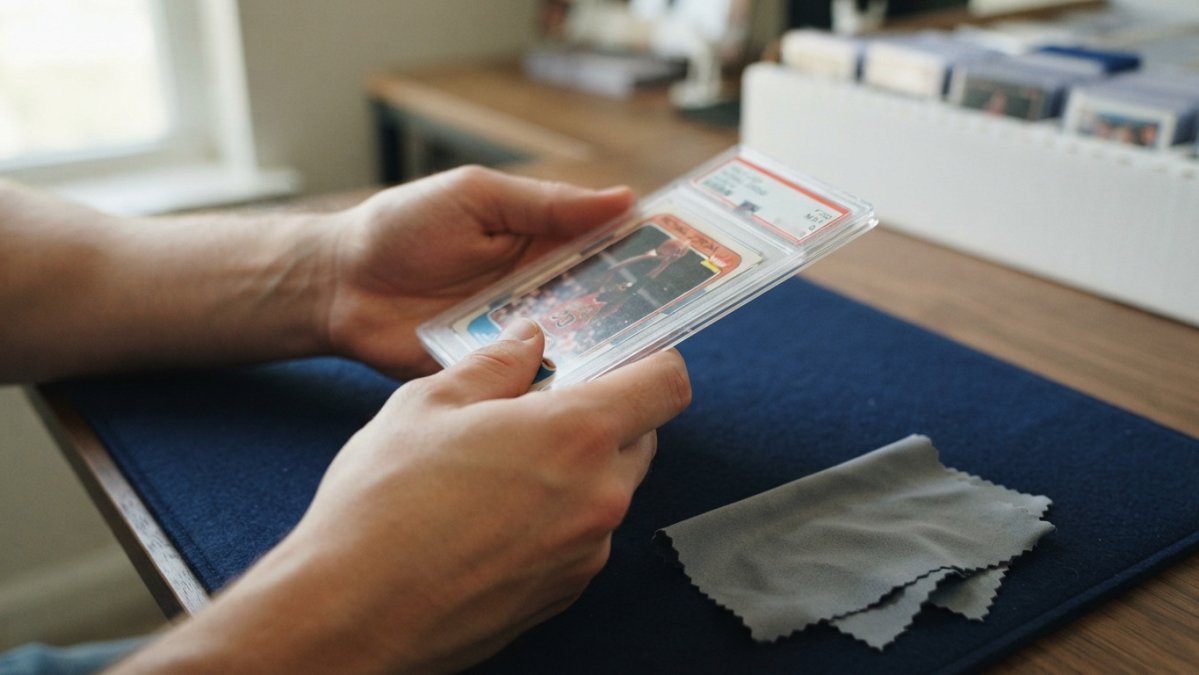
Follow these simple steps:
- Clear a flat, padded surface like a soft mat or a folded microfiber cloth.
- Hold the slab by its edges, never by the face.
- Lift straight up instead of sliding it across the table.
- Set it down gently on the padded surface.
Tip: Keep a dedicated handling pad near your collection. A soft, lint-free microfiber cloth works well and costs very little.
Pay attention to transport, too. When you move slabs between rooms or to a show, place them in a rigid holder or a padded case.
Best Protective Sleeves for Graded Cards
Sleeves add a thin layer of protection to a slab's face and back. They are not a cure-all, but they stop many everyday scuffs before they start.
Keep these points in mind when choosing sleeves:
- Pick a clean, soft sleeve that does not have grit or texture.
- Check the fit. A loose sleeve can slide and rub. A tight one can bow the case.
- Replace sleeves that show wear like cloudiness or tears.
If you are shopping for supplies, Cardboard Superstars carries a range of graded card supplies, and the [product: graded card collection | page:5] page is a good place to browse options for protected cards.
Storage and Display Habits That Protect Slab Clarity
Storage affects a slab's condition more than most collectors expect, and it does so through a mechanism worth understanding: plastic does not just get dirty, it gets brittle. Over time, heat, UV light, and repeated temperature swings draw plasticizers out of the surface layer. A brittle case scratches more easily, chips at the corners, and can even crack under its own stacking weight.
The Environmental Levers
Three variables do most of the work:
- Light. UV is the primary driver of label fading and plastic yellowing. Keep display shelves out of direct sun and away from unshaded windows. If a room gets strong afternoon light, rotate displays or use UV-filtering case covers rather than relying on blinds alone.
- Temperature stability. Wide swings, a hot car, a cold garage, then a warm room, stress the case seams and accelerate brittleness. A stable indoor room is far safer than a space that heats and cools daily.
- Humidity. High humidity promotes fogging on the inside of the case and can affect paper labels; very low humidity in heated rooms dries the plastic further. A cheap hygrometer can help you keep track of the humidity where your slabs are stored.
Material Differences Change the Rules
Not all slabs age the same way, and storage advice should follow the plastic:
- Acrylic is optically clearer and harder, but it is more brittle and more prone to crazing under thermal stress.
- Polycarbonate is tougher and more impact-resistant, but it yellows more readily under UV and is more sensitive to solvent fumes, including those from adhesives, paints, and cleaning products stored nearby. Keep polycarbonate cases away from freshly painted shelves and solvent-heavy household products.
If you do not know which plastic a given slab uses, treat it as the more sensitive of the two: stable temperature, low UV, moderate humidity.
Stacking, Standing, and Display
- Store slabs upright, not flat, for long periods. Long-term flat stacking puts continuous pressure on the face and corners and is a common cause of hairline corner chips.
- Limit stack height. Short stacks of a few slabs are fine; tall stacks transfer weight to the bottom cases.
- Use stands that contact the edges, not the face. A stand that grips the face can leave rub marks over time.
Watch out: garages, attics, and storage units are the most common hidden failure points. They combine temperature swings, humidity, and sometimes solvent fumes from paint or fuel, which is the worst combination for both acrylic and polycarbonate. If a slab must live in one of these spaces, seal it in a rigid, padded case and bring it indoors for long-term storage when you can.
A Simple Storage Audit
Once a season, walk your collection and check any slab near a window, any stack taller than a few cases, any sleeve that looks cloudy or gritty, and any room where temperature or humidity swings noticeably.
Step-by-Step: How to Remove Scratches From a PSA Slab
Sometimes a mark is already there. Before you try anything, know that a slab is a sealed case, and attempting a repair can cause new damage.
The single biggest variable is what the case is made of. Grading companies do not all use the same plastic, and the two you will meet most often behave differently under polish:
- Acrylic cases (common on many encapsulation services) are harder and take a finer polish, but they are brittle and chip at the corners if you press hard. They also craze, tiny internal stress cracks, if you heat them with friction.
- Polycarbonate cases are tougher and resist impact, but they scratch more readily and are more sensitive to solvent-based products. A polish that is safe on acrylic can haze polycarbonate.
Because you usually cannot tell which plastic you have by looking, test a pea-sized area on the back edge or a corner before touching the face.
A workable sequence for light surface haze:
- Inspect under raking light. Hold a bright flashlight at a low angle across the face. Surface haze scatters light in a broad sheen; a deep gouge shows a sharp bright line. If a fingernail catches the line, polishing will not remove it, it will only round the edges and make the gouge look wider.
- Clean first, polish second. Grit left on the surface turns a polishing cloth into sandpaper. Wipe the face with a clean, lint-free microfiber cloth and a drop of distilled water, then let it dry fully.
- Choose a plastic polish, not an abrasive. Products sold for acrylic and polycarbonate (often labeled as plastic or headlight polish) are formulated to cut slowly. Avoid toothpaste, baking soda, and metal polishes, they are far too aggressive for a card case and will leave a permanent dull patch.
- Apply to the cloth, never the slab. A pea-sized amount on a folded microfiber pad keeps polish out of the seam where the case is sealed. Polish that wicks into the seam can stain the label edge.
- Work in short, light circles over an area no larger than a quarter, using almost no pressure. Let the compound do the work. Count your passes, ten light passes, then wipe and inspect, rather than polishing by feel.
- Wipe residue with a clean section of cloth, then inspect again under raking light. Repeat in small increments. If haze has not softened after two or three short cycles, stop; more pressure will not help and will likely cloud the plastic.
- Finish with a dry buff using a fresh microfiber cloth to remove any film.
Watch out: heat is the hidden failure mode.
Long-Term Chemical Risk Most Guides Skip
Polishing compounds are not inert. Many contain solvents, surfactants, and fine abrasives that can migrate into the plastic over months. A common pattern reported by long-term collectors is that repeatedly polished cases yellow or develop a faint bloom faster than untouched ones, especially when stored in warm rooms. The mechanism is straightforward: solvents can leach plasticizers out of the surface layer, and UV exposure then accelerates the change.
Practical rules that follow from this:
- Polish once, not routinely. Treat polishing as a one-time correction, not maintenance.
- Avoid solvent-heavy products (those that smell strongly of petroleum or alcohol) on polycarbonate.
- Keep polished slabs out of direct sun for the first weeks after treatment so any residual solvent can flash off evenly.
When Polishing a Slab Is a Mistake
Polishing is not always the right move. Stop if the scratch is deep enough to catch a fingernail, if the label is near the mark, or if the slab seal looks loose.
There is also a decision point between DIY repair and re-slabbing. Re-slabbing, sending the card back to the grading company for a new holder, carries real trade-offs, including shipping risk, a new grading fee, and turnaround time.
Do Scratches on a Slab Affect Card Value?
Scratches on the slab can affect value, but the effect depends on the size and location of the mark. A light surface haze on the case is less serious than a deep groove or a mark over the card itself.
Here is how collectors typically weigh it:
- Light case haze may have little effect on resale.
- Deep scratches on the front are more likely to lower interest.
- Label damage can matter more than surface marks.
Because value depends on the card and the market, it's best to check recent sales of similar slabs before deciding what to do.
Here is how collectors typically weigh slab damage against resale value:
| Damage type | Likely effect on value | Note |
|---|---|---|
| Light case haze | Little effect on resale | Surface marks on the case |
| Deep scratches on the front | Lower buyer interest | More likely to reduce value |
| Label damage | Can matter more than surface marks | Affects the grading label |
| Re-slabbing | An option for some cards | Has costs and risks |
Choosing Your Next Protected Card or Starter Supplies at Cardboard Superstars
Protecting a slab starts the moment you buy it, so choose cards from sellers who describe condition clearly. Cardboard Superstars lists graded cards with clear product details before checkout.
For example, the 2023-24 Upper Deck Allure Connor McDavid Color Flow Orange Yellow CF-1 CGC 9 is a graded hockey card listed at $38.99.
Whether you are starting out or adding to a display, pair every graded card with the handling and storage habits above, and your collection will stay in better shape for years.
Last Updated: November 23, 2026
Frequently Asked Questions
Is it normal for PSA slabs to have scratches?
Minor scuffs are common on graded card slabs, especially on slabs that have been shipped, stacked or handled often. Fine surface marks usually come from contact with other hard objects during transit or storage rather than from any defect in the slab itself. Inspect each slab when it arrives and compare it to the listing photos. If the scratches were not visible in the product details and affect the slab, contact the seller promptly. Keeping slabs in protective sleeves from the start prevents most new marks from forming.
What are the best protective sleeves for graded card slabs?
The best protective sleeves for graded cards are slightly larger than the slab, made from clear, smooth, low-static material, and sized to slide in and out without force. Sleeves that fit snugly can rub the label or the case edges over time, so avoid overly tight options. Pair sleeves with a rigid top loader or slab box for shipping and storage. Choose sleeves labeled as safe for graded slabs, and check that they will not trap dust or moisture against the case.
How do I protect my graded card slabs from future scuffs?
Keep slabs in sleeves, store them upright in a box that holds them snugly without pressure, and avoid stacking them loosely. Handle slabs by the edges and never slide one across a rough surface or another slab. Keep your work area clear before you open a slab, and wipe your hands if they are oily or dusty. Store the collection away from direct sunlight, which can fade labels over time, and avoid damp areas where condensation can form inside sleeves.
Do scratches on a graded card slab affect the resale value?
Yes, visible scratches on a slab can lower its resale value, especially when the scratches sit across the card window or over the grading label. Buyers often pay attention to case clarity because it affects how the card looks in person and in photos. Minor scuffs on the outside of the case usually matter less than marks that cloud the window. Before you sell, compare your slab's condition with recent listings and disclose any visible wear clearly.
