


Quick Summary
Sealed booster boxes hold value because collectors pay for intact factory packaging, a finite number of packs, and sets that stop being printed. Whether a box appreciates depends mainly on its condition, its set's popularity, and whether reprints are likely.
- Sealed product is not a guaranteed investment, and many boxes never appreciate at all.
- Check the shrink wrap, box corners, and seal, and favor popular sets with limited supply.
- A single reprint announcement can erase months of gradual price appreciation.
- Keep boxes in a cool, dry, dark place and use a rigid protector to protect condition.
- Subtract selling fees, shipping, and storage costs to find your real return.
Table of Contents
- Why Sealed Booster Boxes Hold Value Over Time
- What Makes a Sealed Booster Box Worth Holding
- Supply, Reprints, and Scarcity: The Core Value Drivers
- Are Pokémon Booster Boxes Worth Keeping Sealed?
- Sealed vs. Opened Booster Boxes: The Real Trade-Off
- What Pokémon Boxes Are Worth Keeping Sealed?
- How to Store Sealed Pokémon Cards to Protect Value
- Returns After Fees, Storage, and Selling Costs
- Choosing Your Next Sealed Box at Cardboard Superstars
- Frequently Asked Questions
Why Sealed Booster Boxes Hold Value Over Time
Last Updated: November 21, 2026
Sealed booster boxes hold value because they combine three things collectors reliably pay for: intact factory packaging, a finite number of packs, and a product that stops being printed. A box that is still shrink-wrapped and undamaged often sells for more than the packs inside it would fetch if opened and graded individually. That gap is the core of this guide, and it is worth understanding before you decide whether to hold, open, or sell.
Sealed product is not a guaranteed investment. Prices move with demand, and many boxes never appreciate at all. The goal here is to explain what actually drives a sealed box's value so you can judge each release on its own terms.
What Makes a Sealed Booster Box Worth Holding
A sealed booster box is worth holding when its condition is intact, its set is popular, and its supply is limited. Any one of these alone is rarely enough. A popular set that is still widely printed tends to stay flat, while a scarce set in poor condition rarely commands a premium.
Check the factory shrink wrap, the box corners, and the seal before you buy. Box quality and set popularity are two factors collectors commonly weigh when deciding what to hold.
Supply, Reprints, and Scarcity: The Core Value Drivers
Supply is the single biggest long-term driver of sealed product value, but "supply" is not one number. It is the interaction of three things: how many boxes the publisher printed, how many of those are still sealed, and whether the publisher can print more. A box only becomes scarce when all three move in the same direction.
The print-run lifecycle. Most trading card game sets follow a rough arc. At launch, the publisher floods distribution to meet opening demand, and sealed boxes are easy to find at or below MSRP. Over the next several months, the initial print run sells through, and a second or third wave may follow if demand holds. Once the publisher stops ordering new printings, the set is out of print, and the only sealed boxes left are the ones collectors and stores did not open. That is the point where scarcity starts doing real work on price. The mistake many buyers make is treating launch-day availability as permanent supply.
How to assess reprint risk. Reprints are the main thing that can reset a sealed box's price. Before you hold a box, look for concrete signals rather than vibes:
- Whether the publisher has publicly described the set as out of print or has removed it from its current product catalog.
- Whether distributors still list sealed cases at wholesale, which usually means supply is still flowing.
- Whether large retailers keep restocking the set at MSRP, which is a sign of continued printing.
- Whether the set's headline chase cards are still being opened in volume on social channels, which tends to track active printing.
- Whether the publisher has a history of reprinting popular sets in that game, since some games reprint far more aggressively than others.
A set that quietly disappears from shelves without a reprint announcement is the kind of scarcity that tends to hold value. A set that stays in print for years, or gets a surprise reprint wave, can sit flat or fall even if the cards inside are desirable.
Model three scenarios before you buy. Rather than asking "will this go up," ask what happens under each supply path:
- Continued printing. The publisher keeps the set in rotation. Sealed supply stays ample, prices hover near MSRP, and your real return is roughly zero after fees and inflation. This is the most common outcome for mass-printed modern sets.
- Print pause or soft discontinuation. The set stops appearing in new printings but the publisher has not ruled out a reprint. Prices drift up slowly, then stall whenever reprint rumors circulate. Holding here is a bet on patience and on the publisher's silence.
- Discontinuation with no reprint. The set is officially out of print and the publisher has moved on. Sealed supply only shrinks as boxes get opened, and prices tend to climb as long as collector demand persists. This is the scenario sealed holders are actually underwriting.
Watch out: a single reprint announcement can erase months of gradual appreciation, so never size a sealed position as if discontinuation is guaranteed.
Why sealed supply shrinks faster than singles supply. Every time someone opens a sealed box to chase cards, that box leaves the sealed population permanently. Singles supply goes up when boxes are opened; sealed supply goes down. That asymmetry is the mechanical reason sealed product can outperform the sum of its packs over long horizons, and it is why the sealed premium widens most in sets where opening is common and holding is rare.
Are Pokémon Booster Boxes Worth Keeping Sealed?
Pokémon booster boxes can be worth keeping sealed, but the answer depends on the specific set, its print run, and whether a reprint is coming. Sealed Pokémon boxes from different expansions have followed different price paths over time.
Treat any historical example as a single data point rather than a promise. Look at completed sales for the same set over several months before concluding that a box is a good hold.
Sealed vs. Opened Booster Boxes: The Real Trade-Off
Keeping a booster box sealed preserves the option to sell it whole, but it earns nothing until you sell. Opening it lets you chase specific cards, enjoy the hobby now, and possibly recover value through singles, but it destroys the sealed premium.
Keep sealed if:
- The set is popular and likely to go out of print
- You can store the box safely for years
- You are comfortable waiting for a sale
Open if:
- You want to play, display, or chase particular cards
- The set is widely printed and unlikely to appreciate
- The box's expected singles value is close to its sealed price
What Pokémon Boxes Are Worth Keeping Sealed?
The boxes most worth keeping sealed are usually from sets with strong collector demand, limited production, and no announced reprint. Sets with signature chase cards and high demand among both players and collectors tend to hold their interest longer than thin or heavily printed releases.
Compare each box against its own history rather than against the hype around a new release. Hype fades quickly, and the boxes that hold value are often the ones nobody was talking about at launch.
How to Store Sealed Pokémon Cards to Protect Value
Storage determines whether a sealed box keeps its premium. Dust, moisture, sunlight, and handling all reduce condition, and condition drives resale price.
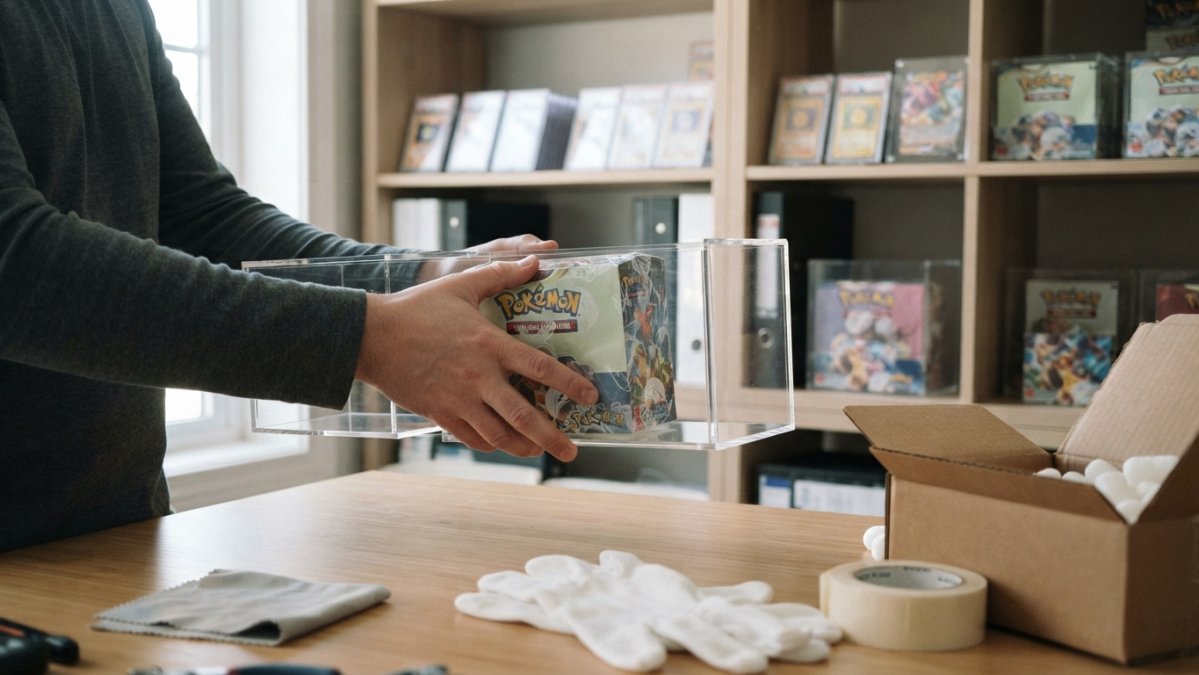
Keep sealed boxes in a cool, dry, dark place away from direct sunlight. Use a protective display case or a rigid box protector to prevent corner dents and shrink-wrap tears. Avoid stacking heavy boxes on top of thin ones, and handle sealed product by its edges rather than its wrap.
Returns After Fees, Storage, and Selling Costs
A sealed box's headline price is not your profit. The number that matters is what lands in your account after every cost is subtracted, and most sealed-product discussions skip that step. Here is how to do it honestly.
Start with the gross spread. Take the price you paid, then take a realistic selling price based on completed sales of the same set and condition, not asking prices. The difference is your gross gain. If the box has not moved in price, stop here: you are already at a loss once costs are counted.
Subtract the selling costs. Selling a sealed box typically involves marketplace or payment fees, shipping, and packing materials. Check the current fee schedule for the platform you use before you model a sale.
Account for the costs of holding. Storage is not free even if you are not renting a unit. A sealed box needs a cool, dry, dark space, a rigid protector, and protection from stacking damage. If you use climate control, shelving, or a storage unit, those costs accumulate over a multi-year hold and quietly eat into the return. Insurance, if you carry it, is another line item.
Adjust for taxes and inflation. Tax treatment of purchases and resale gains depends on your situation, so consult a qualified tax professional. Inflation matters too: a box that rises from one price to a higher one over several years may have gained less in real terms than the nominal number suggests.
A worked example of the math. Suppose you buy a sealed box, hold it for several years, and sell it for a higher price. From that sale price, subtract the marketplace fee, payment processing, shipping, and packing materials. From the result, subtract your original purchase price and any sales tax you paid. Then subtract storage costs accumulated over the hold. What remains is your realized gain.
Watch out: sellers often quote the gross sale price as if it were profit, which makes weak holds look strong and strong holds look better than they are.
Liquidity is part of the return. A box is only worth its sale price if a buyer shows up. Sealed boxes can take weeks or months to sell at a fair price, and impatient sellers accept lower offers. Factor in the time to sale, because capital tied up in a slow-moving box is capital that is not working elsewhere.
The table below breaks down the cost categories that reduce a sealed box's real return.
| Cost | What it covers | Why it matters |
|---|---|---|
| Selling fees | Marketplace and payment fees | Check the platform's current schedule |
| Shipping and packing | Shipping and packing materials | Adds to the cost of every sale |
| Storage | Cool, dry, dark space and a rigid protector | Accumulates over a multi-year hold |
| Insurance | Optional coverage on the box | Another line item if you carry it |
| Taxes | Purchase and resale gains | Consult a qualified tax professional |
Choosing Your Next Sealed Box at Cardboard Superstars
If you are ready to add sealed product, start by browsing our Japanese Pokémon booster box, the Munikis Zero M3 Nihil, which is factory sealed and ships from a US-based seller.
For a standout piece of older sealed product, consider the 1986 Fleer Factory Sealed CELLO Box, which is BBCE certified and contains 24 packs of 28 cards each.
Find cards that fit your plans, whether you intend to hold, open, or display them.
Frequently Asked Questions
Is it worth keeping booster boxes sealed?
For many collectors, yes, but not automatically. Sealed product tends to hold value when a set is out of print, print runs were limited, and collector demand stays steady. Boxes from sets that were heavily reprinted or overproduced often gain little. Before holding, check recent completed sales in USD, factor in storage and selling fees, and treat the box as a multi-year hold rather than a quick flip.
Are sealed Pokémon boxes worth anything?
Sealed Pokémon boxes can be worth substantially more than their retail price, but value depends on the specific set, its print run, and current demand. Popular older sets with limited supply usually command the strongest resale prices. Newer sets that remain in print often trade near retail. Check completed sales for the exact product before assuming any appreciation.
Why can sealed booster boxes become more valuable over time?
Sealed booster boxes gain value when supply shrinks faster than collector demand. As retailers sell through stock and a set goes out of print, fewer intact boxes remain available. Reprints, however, can offset that scarcity. Because a sealed box is a finished, unopened product, its value rests on condition and seal integrity as well as on the set's market standing.
Do sealed booster boxes hold their value better than individual cards?
Sealed product often holds value more steadily than individual cards because it cannot be ruined by a single damaged card and its contents remain unknown. Singles can appreciate sharply when a chase card becomes popular, but they also fall hard when interest fades. Sealed boxes trade in a narrower market, so liquidity and selling fees should be weighed against potential gains.
