


Last Updated: November 7, 2026
Quick Summary
Not automatically. Card grading adds value only when buyers want that specific grade enough to pay the premium over a raw card. On modern sets, common cards often fail to cover grading and shipping costs, so chase cards with strong demand are the best candidates.
- Grading is a multiplier on demand, not a source of value by itself.
- Check completed sales of graded and raw copies before paying for submission.
- Calculate net profit after platform fees, shipping, grading and insurance costs.
- Run the math at one grade lower to see if the submission still makes money.
- Inspect centering, corners, edges and surface before you submit a card.
Table of Contents
- Why Grading Does Not Automatically Add Value
- Raw Cards Versus Graded Cards: Where the Premium Comes From
- Is It Worth Grading Modern Pokémon Cards?
- PSA 9 vs PSA 10 Card Value in Modern Sets
- PSA Grading Cost and What It Adds to Your Break-Even Price
- Grading Fees and Card Resale Value: Calculating Your Net Profit
- Deciding Which Modern Card to Submit Before You Spend Anything
- Frequently Asked Questions
Why Grading Does Not Automatically Add Value
Card grading sends a card to a third-party company that inspects it, assigns a numeric grade, and seals it in a protective holder. That process creates trust and standardization. It does not, by itself, make a card worth more.
A card earns a higher price only when buyers want that specific grade badly enough to pay the premium. A graded 10 on a common card may sell for less than the grading and shipping cost. Many collectors learn this the hard way after their first submission returns.
Think of grading as a multiplier on demand, not a source of value. Strong demand multiplied by a good grade can produce a large gain. Weak demand multiplied by any grade produces a small one.
Raw Cards Versus Graded Cards: Where the Premium Comes From
A raw card is ungraded and sold as-is. A graded card is sealed in a slab with a grade and a serial number. The gap between their prices is called the raw-to-graded premium.
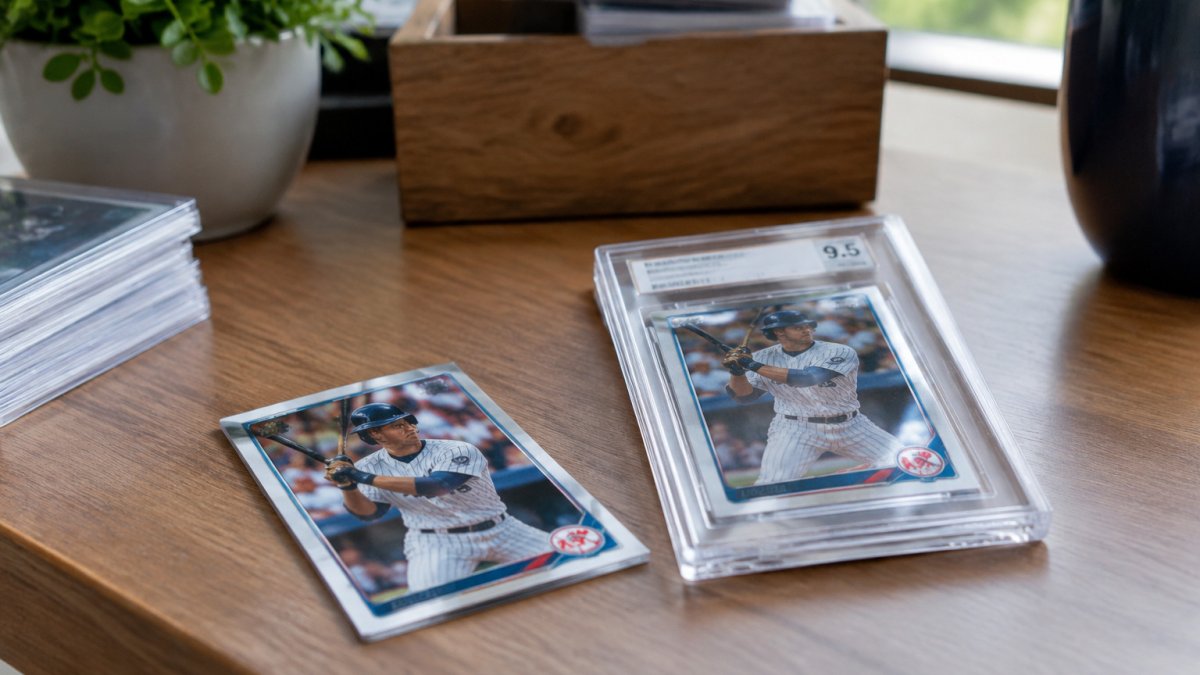
That premium comes from three places:
- Verified condition: Buyers trust a grader's opinion more than a seller's photos.
- Scarcity of top grades: Few cards earn a 10, so those copies command a premium.
- Convenience: Buyers can purchase a slabbed card without inspecting it themselves.
Raw cards can still sell well, especially when the card is rare and its condition is visibly excellent. Graded status simply removes some of the risk for the buyer.
Is It Worth Grading Modern Pokémon Cards?
Modern Pokémon cards are the most common grading question we hear, and the answer is that it depends on the card. Modern sets print in large volumes, so a common card rarely needs grading to sell. Chase cards, alternate arts, and special illustration rares are different. Demand for them can justify the fee.
Before you submit, check these points:
- Is the card a chase card or a popular character?
- Does a raw copy in similar condition already sell for a healthy price?
- Would a top grade move the price enough to cover costs?
If the answer to the last question is unclear, search completed sales for graded copies of the same card. Completed sales show what buyers actually paid, which matters more than asking prices.
PSA 9 vs PSA 10 Card Value in Modern Sets
The jump from a PSA 9 to a PSA 10 can be a large price difference in graded cards, but on modern sets it is also easy to misunderstand. The size of that premium depends on the specific card, its population at each grade, and recent demand.
Start with what the grades measure: centering, corners, edges, and surface condition, judged against the grader's standards.
When evaluating the 9-to-10 gap, consider the demand for the specific card, the population count at each grade as shown in the grading company's population report, and the card's overall collector interest.
Compare the two grades on the same card before deciding, using completed sales for both grades rather than asking prices.
Watch out: Do not assume a card will earn a 10 because it looks perfect in photos or in hand. Self-assessment cannot guarantee a grade.
Before submitting, inspect the card under good light for centering, corners, edges, and surface, and plan your numbers conservatively if any area looks off.
PSA Grading Cost and What It Adds to Your Break-Even Price
Grading fees, shipping to and from the grader, insurance, and handling all add to your cost. Confirm current pricing directly with the grading company before you submit, and add the total to your purchase price to find your break-even point.
Your graded value must exceed that total, or the submission loses money. For example, if a raw card costs $80, grading and shipping add $60, and the graded card sells for $130 before selling fees, the submission may lose money once all costs are counted. Do the math before you send the card.
Grading Fees and Card Resale Value: Calculating Your Net Profit
Net profit is what you keep after every cost is paid, and on modern cards the costs add up faster than most first-time submitters expect. The formula is simple, but the inputs are where submissions go wrong.
- Sale price of the graded card
- Minus selling platform fees
- Minus shipping to the buyer
- Minus grading fee and grading shipping
- Minus insurance and handling on the outbound shipment
- Minus what you paid for the raw card
- = Net profit
Run this calculation twice: once at the grade you expect and once at one grade lower. If the profit only works at a 10 and you are unlikely to earn one, the card may not be worth grading. This risk-adjusted view is the part most grading guides skip, and it is the difference between a submission that makes money and one that quietly loses it.
A worked example shows why. Suppose a raw modern chase card costs $80. Grading and shipping add $60, and the graded card sells for $130 before selling fees. After platform fees and shipping to the buyer, you are below your total cost, so the submission loses money even though the graded price looks higher than the raw price. The raw-to-graded premium has to clear every cost in the stack, not just the grading fee.
Modern-set-specific costs to include:
- Grading tier: Confirm current fees and service levels directly with the grading company before you submit.
- Outbound shipping and insurance: Insure the package for its raw value, and factor in the cost of tracked shipping both ways.
- Marketplace fees: Selling platforms take a percentage of the sale price, and the percentage varies by platform and category. Subtract it before you judge the premium.
- Buyer shipping: On many platforms the seller pays to ship the slab, and a graded holder weighs more and needs more protection than a raw card.
- Risk of a lower grade: Weigh the expected profit against the realistic chance of a lower grade before submitting.
To sell a graded card online safely and profitably, read our guide on selling graded cards online. It covers listing, shipping, and buyer protection steps.
Watch out: Do not use asking prices to estimate your sale price. Completed sales show what buyers actually paid.
The article lists the costs that come out of a graded card's sale price, so this table sums up where the money goes.
| Cost item | Role in net profit | Note |
|---|---|---|
| Selling platform fees | Subtracted from sale price | Varies by platform and category |
| Buyer shipping | Seller often pays | Slabs weigh more and need protection |
| Grading fee and shipping | Added to total cost | Confirm current pricing with the grader |
| Insurance and handling | Outbound shipment cost | Insure for raw value |
| Raw card purchase price | Part of break-even | Counted in total cost |
| Risk of lower grade | Lowers expected profit | Run the math at one grade lower too |
Deciding Which Modern Card to Submit Before You Spend Anything
Before paying for grading, check the raw card's condition and authenticity. Inspect centering, corners, edges, and surface under good light, and compare it against recent sold listings of raw copies.
Use this checklist:
- Recent completed sales show a strong price for the raw card
- Centering looks even on both sides
- Corners are sharp with no visible wear
- Edges are clean and free of whitening
- Surface has no scratches or print defects
- Net profit is positive at the likely grade
To verify a raw card's condition and authenticity before you spend on submission, see our card condition guide. For the grading company that fits your budget, see our grading service evaluation guide.
Not every card is worth the cost of grading. If your numbers do not work, compare with our low-value card grading breakdown before you submit.
Grading can increase value for modern sets, but only when demand, condition, and net profit all line up. Run the numbers first, and submit only the cards that clear your break-even price.
Ready to find your next card? Browse graded and raw singles at Cardboard Superstars, where every listing shows clear condition details before checkout.
Frequently Asked Questions
Does getting a card graded make it more valuable?
Not automatically. Grading adds value only when the expected graded price, minus grading fees, shipping and selling costs, is higher than what the raw card sells for. A modern card in strong raw condition with a low grade expectation often loses money once fees are counted. Check recent completed sales for the same card at the grade you expect before submitting, and compare the net result against the raw sale price.
How much does PSA grading cost per card?
PSA submission fees vary by service level, declared value and turnaround time, and they change over time, so confirm current pricing on PSA's website before submitting. Add shipping to and from the grader, insurance, and any sales tax or seller fees on the eventual sale. These costs together set the minimum sale price a card must reach for grading to break even.
Is it worth grading modern Pokémon cards?
It can be, but usually only for cards whose graded prices clearly exceed raw prices after costs. Common modern commons and uncommons rarely justify fees. Stronger candidates are high-demand chase cards, alternate arts, and cards where raw condition looks very likely to earn a 9 or 10. Look at population reports to gauge scarcity at each grade before you commit.
Is the price difference between a PSA 9 and a PSA 10 worth it?
The gap varies widely by card. The difference varies by card. Compare recent completed sales for both grades. Pre-submission inspection matters here, because centering, corners and surface determine whether a card has a realistic shot at a 10 or is more likely to land a 9.
