


Quick Summary
Card grading is usually worth it for low value cards only when the expected grade premium clearly exceeds the total cost of grading and shipping. Because fixed fees can match or exceed a cheap card's value, compare recent sold comps and total costs before submitting.
- Grading fees are fixed, so they can cost more than a low-value card itself.
- Subtract the raw sale value and total grading cost from the expected graded sale price.
- Total cost includes grading fee, shipping both ways, insurance and packaging.
- Use recent sold listings in the same condition, not asking prices, to estimate raw value.
- If the grade premium is small or uncertain, keep the card raw and protected instead.
Table of Contents
- Why Grading Low-Value Cards Is a Different Decision
- How to Determine If a Card Is Worth Grading
- PSA Grading Cost Breakdown: Fees, Tiers and Hidden Costs
- Raw vs Graded Card Value Comparison
- Grading for Resale vs. Personal Collection
- Common Mistakes When Submitting Low-Value Cards
- Booking Your Next Move: Sell Raw, Grade or Keep It
- Frequently Asked Questions
Why Grading Low-Value Cards Is a Different Decision
Last Updated: November 4, 2026
Grading a card costs a fixed fee, and that fee does not care how much the card is worth. For a high-value card, the fee is a small slice of the total. For a low-value card, the fee can cost more than the card itself, which is why card grading is worth it for low value cards only under narrow conditions. Many collectors make this decision without running the numbers first.
The core question is simple: will the grade increase the card's sale price by more than the total cost of grading and shipping it? Answering that takes a clear view of what you pay, what you might get back, and what a graded slab does for the card's market.
Grading is a decision about margin, not sentiment. A card you love can still be a poor grading candidate if its market value is low. Collectors who skip this step often end up with a slab worth less than the fees they paid.
How to Determine If a Card Is Worth Grading
Start with the raw card's current market value. Look at recent sold listings for the same card in the same condition, not asking prices. Then estimate what the card could sell for at each possible grade.
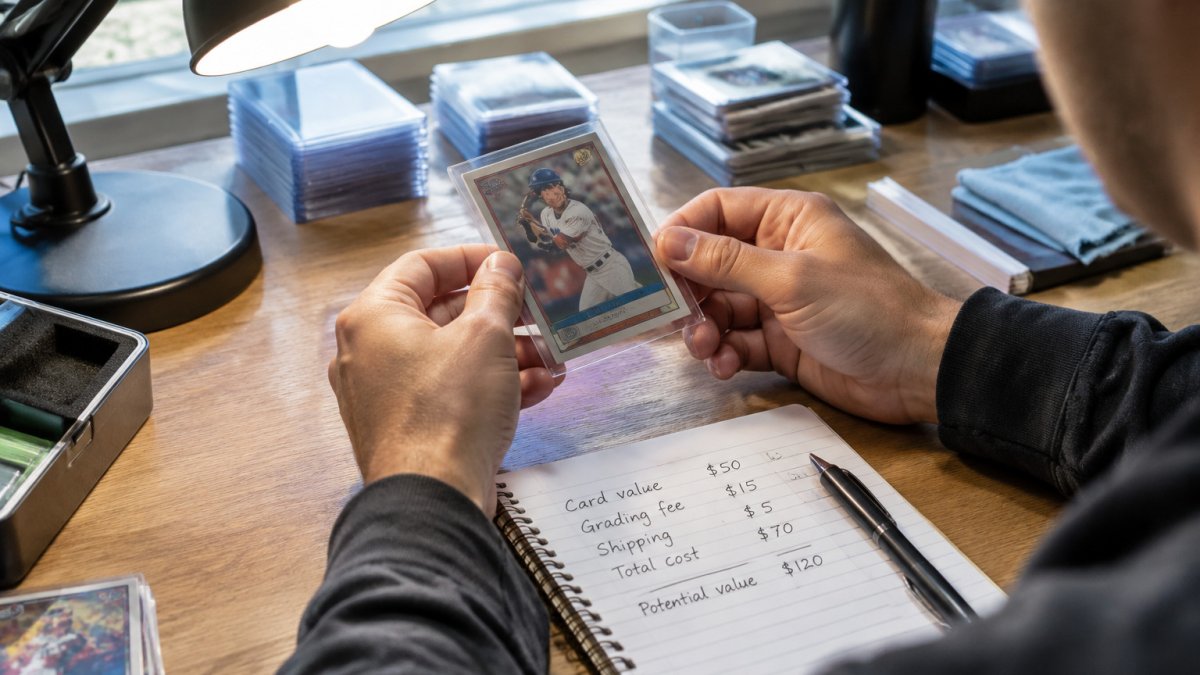
Next, assess condition honestly. Grading services look closely at centering, surface wear, corners, and edges. A card that looks clean to the eye can still grade lower than expected.
Finally, compare the grade premium to your total cost. If a PSA 9 sells for only a few dollars more than the raw card, grading usually loses money. If a likely PSA 10 sells for a large premium, the math can work even on a modest card.
Watch out: many collectors assume a gem mint grade is likely because the card looks clean in photos. Photos hide surface wear and centering problems, so treat any grade you expect as a guess until the card is in hand.
Before submitting a card, compare the expected premium against your total cost using these steps. You can also learn how to recognize counterfeit or altered cards before paying for grading.
| Step | What to do | Note |
|---|---|---|
| Find raw value | Check recent sold listings in the same condition | Not asking prices |
| Assess condition | Look closely at centering, surface wear, corners and edges | Photos can hide problems |
| Estimate grades | Estimate what the card could sell for at each possible grade | Treat expected grades as guesses |
| Compare premium | Check whether the grade premium exceeds your total cost | Grading usually loses money on a small premium |
PSA Grading Cost Breakdown: Fees, Tiers and Hidden Costs
Grading fees generally depend on the service level you choose, the declared value of the card, and how fast you want the card back. Grading companies publish their fee schedules on their official sites, and those schedules change over time, so check the current sheet before you submit.
The headline fee is only part of the cost. Add return shipping, insurance, and packaging. Factor in the time the card spends in transit and in the grading queue, since that tied-up money has a cost too. A common pattern is for round-trip shipping and insurance on a single low-value card to approach or exceed the grading fee itself, which is why single-card submissions rarely pencil out.
Declared value matters as well. Declaring a higher value can raise your fee, but it also protects you if the card is lost or damaged. Declaring too low leaves you under-insured. Set the declared value to a realistic replacement cost, not to the number that gets you the cheapest tier.
Hidden costs add up fast on low-value submissions. Shipping both ways can rival the grading fee itself. If you submit several cards, bundling can reduce per-card shipping, but it also means one slow order holds everything back. Packaging supplies, a trackable and insured return label, and the risk of a damaged or lost card in transit all belong in your total cost line, not in a mental footnote.
The Break-Even Calculator
Use this formula before you submit:
Break-even graded sale price = Raw sale value + Total grading cost
In words: your total cost (grading fee + shipping both ways + insurance + packaging) must be less than the expected sale price of the graded card minus the raw card's sale price. Equivalently, the grade premium, graded sale price minus raw sale price, must exceed total grading cost.
Worked example: suppose a raw card sells for $20. Your total cost for grading is $35 once you add the fee, shipping, and insurance. The graded card must sell for at least $55 for you to break even. If the graded card is likely to sell for $45, grading loses about $10 per card before you account for your time. If the graded card is likely to sell for $70, the premium is $50 against a $35 cost, a $15 gain, thin enough that a single lower-than-expected grade wipes it out.
Fill in these numbers for your own card:
- Raw sale value: $______
- Total grading cost (fee + shipping both ways + insurance + packaging): $______
- Expected graded sale value at target grade: $______
- Break-even check: (expected graded value − raw value) vs. total cost
If the difference is smaller than your total cost, keep the card raw. If it is larger but only by a few dollars, treat the margin as noise and assume a lower grade will erase it.
Watch out: collectors sometimes compare the graded price to the raw price and forget to subtract shipping and insurance from the graded sale proceeds. Net proceeds, not gross sale price, is the number that belongs in the calculator.
Raw vs Graded Card Value Comparison
A raw card and a graded card sell to different buyers. A raw card is judged by the buyer's own inspection, which adds uncertainty and usually a discount. A graded slab removes that uncertainty by stating a grade from a third-party service.
Cameron Jordan 2026 Topps Football Holo Card #148 New Orleans Saints →
That certainty has value only when the grade is high enough to matter in the market. A slab at a middling grade often sells close to the raw price, while a top grade can command a clear premium.
Market liquidity also shapes the comparison. Some cards sell quickly in both raw and graded form. Others sit unsold for months, and the graded version can be harder to move, not easier.
Keep the raw card if the grade premium looks thin or uncertain. Grade the card if the expected premium is clearly larger than your total cost.
Grading for Resale vs. Personal Collection
Grading for resale is a financial decision. You should expect to recover your full cost plus a profit, and the break-even check above tells you whether that is realistic. Before you grade for resale, confirm that the graded version of your specific card has recent sold comps, not just active listings.
Grading for a personal collection is different. Many collectors grade a card because they want it protected in a slab, or because a particular card matters to them. Those reasons are legitimate, but they should be a conscious choice rather than an assumption that the card will pay off.
Be clear about which goal you have before you submit. A card you grade for personal reasons may never recover its fees.
One factor resale-focused articles rarely explain is the population report. Grading services publish counts of how many examples of a card exist at each grade. For a low-value card, a high population at your target grade means the slab is not scarce and the premium will be thin, even if the grade is high.
If your real goal is protection rather than resale, professional grading is not the only option.
Watch out: collectors sometimes grade a low-value card for personal reasons and then try to sell it later, only to find the slab premium does not cover the fees they already paid. Decide the goal first, and let the goal, not the hope of a premium, drive the submission.
Common Mistakes When Submitting Low-Value Cards
The most common mistake is grading a card without checking its sold comps first. Many collectors assume a clean card will grade well and then find the premium does not cover the fees.
A second mistake is ignoring the risk of a low grade. A card that grades lower than expected can sell for less than the raw price, and you have paid for that outcome.
Third, collectors often underdeclare or overdeclare value without thinking through the consequences. Both choices affect cost and protection, so set the declared value deliberately.
Protect raw cards before and during any submission. Compare practical protective supplies such as sleeves, top loaders and mailers before you ship. Sleeves and penny sleeves, top loaders or semi-rigid holders, and a bubble mailer or box for shipping all reduce the chance of surface damage while the card is in transit.
If you decide not to grade a card, keep it protected and store it properly. Our guide to card storage for long-term collecting covers how to protect raw cards over time. Our guide to card storage for long-term collecting covers how to protect raw cards over time.
Booking Your Next Move: Sell Raw, Grade or Keep It
For most low-value cards, the answer is to sell raw or keep the card protected in your collection. Grading only makes sense when the break-even check shows a clear gain or when the card matters to you personally.
If you decide against grading, you can still build your collection with cards that are already graded. Browse graded sports cards with the grade you want. Browse graded sports cards with the grade you want.
Run the break-even math before every submission, and keep cards you cannot justify grading in protected storage.
Frequently Asked Questions
Why do people grade low value cards?
Most people grade low-value cards for condition certainty, authenticity confirmation, or sentimental reasons rather than profit. A slabbed card is sealed, labeled and protected from handling wear, which matters for a favorite player or a card you plan to keep for years. Grading a low-value card only makes financial sense when the expected graded value, minus the grading fee, shipping and insurance, still leaves a meaningful profit over the raw sale price.
How much does it cost to grade a $1000 card?
For a card worth $1,000 raw, grading fees are usually a small share of the total outlay, and the decision turns on the expected graded result rather than the fee alone. Add shipping, declared value insurance and the possibility of a lower grade than expected. A card that grades at a higher tier can justify the cost, while a weaker grade can erase the gain. Run the break-even math with the exact fee tier before you submit.
Does grading a card decrease value?
Grading does not reduce value in itself, but it can. If a card grades lower than you hoped, the slabbed value may sit below the raw market price, and you will have paid fees to learn that. Cards with visible centering, surface or corner issues are the most common cases where the grade disappoints. Check the card's raw condition closely before submitting, and compare recent sold listings for both raw and graded copies.
What is the minimum card value required to justify grading costs?
No universal threshold exists, but the rule of thumb is that the expected graded value must exceed the raw value by more than all grading costs combined. Fees, return shipping, insurance and the risk of a low grade all count. Cards that sell for only a few dollars raw rarely clear that bar unless a high grade is very likely. Use the break-even calculation in this guide with recent sold prices to test your specific card.
