


Table of Contents
- What Makes a Pokémon Card Rare
- The 10 Rarest Pokémon Cards Collectors Hunt For
- How to Spot Fake Pokémon Cards
- Understanding Card Condition and Its Impact on Value
- How to Grade Pokémon Cards
- Market Value and Price History of Rare Cards
- Building Your Rare Card Collection
- Frequently Asked Questions
Last Updated: September 28, 2026
What Makes a Pokémon Card Rare
Understanding what makes rarest pokemon cards valuable comes down to supply, demand, and historical significance. A card becomes rare when fewer copies exist in high condition, collectors actively seek it, or it represents a milestone in trading card history. The rarest Pokémon cards command five or six-figure prices at auction because they're nearly impossible to find in mint condition.
Several factors drive rarity. First Edition printings are scarcer than Unlimited versions because they had smaller initial runs. Shadowless cards from 1999 predate the set symbol that appears on later printings, making them harder to locate. Tournament prize cards were never sold to the public, only awarded to winners, which instantly limits their population. Test prints and prototype cards exist in single-digit quantities because they were never meant for mass distribution.
Condition matters enormously. A First Edition Base Set card in PSA 10 (Gem Mint) condition is exponentially rarer than the same card in PSA 7 (Near Mint). Grading services track population reports showing exactly how many copies have been graded at each condition level. When a population report shows only three PSA 10 copies of a card exist worldwide, that scarcity directly translates to value.
At Cardboard Superstars, we provide a curated selection of authentic sports cards, Pokémon, and TCGs, with clear product details provided before checkout, making it easy for enthusiasts at every level to find their next hobby win with total confidence.
The 10 Rarest Pokémon Cards Collectors Hunt For
Finding rarest pokemon cards requires knowing which specific cards have limited populations and why. These ten cards represent the pinnacle of collecting, each one is pursued by serious hobbyists and investors worldwide.
Pikachu Illustrator
The Pikachu Illustrator is widely considered the holy grail of Pokémon cards. Only 39 copies were ever produced as a promotional card awarded to winners of the 1997 and 1998 Pokémon Card Illustration Contest in Japan. The card features Pikachu in a watercolor style and carries the stamp "Illustrator" on the bottom right.
Population reports show that most known copies are in moderate condition. Gem Mint examples are exceptionally rare. A PSA 10 copy sold for over $900,000 in 2021, establishing this card as the most valuable Pokémon card ever sold. Even damaged copies regularly fetch six-figure sums at auction.
The card's rarity stems from its contest-only distribution and the fact that many winners kept their cards in personal collections rather than selling them. Counterfeits are common, making authentication critical before any purchase.
First Edition Base Set Charizard
The First Edition Base Set Charizard is the most recognizable rare card among collectors. This holographic card features Charizard in flight and comes from the 1999 Base Set. Only cards with the "1st Edition" stamp on the left side are considered truly rare, Unlimited printings are far more common.
PSA 10 copies of this card have sold for over $300,000. Even PSA 8 (Near Mint-Mint) examples command five-figure prices. The card's popularity, combined with its limited First Edition print run, makes it the most sought-after card for serious collectors.
Condition is everything with this card. Centering issues, surface wear, and edge damage significantly reduce value. The holographic pattern must be pristine with no scratches or imperfections.
Tournament Trophy Cards
Tournament trophy cards were awarded to winners at official Pokémon TCG tournaments and were never sold commercially. The most famous is the Kangaskhan trophy card from the 1997 World Tournament. Only a handful of copies exist, and they're rarely offered for sale.
Other tournament trophy cards include the Tropical Mega Battle Pikachu and various regional tournament cards. These cards carry special stamps or markings indicating their tournament origin. Population reports show single-digit quantities for most trophy cards.
Because these cards were never mass-produced, their rarity is absolute. Even damaged examples are highly valued by collectors pursuing complete trophy card sets.
Test Prints and Prototype Cards
Test prints and prototype cards are experimental versions created during the card design and manufacturing process. Very few escaped the factory, making them extraordinarily rare. These cards may have different artwork, text, or card stock than the final released version.
A famous example is the Blastoise test print, which shows variations from the released version. Test prints often have minimal population reports, sometimes showing zero or one certified copy. When they surface at auction, they attract intense bidding from collectors seeking the rarest possible cards.
Authentication is critical with test prints because their rarity makes them prime targets for counterfeits. Only reputable grading services should evaluate these cards.
Shadowless and Unlimited Variants
Shadowless cards were printed from 1999 to early 1999 and lack the drop shadow effect behind the Pokémon illustration that appears on later printings. These early Base Set cards are significantly rarer than Unlimited versions, which were printed continuously from 1999 onward.
The difference is visual: Shadowless cards have a clean white border around the artwork, while Unlimited cards show a subtle shadow. This distinction dramatically affects value. A Shadowless Charizard in PSA 9 condition can be worth three times more than an Unlimited copy in the same grade.
Shadowless cards from the earliest print run command premium prices. Collectors specifically seek these variants because they represent the true beginning of the Pokémon TCG era in North America.
Regional Exclusive Cards
Some Pokémon cards were released exclusively in specific regions or countries, never making it to North American distribution. Japanese-exclusive cards often feature different artwork or special stamps. European and Australian releases sometimes included cards unavailable elsewhere.
Regional exclusives create natural scarcity because collectors in other regions cannot easily acquire them. A Japanese Base Set card with specific characteristics may be worth significantly more than its North American equivalent.
These cards require knowledge of regional release dates and distribution patterns to identify correctly. Cardboard Superstars offers a curated selection of authentic products, including Pokémon and TCGs.
How to Spot Fake Pokémon Cards
Counterfeit Pokémon cards are a serious problem in the collecting market. Learning to identify fakes protects your investment and ensures you're purchasing authentic pieces.
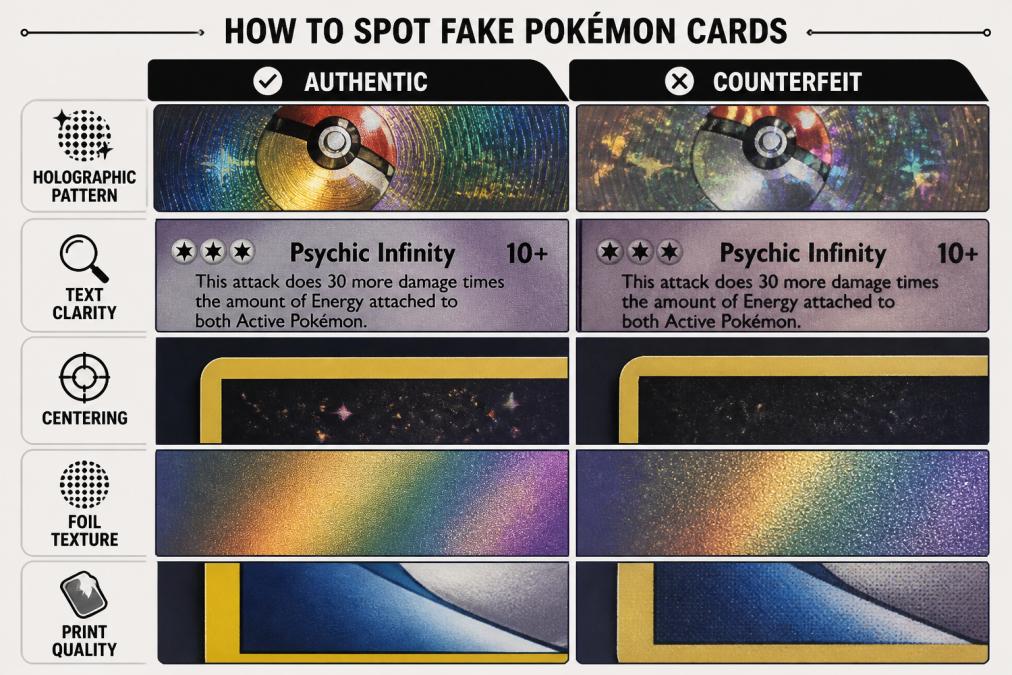
The most reliable authentication method is professional grading through a reputable service. However, you can perform initial checks before sending cards for grading. Examine the card's weight and thickness, authentic cards have a specific feel that counterfeits rarely match. Run your finger across the surface; genuine cards have a particular texture that fakes cannot replicate.
Check the text quality. Authentic Pokémon cards use crisp, clean typography with sharp edges. Counterfeit text often appears blurry or slightly misaligned. Look at the holographic pattern, real holos show a consistent, high-quality reflective surface. Fake holos often display uneven patterns or poor color saturation.
Inspect the card's edges. Authentic cards have clean, uniform edges with proper alignment. Counterfeits frequently show rough or misaligned edges due to poor cutting during manufacturing.
Understanding Card Condition and Its Impact on Value
Card condition is the single most important factor determining value for rare Pokémon cards. Two identical cards can differ in price by hundreds of thousands of dollars based solely on condition differences.
How to Grade Pokémon Cards
Professional grading provides an objective assessment of card condition and authenticity. Grading services examine cards under controlled conditions using standardized criteria. The most recognized grading companies include PSA, BGS, and CGC.
Market Value and Price History of Rare Cards
The market for rarest Pokémon cards has experienced dramatic growth since 2020. Auction results show exponential price increases for Gem Mint examples of the most sought-after cards. A PSA 10 First Edition Charizard that sold for $50,000 in 2019 commanded $300,000+ by 2023.
Building Your Rare Card Collection
Starting a rare card collection requires strategy, patience, and knowledge. Most collectors begin with more affordable cards before pursuing the rarest examples.
| Card | Rarity Level | Key Factor | Typical Grade Range |
|---|---|---|---|
| Pikachu Illustrator | Extreme | Contest-only, 39 copies | PSA 4-9 |
| First Edition Charizard | Extreme | First Edition stamp, holographic | PSA 7-10 |
| Tournament Trophy Cards | Extreme | Never sold commercially | PSA 5-9 |
| Test Prints | Extreme | Prototype only, factory samples | PSA 6-8 |
| Shadowless Cards | Very High | Early 1999 print run | PSA 6-9 |
| Regional Exclusives | High | Geographic distribution limits | PSA 7-9 |
Frequently Asked Questions
What are the rarest Pokémon cards to look for as a collector?
The rarest Pokémon cards include the Pikachu Illustrator (fewer than 40 known to exist), First Edition Base Set Charizard, tournament trophy cards like Kangaskhan, and test print prototypes. These cards command premium prices due to extremely limited print runs or unique release circumstances. Shadowless variants and regional exclusives also rank among the most sought-after. Rarity is determined by print run size, release date, condition availability, and historical significance within the Trading Card Game.
How do I know if a rare Pokémon card is authentic and not counterfeit?
Examine the card's texture, print quality, and holographic pattern closely. Authentic cards have sharp, consistent text and proper centering. Counterfeit cards often show fuzzy printing, incorrect colors, or misaligned holograms. Check the card stock weight and flexibility, counterfeits typically feel thinner or flimsy. Verify the set symbol and illustrator name match official records. For high-value cards, request professional authentication from a grading service like PSA, BGS, or CGC before making a significant purchase.
What factors determine the value of a rare Pokémon card?
Card rarity, condition grade, print run size, and market demand all influence value. First Edition and Shadowless variants typically cost more than Unlimited prints. Gem Mint condition (PSA 10 or BGS 10) commands premium prices compared to lower grades. Provenance and authentication history matter, cards with clear ownership documentation and professional grading certificates hold value better. Auction results and secondary market sales data show that investment-grade cards maintain value more consistently than damaged or ungraded examples.
How do I grade Pokémon cards accurately?
Professional grading services evaluate centering, corners, edges, and surface quality using a 1-10 scale. Gem Mint (9) cards show minimal wear and near-perfect centering. Mint condition (8) allows slight imperfections. Examine card stock for creases, stains, or print lines under bright light. Check holographic surfaces for scratches and edge wear with a loupe. For valuable cards, submit to PSA, BGS, or CGC for official condition reports and population data. Grading services provide authentication, protecting your investment in rare cards.