


Last Updated: November 16, 2026
Quick Summary
A low grade usually reflects what the grader saw under magnification, most often centering, corners, edges, or surface. Before acting, verify the label, inspect the slab, and compare the lowest sub-grade to your own measurements. Avoid cracking the slab, since that voids the grade.
- Grading companies score centering, corners, edges, and surface separately, and the final grade is usually limited by the weakest one.
- Verify the label against the card first, since mislabeled cards are a customer-service issue, not a grade dispute.
- Do not crack the slab to get a better look, because opening it voids the grade and any review or label-error claim.
- Choose between review, regrade, crossover, or selling as-is by comparing all-in costs against recent sold price differences.
Table of Contents
- Why Your Card Received a Lower Grade Than Expected
- Common Card Flaws That Reduce Grades
- Understanding the Grade Shown on Your Slab
- Your Immediate Next Steps After a Low Grade
- Review, Regrade, Crossover, or Slab Removal: Your Options
- Does a Low-Grade Card Still Have Value? Comparing Market Prices by Condition
- Should You Keep or Sell a Low-Grade Card?
- Deciding Your Card's Next Move With the Numbers
- Frequently Asked Questions
Why Your Card Received a Lower Grade Than Expected
A low grade on a graded card is frustrating, but rarely a mystery. Collectors often open a slab hoping for gem mint and find a grade far lower than expected. In most cases, the grade reflects what a grader saw under magnification, not what the card looked like in your hand. What happens if my card gets a low grade is worth answering calmly, because the next steps depend on understanding the reason behind the number.
Grading companies evaluate four main areas: centering, corners, edges, and surface. Each one is scored separately, and the final grade is usually limited by the weakest of them. A card with excellent corners can still land a modest grade if its centering is off.
Centering and Measurement
Centering measures how evenly the image sits within the card borders. Graders check front and back, and an uneven border on either side can pull the grade down. A small shift that is hard to see at arm's length can be easy to spot under a loupe.
Before you submit a card, measure the borders yourself with a ruler or a centering tool. Compare the left-to-right and top-to-bottom ratios. If the numbers are far from even, the grade may reflect that.
Corners, Edges, and Surface Condition
Corners are often the first place wear appears; even slight softening or a tiny white dot can cost points. Edges can show chipping, especially on cards stored loose or handled often. Surface condition covers scratches, scuffs, print lines, and clouding on the finish.
Look at the card under a bright light at an angle. Surface flaws invisible straight on often show up as glare or shadows when you tilt the card. Learn whether minor surface scratches are even eligible for grading before you decide what to do next.
Common Card Flaws That Reduce Grades
Some flaws show up again and again in low-grade results. Recognizing them makes it easier to understand the feedback you received.
- Off-center borders on the front or back
- Soft or rounded corners, even when the edges look clean
- Chipping or whitening along the card edges
- Surface scratches visible at an angle
- Print defects such as lines, dots, or ink spots
- Stains or discoloration on the card face or back
Print defects can be especially hard to judge. Some are factory issues present when the card leaves the pack, while others come from handling after purchase. Graders score what they see, not what caused it.
Understanding the Grade Shown on Your Slab
A slab usually shows an overall grade and may list sub-grades for centering, corners, edges, and surface. Many collectors focus only on the big number, but the sub-grades tell you exactly where the card lost points.
Read the label from top to bottom: find the overall grade first, then check each sub-grade. Our step-by-step guide to reading a grading report walks through each line of the label. If one sub-grade is much lower than the others, that category likely drove the final result. A card with strong corners but weak centering is a different situation from one with clean centering and damaged edges.
The breakdown also helps you decide what to do next, showing whether the card has a real condition problem or the grade reflects a strict call on a small flaw.
Your Immediate Next Steps After a Low Grade
The question "what happens if my card gets a low grade" is really about the first 48 hours.
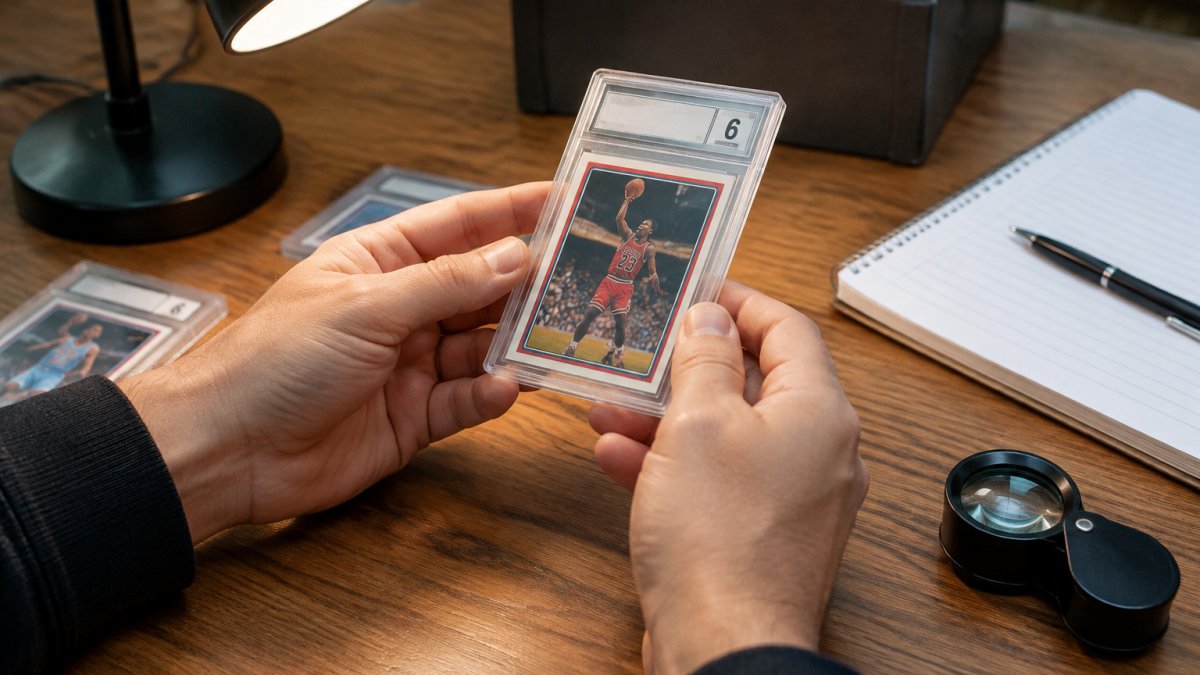
1. Verify the label against the card before anything else. Read the flip top to bottom: card name, set, card number, year, variant (base, refractor, parallel), and the overall grade plus any sub-grades.
2. Inspect the slab itself. Look for cracks, scuffs on the plastic, debris sealed inside, and any sign the case was opened.
3. Document the card under consistent light. Shoot front and back, straight-on and at a low angle, outside the slab if safe, or through the slab with light raking across the surface to reveal scratches and print lines.
4. Re-measure centering and re-check the four sub-grades. If the label shows sub-grades, identify the lowest one, that is almost always the limiting factor. Measure the borders yourself and compare your numbers to the sub-grade.
5. Pull recent sold comps at this grade and one or two grades up. Use sold listings, not active asking prices.
6. Write down your options and their costs before you act. List the review fee, the regrade fee plus shipping, the crossover cost, and the net proceeds from selling as-is.
A common pattern is that the first day's disappointment fades once the comps are in front of you. Give yourself that day before spending another dollar.
Before taking any action, work through these steps in order to protect the card and your options.
| Step | What to do | Timing or note |
|---|---|---|
| Verify the label | Check name, set, number, year, variant and grade | First 48 hours |
| Inspect the slab | Look for cracks, scuffs and a card shifted in the well | Before any other action |
| Document the card | Shoot front and back under consistent light | Keep lighting and distance the same |
| Re-measure centering | Compare your ratios to the lowest sub-grade | Identify the limiting sub-grade |
| Pull sold comps | Check the same grade, the grade above and raw | Use sold listings, not asking prices |
| List costs | Note review, regrade, crossover and sell-as-is figures | Compare side by side |
| Avoid cracking | Do not open the slab to get a better look | Opening voids the grade and any claim |
Review, Regrade, Crossover, or Slab Removal: Your Options
There are four realistic paths after a low grade, and they are not interchangeable. Each has a different cost, risk of the grade going down, and effect on marketability. The right choice depends on why you think the grade is wrong and what the comps say the next grade up is worth.
Review (appeal). A review asks the same grading company to look at the card again, usually with the slab intact. The card never leaves its holder, so there is no handling risk and the existing grade is preserved if the review fails.
Regrade (resubmission). A regrade sends the card back through the full grading process, either in its current slab or raw. This is the path with real upside and real downside: the card can come back higher, the same, or lower.
Crossover. A crossover moves the card from one grading company's holder to another's, usually in hopes of a more favorable grade or a slab the market pays more for. Before resubmitting, compare grading services to see how their policies and turnaround differ.
Slab removal (cracking). Removing the card from its holder is the highest-risk option and the one most often chosen in frustration. It is irreversible. If you are preparing a card for resubmission, see how to use semi-rigid holders for submission.
How to document a perceived grading error without damaging the card. The strongest review or regrade case is built on evidence, not opinion. Photograph the card in the slab under raking light so scratches and print lines are visible.
A simple decision rule. If the lowest sub-grade is clearly inconsistent with your measurements, start with a review, the cheapest path that preserves the grade.
Watch out: Do not submit the same card for a regrade repeatedly hoping for a different result.
Does a Low-Grade Card Still Have Value? Comparing Market Prices by Condition
Yes, many low-grade cards still have value, but the amount depends heavily on the player, the set, and the demand. A common rookie card at a lower grade can still sell well, while a niche card may drop sharply.
Compare recent sold prices for the same card in similar grades, and watch how prices move between your grade and the grades just above it. A small jump suggests the slab is not adding much value; a large one may justify a closer look at a review or regrade.
Pricing depends on quantity, timing, and the buyer's expectations. Check current listings rather than relying on old estimates. For specific pricing questions, contact Cardboard Superstars directly for a current quote.
Should You Keep or Sell a Low-Grade Card?
Keeping a card makes sense when it has personal meaning, when you enjoy the player or set, or when you expect demand to grow. Selling makes sense when the card no longer fits your collection or when the market offers a fair return.
Ask yourself a few direct questions. Would you be happy keeping this card at its current grade for years? Does the expected sale price cover the grading cost you already paid? Would the money work better on a card you want more?
Many collectors find it helpful to set a price floor before listing. That keeps emotion from driving a bad sale.
Deciding Your Card's Next Move With the Numbers
Put the decision on paper. List the total cost of a review or regrade, including shipping and fees. Estimate the likely grade and the price it would bring, then subtract expected costs from expected return.
If the math is unclear, a simpler rule works well: only spend more on a card when the likely gain is clearly larger than the cost and the risk of a lower grade. If the gain is uncertain, keeping the card or selling it as is often makes more sense than paying to chase a higher number. For a broader look at whether grading pays off, read are graded cards worth the investment.
Browse the Cardboard Superstars collection for protective supplies and other collecting ideas, and keep your cards safe while you decide.
Frequently Asked Questions
Does a low grade make a card worthless?
No. A low grade lowers the card's value compared with a higher grade of the same card, but it does not make the card worthless. Many collectors still want low-graded examples of rare or sought-after cards, especially when the card is a key set piece, a early print, or a character they care about. Market value depends on the card, the grade, and recent sales of that exact grade. Check recent completed sales for your specific card and grade before deciding that the card has little or no worth.
Can I get a card regraded if I disagree with the grade?
Often, yes. Most grading companies offer a review or resubmission process, though policies, fees, and turnaround times vary by company and service level. Before resubmitting, examine the card under good light and compare it with the grading standards the company publishes. Be realistic: a regrade can come back the same, higher, or lower. Factor the grading fee, shipping, and insurance into your decision, since you pay those costs again whether or not the grade changes.
Should I crack a low-grade card out of its slab and resubmit it?
Sometimes, but only after you weigh the risks. Removing a card from its slab, often called cracking, can damage the card, and a card that has been cracked out typically cannot return to its original slab. Cracking is most worth considering when you believe the card is likely to earn a higher grade and the expected gain justifies the new grading fee and the risk of handling damage. If the card is already a strong example of its grade, leaving it sealed is usually the safer choice.
Should I sell a card after it gets a low grade?
It depends on the card's market value at that grade, the fees you will pay to resubmit or sell, and how much you value keeping it. Compare recent sales for the same grade to estimate what you could realistically receive after platform fees and shipping. If the expected return is lower than the cost of regrading, selling or keeping the card as a personal collectible may make more financial sense than sending it back for another grading attempt.
