


Table of Contents
- Should You Clean Trading Cards at All?
- Gather a Trading Card Cleaning Kit That Won't Scratch
- Step-by-Step: Remove Loose Dust Without Dragging It Across the Surface
- How to Clean Trading Cards for Grading Without Risking Damage
- How to Clean Pokemon Cards Without Damaging Them
- How to Clean Old Trading Cards Safely: Stubborn Dirt, Residue and Existing Damage
- Booking Your Next Batch of Protected Cards
- Frequently Asked Questions
Should You Clean Trading Cards at All?
Last Updated: November 8, 2026
Dust on a trading card is a normal part of owning one, and most collectors should only clean their cards when it is truly needed.
Cleaning makes sense in a few clear cases. A card with loose dust sitting on the surface can be lifted off safely.
Cardboard Superstars recommends a simple rule: protect first, clean second. A card kept in a sleeve and a top loader rarely needs more than an occasional dust check.
- Clean when: loose dust is visible, or fingerprints are on the surface
- Leave alone when: the card is already sealed in a protector and looks clean
- Stop and reassess when: the card has a coating, texture or old damage
Gather a Trading Card Cleaning Kit That Won't Scratch
A good cleaning kit has only a few items, and each one should be soft, clean and dry. The goal is to lift dust, not grind it into the surface. Any tool that has been used on something else, or that has grit in it, can cause scratches.
Here is what to gather before you start:
- A soft, clean makeup brush or a clean soft brush for loose dust
- A dry microfiber cloth, used only for cards
- Cotton swabs for tight corners and edges
- Penny sleeves or card sleeves to hold cards during the process
- A clean, flat work surface, such as a folded towel
You do not need harsh cleaning liquids. Our Standard Card Sleeves - BCW are a good way to keep each card protected while you work, and Archival Safe Card Sleeves: A Beginner's Guide explains which sleeve materials suit long-term storage for anyone learning how to remove dust from trading cards without scratching.

If you want a complete setup in one purchase, the Rip & Protect Bundle 200 Penny Sleeves, 200 Semi Rigid Card Savers at $32.00 gives you sleeves for everyday handling and savers for extra structure.

Step-by-Step: Remove Loose Dust Without Dragging It Across the Surface
The biggest danger when removing dust is dragging it across the card, since a speck of grit under a cloth can press into the finish. The method below works by lifting dust off the card first, then wiping only what remains. Work slowly, and check the card in good light after each step.
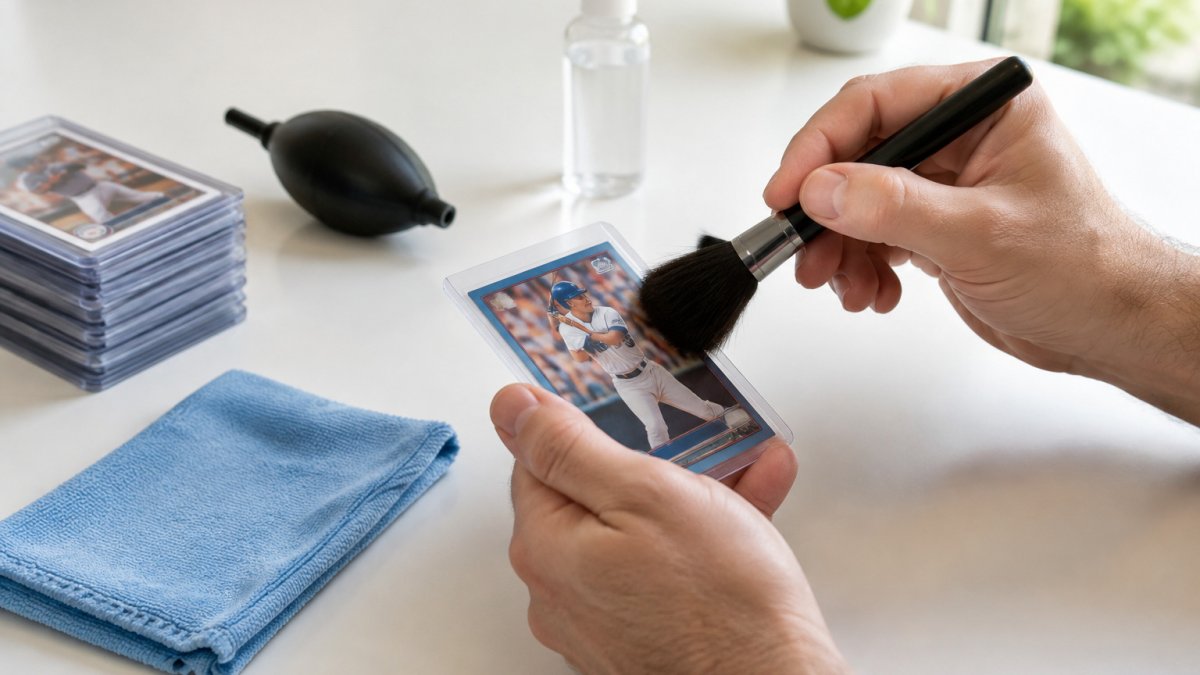
A Repeatable Low-Risk Protocol
Use the same order every time:
- Wash and dry your hands. Oils and grit on fingers transfer to edges and faces. Dry completely on a clean towel before touching any card.
- Clear and inspect the work surface. Use a clean, flat surface such as a folded microfiber towel. Tilt the card under a lamp and note where the dust sits and whether the surface is glossy, foil, textured or matte.
- Lift loose particles first. Use a soft brush or air blower before any cloth touches the card (details below).
- Wipe only the residue that remains. Use a dry microfiber cloth with the lightest pressure, in one direction.
- Re-inspect and stop. If dust or a speck remains after one or two light passes, stop. Repeated passes are how scratches happen.
Lift Dust Off With a Soft Brush or Air Blower First
Start by moving loose dust away from the surface without touching it. Hold the card flat on a clean, dry table. Use a soft brush in one short, light stroke from the center toward the edge, so debris falls off the card.
Never brush back and forth. Repeated strokes press dust into the surface and can scratch glossy or foil finishes. If the dust does not move with one or two light passes, stop. Forcing it is how scratches happen.
Wipe Gently With a Dry Microfiber Cloth
Once the loose dust is gone, use the dry microfiber cloth for any light residue left behind. Fold the cloth so you have a clean, soft surface. Touch the card with only the lightest pressure, then wipe in one consistent direction, such as edge to edge. Do not scrub in circles.
Lift the cloth between passes instead of sliding it back across the same spot. Check the cloth often. If it picks up grit, switch to a fresh section or a clean cloth.
Decide Whether to Lift, Wipe or Leave It
Not every particle should be wiped. Use this quick decision path before you touch the card:
- Loose surface dust on a clean card: lift with a blower or soft brush, then stop. No cloth needed.
- Light film or fingerprint haze on a glossy or foil card: one dry microfiber pass with minimal pressure, then re-inspect.
- Grit that feels embedded or will not lift after two light passes: stop. Wiping further risks a scratch, and embedded debris is a job for a conservator, not a cloth.
- Card with existing scratches, edge wear or a delicate coating: brush only, or leave it alone.
- High-value or grading-bound card: err toward leaving it untouched unless the dust is clearly loose.
Keep Tools Clean Between Cards
Grit trapped in cloth fibers or brush bristles is a common cause of new scratches. Keep card tools separate from household cleaning supplies, store them in a clean zip bag or lidded container, and wash microfiber cloths without fabric softener, then air dry. Replace a cloth once it feels stiff or picks up visible particles.
Each step below pairs a task with its tool and the limit that keeps the card safe.
| Step | What to do | Key limit |
|---|---|---|
| Prep hands | Wash and dry hands before touching cards | Dry completely on a clean towel |
| Inspect surface | Tilt the card under a lamp and note dust and finish | Check glossy, foil, textured or matte |
| Lift loose dust | Brush or air-blow before any cloth touches the card | One or two light passes only |
| Wipe residue | Use a dry microfiber cloth in one direction | Lightest pressure, no scrubbing |
| Re-inspect and stop | Check the card in good light | Stop after one or two light passes |
How to Clean Trading Cards for Grading Without Risking Damage
Cards headed for grading face closer inspection, so surface marks matter more. The good news is that the same gentle method applies. Clean only what is needed, and avoid any step that could leave a new mark.
Before you clean a card for grading, keep these points in mind:
- Remove loose dust with a brush or air blower before any wiping
- Use only a dry microfiber cloth, with minimal pressure
- Never clean a card that already has visible wear, since cleaning can make it look worse
- Handle cards by the edges to avoid new fingerprints
If you are preparing a batch, the Rookie Supply Pack - 100 Card Sleeves + 50 Toploaders at $13.75 gives you sleeves and toploaders to protect cards between cleaning and submission. Our guide on How to Clean Graded Card Slabs: A Safe Guide covers slabbed cards separately, since those need different handling.

How to Clean Pokemon Cards Without Damaging Them
Pokemon cards often have glossy or holographic surfaces, and those finishes show scratches easily. The same dry, light method works here. Lift dust first, then use a clean microfiber cloth with very little pressure. Avoid any liquid, since moisture can affect the card's coating and edges.
Holographic cards need extra care. Tilt the card under light to check for marks before and after you clean. Our guide to Pokémon Card Sleeves and Toploaders explains which protection suits these finishes.
How to Clean Old Trading Cards Safely: Stubborn Dirt, Residue and Existing Damage
Older cards often carry embedded grime, residue and wear that a dry cloth cannot fix. For these cards, the safest choice is usually to stop. Pushing harder or adding moisture can cause more damage than the dirt itself. The key skill is telling loose dust apart from debris that has bonded to the surface, and knowing when cleaning would cost more than it fixes.
Tell Loose Dust From Embedded Debris
Before you touch an old card, inspect it under a lamp at a low angle. Loose dust sits on top of the surface and shifts when you tilt the card or pass a dry brush nearby.
A simple test: brush one light stroke from the center toward the edge. If the particle moves, it was loose. If it stays, treat it as embedded and stop.
Stop Conditions: When Not to Clean
Leave the card alone, or route it to a professional conservator, when any of these apply:
- The particle will not lift after two light brush passes.
- The surface is textured, embossed or has a soft coating that a cloth can catch on.
- There is existing scratching, edge wear, corner damage or a crease near the debris.
- The card is high-value or you plan to submit it for grading.
- The debris sits in a scratch, a print line or a recessed area of the finish.
Watch out: Picking at a speck with a fingernail, toothpick or sharp tool almost always enlarges the mark. A cotton swab used dry at the very edge is the only tool worth trying, and only on a low-value card where a test on an inconspicuous corner shows no change.
Why Cleaning Can Hurt a Grading Outcome
Grading companies evaluate the surface, corners, edges and centering of a card, so new marks from cleaning can affect how a card is assessed. Embedded debris that sits in a scratch is already part of the card's condition; wiping around it rarely improves the grade and can add a new defect. If a card is a grading candidate, the safer move is to protect it and submit as-is rather than risk a new mark.
What to Do Instead of Cleaning
For old or valuable cards, protection beats cleaning. Sleeve the card, place it in a rigid holder, and store it away from heat, humidity and direct light. For guidance on keeping a collection safe, see Protecting High Value Trading Card Collections in 2026.
If you are organizing a batch of older cards, the Rookie Supply Pack - 100 Card Sleeves + 50 Toploaders at $13.75 gives you sleeves and toploaders to protect cards without further handling, and the Rip & Protect Bundle 200 Penny Sleeves, 200 Semi Rigid Card Savers at $32.00 covers larger batches.
Booking Your Next Batch of Protected Cards
Dust removal is a small job, but it is one that can cause lasting damage if rushed. Take your time, use dry and soft tools, and protect each card before and after you clean it. When in doubt, leave the card alone.
At Cardboard Superstars, we want every card in your collection to stay in pristine condition. Browse our protective supplies and find the right supplies for your next batch of cards.
Frequently Asked Questions
How do you clean a trading card without damaging it?
Start with the gentlest method. Lift loose dust with a soft brush or a short burst from an air blower, keeping the card flat and the tool away from the surface edge. If you still need to wipe, use a clean, dry microfiber cloth with minimal pressure and move in one consistent direction. Avoid liquids, paper towels and anything abrasive, because these scratch glossy and foil finishes. When in doubt, leave the card as it is, since a dusty card is far easier to restore than a scratched one.
Should you clean a trading card before sending it for grading?
Light dust removal is generally safe and can help a card photograph cleanly, but aggressive cleaning is risky. Grading companies assess the card's surface as received, so visible scratches or residue from cleaning can affect how the card is evaluated. Only remove loose dust with a dry brush or microfiber cloth, and never use solvents or sprays. If the card has fingerprints or stubborn grime, it is usually better to submit it as is and let the grader evaluate it.
Can you use a microfiber cloth on trading cards?
Yes, a clean, dry microfiber cloth is one of the safest tools for trading cards when used correctly. Choose a fresh, lint-free cloth stored apart from other supplies, and fold it so you use a clean section. Apply very light pressure and wipe in a single direction rather than scrubbing back and forth. Never use a dirty cloth, since trapped grit is what creates scratches.
What is the safest tool for removing dust from trading cards?
A soft, clean brush or a low-power air blower is the safest first tool because it lifts dust without touching the surface. Follow with a dry microfiber cloth only if dust remains. Keep all tools clean and stored in a sealed container so they do not transfer contamination to your cards.
