


Table of Contents
- Start with Visual Inspection of Packaging and Seals
- Inspect Materials, Texture, and Construction Quality
- How to Spot Fake Pokémon Cards During Inspection
- Recognize Fake Pokémon Card Signs in Serial Numbers and Identifiers
- Document Condition and Contents Verification
- Conduct a Trading Card Authenticity Check Using Comparison and Provenance
- When to Seek Third-Party Grading and Expert Assessment
- Frequently Asked Questions
Last Updated: October 14, 2026
Start with Visual Inspection of Packaging and Seals
When you're buying trading cards online or in person, the first thing you see tells you a lot. At Cardboard Superstars, we've helped thousands of collectors learn to spot problems before they spend their money. Start by examining the box itself. Look at the corners, edges, and seams.
Run your fingers along the seal. It should feel uniform and secure. Counterfeit boxes often have uneven sealing tape or glue that feels tacky or loose. Check the printing on the box too. The text should be sharp and crisp, not blurry or faded. Colors should match what you see in official product photos.
Examine the Box and Factory Seal
A factory seal is your first line of defense when you verify card authenticity. The seal should wrap completely around the box with no tears, creases, or signs of tampering. Real seals use consistent adhesive and sit flush against the cardboard.
Look for these red flags:
- Wrinkled or bubbled seal tape
- Visible gaps between seal and box edge
- Mismatched tape color or texture
- Signs the seal was removed and reapplied
Take clear photographs of the seal from multiple angles before you buy. This documentation matters if you need to dispute the purchase later.
Check for Sealed Trading Card Product Tampering Signs
Tampering is the biggest risk with sealed products. Counterfeiters reseal boxes after removing valuable cards. Here's what to inspect:
The seal edges should have no scratches or marks where a knife might have cut. Feel the seal carefully, it should be one continuous piece. If you spot a seam where two pieces of tape overlap, that's a warning sign. The seal should not feel like it was heated and re-glued.
Look at the box itself under bright light. Genuine boxes have consistent printing density. Fake boxes sometimes show ink inconsistencies or color shifts. The hologram or special printing on the box should be sharp and reflective, not dull or pixelated.
Inspect Materials, Texture, and Construction Quality
The materials tell a story. Genuine trading cards use specific paper stock and printing methods that counterfeiters struggle to replicate. Run your fingers across the card surface.
The card weight matters too. Genuine cards have a specific thickness and density. Hold a known authentic card next to the one you're inspecting. The weight should feel identical.
Look at the card edges. Genuine cards have clean, straight edges with no fraying. Counterfeit cards sometimes have rough edges or visible printing artifacts.
Check the back of the card as well. The printing should be centered and aligned perfectly. Any misalignment is a red flag.
How to Spot Fake Pokémon Cards During Inspection
Pokémon cards are among the most counterfeited trading cards in the world. Learning to spot fakes takes practice, but the signs are consistent once you know what to look for.
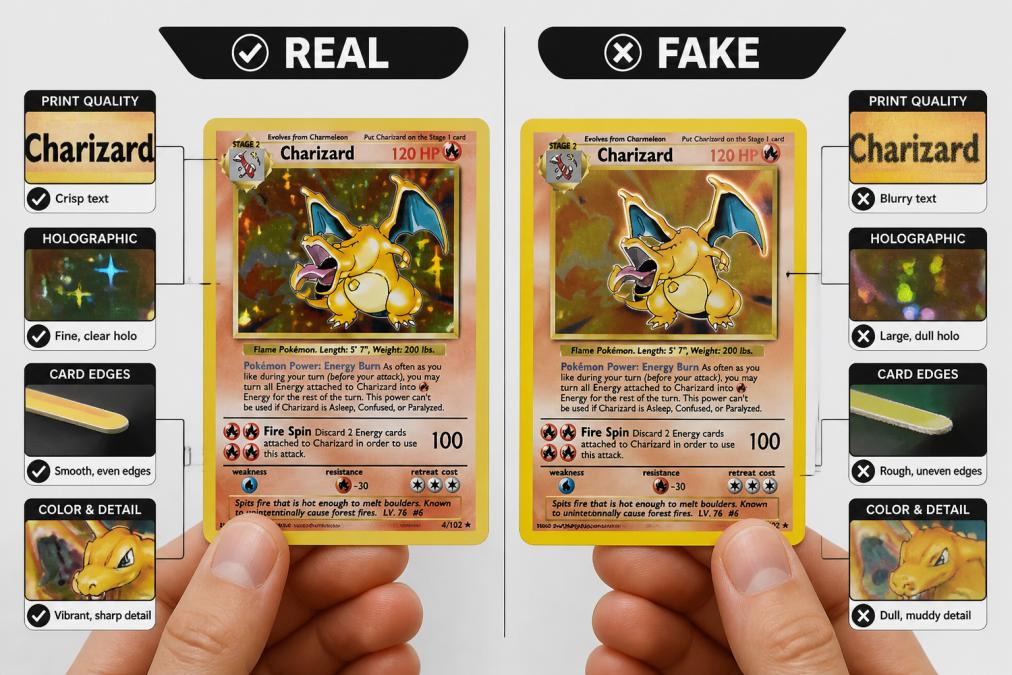
Print Quality and Card Stock Feel
Print quality separates genuine Pokémon cards from counterfeits immediately. Authentic cards use high-quality offset printing with sharp, precise lines. Fake cards often show blurry text, misaligned colors, or ink bleeding at the edges.
Run your finger across the card's surface. Genuine Pokémon cards have a slightly textured finish that feels smooth and consistent. Counterfeit cards often feel waxy, slick, or rough.
Look at the text on the card. Font size, spacing, and alignment should match official references exactly. Counterfeit cards frequently have typos, incorrect font weights, or misplaced text.
Holographic Patterns and Surface Details
Holographic elements are nearly impossible for counterfeiters to replicate perfectly. Authentic Pokémon cards have holograms with specific patterns and reflective qualities. Tilt the card under bright light and watch how the hologram moves and changes.
Genuine holos show a consistent, organized pattern. Fake holos often appear random, distorted, or too bright. The hologram should be smooth and flush with the card surface. Raised or bumpy holos are a sign of counterfeiting.
The card's surface should have a subtle texture. Genuine cards sometimes have a light sparkle or sheen. Counterfeit cards either look completely flat or have an overly glossy, plastic-like appearance.
Recognize Fake Pokémon Card Signs in Serial Numbers and Identifiers
Every genuine Pokémon card has identifiers that authenticate it. Serial numbers, set symbols, and edition marks follow strict formatting rules.
Check the set symbol, the small icon that identifies which set the card comes from. The symbol should match official references exactly.
Look at the edition mark. First edition cards have a specific stamp or notation.
Serial numbers on graded cards are another verification point. If you're buying a graded card, verify the serial number matches the grading certificate.
The copyright information at the bottom of the card should be precise. Any misspellings, incorrect punctuation, or formatting errors are red flags.
Document Condition and Contents Verification
Documentation is everything when you verify card authenticity. Before you price, list, or sell any card, photograph every detail. These photos protect you and help future buyers trust your listings.
Photograph Every Detail Before Pricing or Listing
Take photos under bright, natural light. Use your phone's macro mode or a close-up lens to capture fine details.
For sealed products, photograph the seal from multiple angles. Show the front, back, sides, and corners. Document any imperfections in the box printing or packaging.
1985 Donruss BASEBALL Factory Sealed Hobby Box - BBCE Certified →
Create a photo timeline. Take pictures immediately after receiving the item, before you open it or handle it extensively. This documentation protects you if a buyer disputes the condition later.
For graded cards, photograph the grading label. Capture the grade, serial number, and company name clearly. This confirms the card is actually graded and the grade is accurate.
Verify Contents of Sealed and Opened Products
For sealed booster boxes and starter sets, inspect the contents without opening the box if possible. Hold the box up to bright light and look inside. You should see individual packs arranged neatly.
Feel the weight of the box. It should feel substantial and full. A light box might indicate missing packs or that the box was opened and resealed.
For opened products, verify every item listed in the contents. If the product includes a holographic card, a foil pack, or special inserts, confirm they're all there.
Create a contents checklist for each product type. This standardized approach ensures you don't miss anything and helps buyers understand exactly what they're getting.
| Product Type | Key Contents to Verify | Documentation Method |
|---|---|---|
| Booster Box | Pack count, pack condition, seal integrity | Count packs, photograph seal, weigh box |
| Hobby Box | Pack count, insert cards, special packaging | Count packs, verify inserts, photo seal |
| Starter Set | Deck composition, accessories, packaging | List all cards, verify accessories, photo box |
| Graded Single | Grade label, card condition, holder integrity | Photograph label, inspect holder, verify serial |
Conduct a Trading Card Authenticity Check Using Comparison and Provenance
Comparing your card to known authentic examples is one of the most reliable verification methods. Provenance, where the card came from and who owned it, adds another layer of confidence.

Compare Against Known Genuine Examples
Find high-resolution photos of authentic cards from the same set, edition, and print quality. Official Pokémon databases and collector forums have these references.
Start with the big picture. Does the overall layout match? Move to specific elements: text formatting, hologram pattern, color accuracy, and edge quality. Use a magnifying glass to inspect fine details.
Create a comparison document. List the specific details you're checking: print sharpness, color accuracy, hologram pattern, text alignment, corner condition, and edge quality.
For Pokémon cards specifically, compare the Pokémon artwork itself. Counterfeiters sometimes use slightly different artwork or proportions. The colors should match the reference exactly. Any color shift is suspicious.
Review Seller History and Purchase Documentation
Provenance matters. Cards with clear ownership history and documentation are more trustworthy than cards with unknown origins. Ask the seller where they got the card.
Request documentation if available. Original receipts, grading certificates, or purchase confirmations add credibility. These documents prove the card's history and authenticity journey.
Check the seller's reputation. Buy from sellers with long, positive feedback histories. Read recent reviews to see if other buyers received items as described.
For expensive cards, ask if the seller has certificates of authenticity or previous grading reports.
When buying from online marketplaces, use protected payment methods. Buyer protection programs help you recover money if you receive a counterfeit.
When to Seek Third-Party Grading and Expert Assessment
Sometimes you need professional help. Third-party grading companies have equipment and expertise that go beyond what individual collectors can do.
Professional graders use specialized tools to examine cards under magnification and controlled lighting. They test paper stock, ink quality, and printing precision.
Send your card to a grading company if the card is valuable, if you plan to sell it, or if you're uncertain about authenticity.
Choose established grading companies. PSA, CGC, and BGS are the most recognized in the industry. Their grades are trusted by collectors and dealers.
For very high-value cards or disputed authenticity, consider getting multiple independent assessments.
At Cardboard Superstars, we work with professionally graded cards and sealed products from trusted sources. Our inventory includes BBCE-certified sealed boxes like the 1985 Donruss Baseball Factory Sealed Hobby Box and graded singles like the Drake Maye 2024 Topps Chrome Pink Refractor CGC 10.

Verifying card authenticity protects your collection and your investment. Our 100% positive eBay feedback and BBB accreditation reflect our commitment to transparency and collector-grade quality. Find cards you can trust with complete confidence in their condition and contents.
Frequently Asked Questions
How can I verify that a sealed trading card product has not been tampered with?
Check the factory seal for signs of opening or resealing: look for gaps between the box and seal, adhesive residue, or misaligned edges. Examine the seal's texture and color consistency across the entire surface. Original seals have uniform printing and crisp edges. If the seal appears lifted, wrinkled, or has visible glue lines, the product may have been opened and resealed. For high-value items like the 1985 Donruss Baseball Factory Sealed Hobby Box or Japanese booster boxes, BBCE or factory certification provides additional verification of authenticity and seal integrity.
What are the most common fake Pokémon card signs I should watch for?
Counterfeit Pokémon cards typically show poor print quality with blurry text, incorrect colors, or misaligned images. The card stock feels too thin or too thick compared to genuine cards. Holographic patterns appear flat, lack proper refraction, or have inconsistent sparkle. Text and borders may be slightly off-center. Serial numbers and set symbols may be printed incorrectly or have poor resolution. Compare suspected cards directly against verified genuine examples under bright lighting. If multiple signs appear together, poor printing, wrong card stock, incorrect holographic effect, the card is likely counterfeit.
Why is separating authenticity from condition grading important when verifying cards?
A card can be 100% authentic but in poor condition, or it can be authentic and in mint condition. Authenticity answers whether the card is genuine; condition describes its physical state (wear, centering, corners, edges). A graded card like the Drake Maye 2024 Topps Chrome Pink Refractor CGC 10 or Gordie Howe 1969 Topps Hockey PSA 7 proves both. When buying, verify authenticity first through inspection and provenance, then assess condition separately. This prevents overpaying for damaged authentic cards or accidentally purchasing counterfeits that appear to be in good condition.
How do I document product condition and contents properly before listing or pricing?
Take clear photographs of every side of the card or sealed product under bright, even lighting. For sealed boxes, photograph the front, back, sides, and seal details from multiple angles. For graded cards, capture the grade label, card front, and back. For opened products, photograph each card individually if verifying contents. Save images with consistent file names and timestamps. This documentation serves as supporting evidence of authenticity, protects you against disputes, and helps buyers make informed decisions. Before pricing high-value items, compare your photos against verified sales of identical products to ensure accuracy.