


Table of Contents
- Why Humidity Damages Trading Cards
- The Ideal Humidity for Card Collection Storage
- Step 1: Choose the Right Storage Environment
- Step 2: Use Desiccant Packets and Silica Gel
- Step 3: Double Sleeve and Use Airtight Containers
- Best Protective Sleeves for Graded Cards
- How to Fix Warped Trading Cards
- DIY Humidity Monitoring and Regional Strategies
- Frequently Asked Questions
Last Updated: September 23, 2026
Why Humidity Damages Trading Cards
Humidity is the quiet enemy of every collection. To protect cards from humidity, start by understanding what moisture does to paper. Card stock is porous: it pulls water vapor from the air, and the fibers swell unevenly. That swelling is card warping, and it happens slowly enough that most people miss the early signs.
How Moisture Causes Warping and Curling
Moisture absorption makes paper expand. When one side of a card takes on more water than the other, it bends toward the drier side. That is the mechanism behind curling.
Signs Your Cards Are Absorbing Moisture
Catch the problem before it becomes permanent. Watch for these signals:
- Slight bowing when a card sits flat on a table
- Wavy edges on cards stored in a stack
- A soft or spongy feel when you flex a card gently
- Condensation on the inside of a storage container
- A musty smell when you open a box or binder
The Ideal Humidity for Card Collection Storage
The ideal humidity for card collection storage is 45% to 50% relative humidity. Below 40%, cards dry out and become brittle. Above 60%, paper absorbs moisture and mold risk climbs fast.
Temperature and Light Exposure Factors
Heat speeds up every chemical reaction in paper, including the breakdown that yellows card stock. UV light does the same damage from a different angle, fading ink and weakening fibers over time.
Step 1: Choose the Right Storage Environment
Pick a spot with steady conditions before buying supplies. A bedroom closet or interior shelf in a climate-controlled room works for most collections, the goal is a space where temperature and humidity change slowly, if at all.
Container Material Science: What to Look For
Not all plastics are equal for long-term card storage. The two you will see most often are polypropylene (PP) and polyvinyl chloride (PVC).
- Polypropylene (PP): The safer choice. It is chemically stable, does not off-gas plasticizers, and resists moisture well. Most archival-grade sleeves, toploaders, and storage bins are made from PP or a PP blend. Look for the recycling code "5" or a label that says "acid-free" and "PVC-free."
- Polyvinyl chloride (PVC): Avoid it for anything long-term. PVC contains plasticizers that migrate out over time, especially in heat and humidity. Those plasticizers can leach into card stock, cause discoloration, and leave a greasy film. Cheap binder pages and older sleeves are the usual culprits. If a page smells like a new shower curtain, it is probably PVC.
- Polyethylene (PET) and Mylar: Common in archival sleeves and rigid holders. Chemically inert and excellent moisture barriers, but usually more expensive. Good for high-value singles and graded slabs.
Avoid Basements, Attics, and Exterior Walls
Basements and attics are the two worst places for a collection. Basements run damp; attics swing hot to cold with the seasons. Both push moisture into boxes and binders.
Shelf and Container Placement Checklist
- Keep bins off concrete floors and at least a few inches from exterior walls.
- Use gasket-lid bins rather than open-top or cardboard boxes.
- Choose PP or PET containers over PVC whenever the label allows.
- Leave a little air space inside the bin so desiccant can circulate.
- Stack bins no more than two or three high to avoid crushing and to keep airflow around them.
The same rules apply to graded slabs: the slab protects the card, but the label and case can still fog or warp in a damp room, so treat it like any other card when choosing a container.
Step 2: Use Desiccant Packets and Silica Gel
Silica gel and desiccant packets pull water vapor out of the air inside a sealed container. They are cheap, sometimes reusable, and buy real protection in a humid room. Drop a few into every bin and swap them on a schedule.
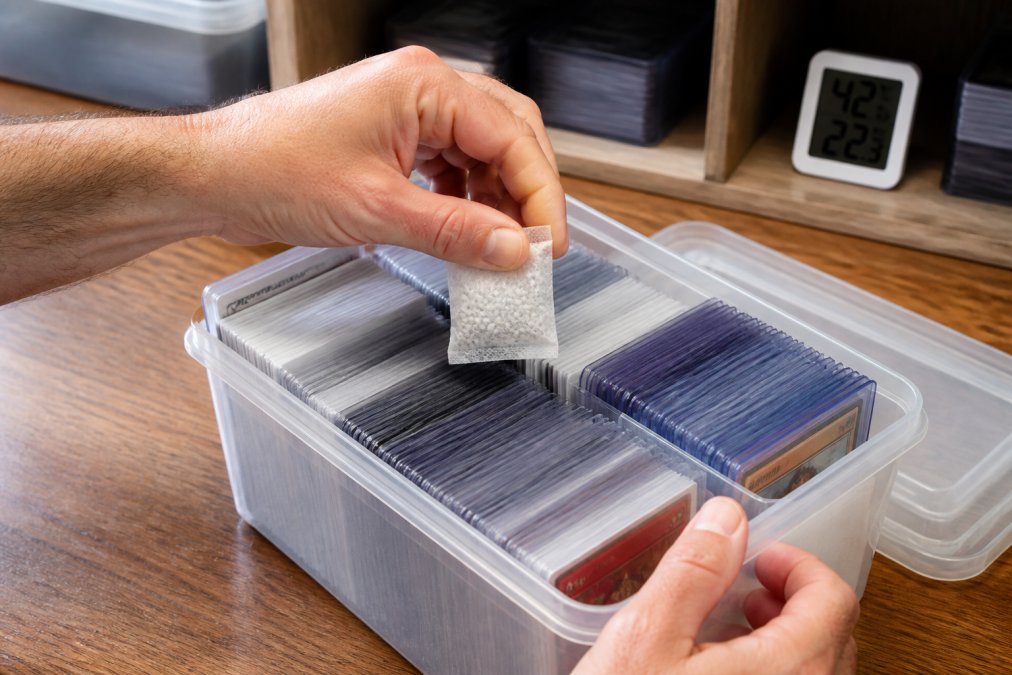
Step 3: Double Sleeve and Use Airtight Containers
Double sleeving means putting a card in a penny sleeve first, then a tighter sleeve or toploader. The inner sleeve blocks dust and surface damage; the outer layer adds structure and slows moisture absorption.
| Step | What to Use | Why It Works |
|---|---|---|
| Inner layer | Penny sleeve | Blocks dust and surface damage |
| Outer layer | Toploader or card saver | Adds rigid structure |
| Container | Airtight bin | Slows moisture exchange |
| Backup | Silica gel packet | Absorbs trapped vapor |
Best Protective Sleeves for Graded Cards
The best protective sleeves for graded cards fit the slab snugly without forcing it. A loose sleeve lets air move around the case, defeating the purpose. Look for a snug fit, crystal-clear material, and a resealable flap.
Here is what to check before you buy:
- Does the sleeve match your slab's exact dimensions?
- Is the plastic free of PVC, which can break down over time?
- Does the seal stay closed without tape?
- Can you read the label through the plastic?
How to Fix Warped Trading Cards
Minor warping can often be reversed; severe damage from long-term moisture exposure usually cannot. The fix works best on cards that curled recently and have not dried into a permanent set.
Reversing Minor Warping with Weight and Dry Air
Move the card to a dry, stable room. Place it flat between two clean sheets of card stock or acid-free paper, then stack a flat, even weight on top, like a heavy book.
A few rules for this method:
- Never press a card that feels damp to the touch
- Avoid direct sunlight or a hair dryer
- Use even weight, not a pointed object
- Stop if the card starts to crack or flake
DIY Humidity Monitoring and Regional Strategies
You do not need expensive gear to track storage conditions. A basic hygrometer costs little and shows relative humidity inside your room or bin. Check it weekly and log the numbers to spot trends.
How to Set Up an Affordable Hygrometer Workflow
Most collectors buy one hygrometer and leave it on a shelf. That tells you the room, not the bin. A better setup uses two cheap units:
- Room hygrometer: Place it at card height, away from vents, windows, and exterior walls. This is your baseline.
- Bin hygrometer: Put a second unit inside your main storage bin, near the cards but not touching them. This is your early-warning sensor.
Regional Climate Strategies
Generic advice fails because humidity problems look different depending on where you live. Here is how to adapt the plan:
- Humid summers: Add more desiccant, seal bins tighter, and run a dehumidifier in the storage room. Check bin hygrometers twice a week during the worst months. If the room climbs above 60%, move cards to a smaller, more controlled space.
- Dry winters: Skip aggressive drying, since low humidity makes cards brittle. A 2-way humidity control pack can hold a steady level. Watch for static and edge cracking when humidity drops below 40%.
- Coastal areas: Salt air and constant damp make airtight containers and regular packet swaps essential. Rinse and dry any tools or hands before handling cards, and inspect for corrosion on metal tins or clips.
- Desert climates: Watch for dryness, not damp. Keep cards away from direct heat and use a humidifier if the room drops below 40%. Avoid storing near evaporative coolers, which add moisture unevenly.
- Seasonal swing zones: The biggest risk is rapid change, not a steady extreme. During spring and fall, log readings more often and adjust desiccant before the swing hits.
When to Escalate Beyond DIY
Preventative maintenance beats repair every time. A steady 45% to 50% relative humidity, a cool room, and airtight storage with fresh desiccant keep a collection stable for years. For supplies and graded cards, Cardboard Superstars offers collector-grade packaging and clear product details before checkout.
Frequently Asked Questions
What is the best humidity level for storing trading cards?
The ideal humidity for card collection storage is between 40% and 50% relative humidity. Below 40% can cause cards to dry out and become brittle, while above 60% creates ideal conditions for warping, mold, and cardboard degradation. Use a hygrometer to monitor levels, and adjust with desiccant packets or a small dehumidifier depending on your climate.
How do silica gel packets help protect card collections?
Silica gel desiccant packets absorb excess moisture from the air inside storage containers, keeping relative humidity stable. Place a few packets in airtight containers or storage boxes and replace them every two to three months, or when the indicator changes color. They are a low-cost, passive way to prevent card warping and curling without electricity.
Can humidity-damaged trading cards be restored?
Minor warping or curling can sometimes be reversed by placing cards under heavy books in a dry room for several days, or by using a controlled drying method with desiccant packets. However, severe damage like mold, delamination, or permanent bends is usually irreversible. Preventative maintenance with proper sleeves and storage is far more effective than trying to fix warped trading cards later.
What are the best protective sleeves for preventing moisture damage?
For graded cards, use snug-fit polypropylene sleeves or graded card bags that create a barrier against ambient moisture. For raw cards, double sleeving with a penny sleeve inside a toploader or semi-rigid card saver offers excellent protection. Products like the Rookie Supply Pack or Team Leader Supply Pack from Cardboard Superstars provide sleeves and toploaders suited for this purpose.
Humidity damage rarely announces itself. It builds quietly until a favorite card curls or a graded slab fogs. Cardboard Superstars helps you stay ahead of it with authentic graded cards, sealed boxes, and protective supplies shipped in collector-grade packaging. Browse our sleeves, toploaders, and supply packs, and get the confidence that your collection will arrive and stay in the condition you paid for. Find cards at Cardboard Superstars and protect every pull from day one.