


Last Updated: November 1, 2026
Quick Summary
To sell graded cards online safely and profitably, first verify the slab's certification number and condition, then price using recent sold listings for the same grade. Calculate your net proceeds after fees and shipping, and ship with packaging, tracking and insurance matched to the card's value.
- Look up the certification number on the grading company's site to confirm the record matches the card.
- Price from recent sold listings for the same card, set, year and grade, not from asking prices.
- Subtract all fees, shipping, insurance and packaging from the sale price to find your real net.
- For cards over $1,000, use double-boxed packaging with the slab suspended and padded.
- Photograph the slab, packing and sealed box to resolve damage disputes quickly.
Table of Contents
- Start With Your Card's Grade, Condition and Authenticity Check
- Where to Sell Graded Cards Online
- How to Price Graded Cards Using Recent Sales
- Net Proceeds: Comparing Fees, Payouts and Shipping Costs
- Graded Card Listing Description Examples You Can Adapt
- How to Ship Graded Cards Safely, Matched to Card Value
- Protecting Yourself From Scams and Disputes
- Listing Your First Graded Card This Week
- Frequently Asked Questions
Selling a graded card online can return far more money than a raw card of the same player or set, but only if the sale goes right. Sellers commonly lose money in a few predictable ways: a slab that arrives cracked, a sale priced against the wrong comps, or fees that quietly eat the profit. This guide covers the best practices for selling graded cards online safely and profitably, from checking your card to getting paid.
A graded card is a card that a third-party company has authenticated, assigned a condition grade, and sealed in a tamper-evident plastic holder, usually called a slab. Buyers pay more for that certainty. Your job as a seller is to protect it.
Start With Your Card's Grade, Condition and Authenticity Check
Before you list anything, confirm the card is what you think it is. Check the slab label for the grading company, the certification number, the grade, and the card details. Look up the certification number on the grading company's own site to confirm the record matches the card inside. Learn how graded sports cards are verified to understand what the record should show.
Look for these signs at a glance:
- The label is straight and sealed, with no gaps or lifting edges.
- The slab is not cracked, scratched or fogged.
- The certification number matches the printed label.
- The card inside matches the set, year and player on the label.
If something looks off, stop and get a second opinion before you sell. Follow this step-by-step method to verify graded Pokémon cards to confirm authenticity. Buyers remember sellers who misrepresent a card, and a dispute costs far more than a few minutes of checking.
Where to Sell Graded Cards Online
You have several options, and each one suits a different kind of seller. Common choices include large general marketplaces, specialist trading card sites, auction platforms, and direct sales through social media or a collector community. Compare the best online stores for graded cards to see which venues suit your card. Some providers offer buy-now or trade-in services, which can be fast but often pay less than a sale to a collector.
Choose based on three questions:
- How fast do you need the money? Direct buy offers pay quickly. Auctions and marketplaces take days or weeks.
- How much do you want to keep? Marketplaces charge fees. Direct sales avoid some fees but carry more risk.
- How valuable is the card? High-value cards often sell best where serious collectors shop, which is usually a specialist venue.
For most sellers, a reputable marketplace with buyer protection offers the best balance. If you sell mostly to experienced collectors, a specialist site may bring a better price.
How to Price Graded Cards Using Recent Sales
Price your card using what similar cards have actually sold for, not what sellers are asking. Asking prices show hope. Sold prices show the market. Read why graded cards command higher prices and how grade shifts value before you set your number.
Follow these steps:
- Find recent sold listings for the same card, set, year and grade.
- Ignore outliers. A single unusually high or low sale tells you little.
- Compare cards with the same grade only. A grade 10 and a grade 9 can differ sharply in price.
- Check how many sales happen each month. A card that sells often is easier to price than one that rarely trades.
- Set your price near the middle of recent sales, then adjust for condition, demand and speed of sale.
A card with few recent sales is harder to price. In that case, expect a longer time to sell, and consider an auction so the market sets the price.
Net Proceeds: Comparing Fees, Payouts and Shipping Costs
The sale price is not what you keep. Work out your net proceeds before you pick a venue.
Subtract these from the sale price:
- Selling or listing fees
- Payment processing fees
- Shipping and insurance cost
- Packaging costs
- Any taxes that apply to your sale
Here is a simple example. Suppose a card sells for $400 on a marketplace that takes 13% in fees, you pay $25 to ship with insurance, and packaging costs $5. Your net is $400 minus $52, minus $25, minus $5, or $318. A direct sale that pays $340 with no marketplace fee could leave you with more money, but only if the buyer is trustworthy and the payment is secure.
Always compare the final number you keep, not the headline price. Fee rates change, so check each venue's current fee schedule before you list.
Graded Card Listing Description Examples You Can Adapt
A clear listing builds trust and reduces questions. Include the card name, year, set, card number, grading company, grade, certification number and any notable features. State the condition of the slab honestly.
Here is a template you can adapt:
[Year] [Set] [Player] #[Card Number] [Grading Company] [Grade] Certification number: [Number]. The card is graded [Grade] by [Grading Company]. The slab is sealed with no cracks or lifting label. Front and back photos show the slab exactly as it will ship. Ships within [X] business days with tracking and insurance. Questions welcome before you buy.
For a title, put the most searchable details first: year, set, player, card number and grade. Avoid vague words like "rare" or "must see" unless you can back them up.
Photograph the slab in good light, with no glare on the label. Show the front, the back and the label clearly. Honest photos prevent returns.
How to Ship Graded Cards Safely, Matched to Card Value
Shipping is where many graded card sales go wrong. A slab is rigid, but it is also brittle at the edges, and a cracked slab can turn a profitable sale into a dispute.
| Card value | Packaging | Tracking | Insurance | Signature |
|---|---|---|---|---|
| Under $50 | Rigid top-loader or card saver inside a bubble mailer | Yes, first-class or ground | Optional; self-insure | No |
| $50-$250 | Slab sandwiched between two rigid boards, padded envelope or small box | Yes | Yes, to full value | No |
| $250-$1,000 | Rigid box with foam or cardboard inserts so the slab cannot shift | Yes | Yes, to full value | Recommended |
| Over $1,000 | Double-boxed: slab in an inner rigid box, padded inside an outer box | Yes | Yes, to full value | Yes |
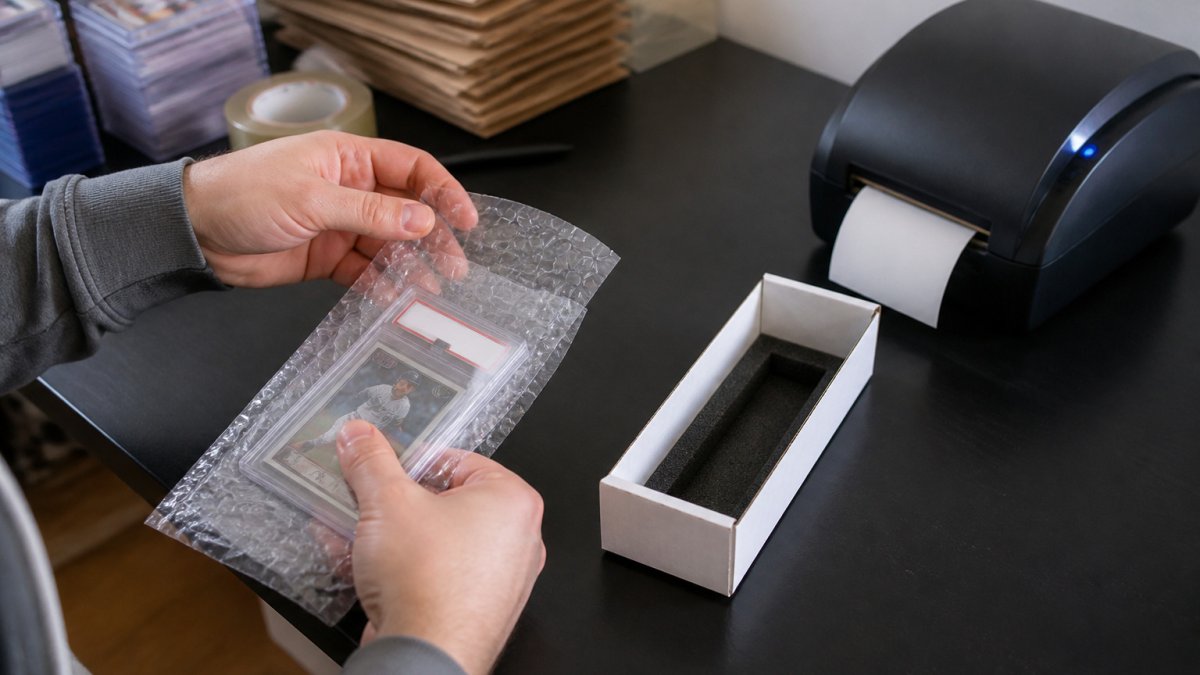
Packaging mechanics that prevent cracked slabs. The slab should not touch the box wall. Wrap the slab in bubble wrap or foam so it is suspended, then fill any remaining void so the contents cannot move when the box is shaken.
Carrier and service level. For lower-value cards, a tracked service is often enough. For mid- and high-value cards, use a service with included or available insurance and a reliable claims process.
Insurance and claims. Declare the full sale value when you buy insurance; under-declaring saves a little at the counter and costs you at claim time.
Handoff documentation. A common pattern among experienced sellers is a short video or photo sequence showing the slab's condition, the packing process and the sealed box. This is not paranoia; it is the evidence that resolves most damage disputes quickly.
Protecting Yourself From Scams and Disputes
Most scams and disputes are preventable with a simple documentation habit. The goal is to create a record that shows what you sold, how you packed it, how you shipped it and how you communicated.
Build the record before the sale. Photograph the slab front and back in good light, including the label and certification number. Save the certification lookup result from the grading company's site. Keep the original listing text and photos.
Document the packing and handoff. A short photo or video sequence showing the slab, the packing materials, the sealed box and the shipping label is the single most useful protection. It takes a minute and resolves most damage claims.
Payment and platform rules. Accept payment only through methods that offer seller protection, and keep the transaction on the platform.
When a dispute opens, respond in sequence.
- Acknowledge the buyer's message promptly and ask for photos of the damage and the packaging.
- Compare their photos with your pre-shipment photos and note any differences.
- Provide the platform or payment provider with your documentation: listing, photos, packing record, tracking and messages.
- Follow the platform's dispute timeline; missing a deadline can forfeit your protection.
- If the carrier caused the damage, open a claim with your shipping documentation and insurance receipt.
Recordkeeping for taxes and disputes. Keep a simple log of each sale: date, card, grade, sale price, fees, shipping cost, buyer and tracking number.
Listing Your First Graded Card This Week
Start small. Pick one card you know well, check its authenticity, look up recent sales, and calculate your net proceeds on two venues. Then write a clear listing, photograph it honestly, and pack it for its value.
Each step makes the next one easier. After your first sale, you will know your fees, your shipping costs and your timing, and the next card will go faster.
Frequently Asked Questions
Where is the best place to sell graded cards online?
The best place depends on card value, how quickly you need cash and how much effort you want to spend on the sale. Large general marketplaces give you the most buyers but charge final value fees and payment processing fees that come out of your proceeds. Specialist grading-company stores and dedicated trading card platforms often pay a flat rate or offer a direct buy, which is faster but usually less than full market value. For higher-value slabs, compare at least two options and calculate your net payout after every fee before you list.
How should I price a graded card?
Start with sold listings, not active asking prices, because asking prices show what sellers hope to get rather than what buyers paid. Filter for the same card, the same grading company and the same grade, and look at the last 30 to 90 days of completed sales. Note whether the card is a common or low-population grade, since scarcity can move prices a lot. Price slightly above the median if your card is in top condition and has a clean recent history, and price near the median if it is a typical example.
How do I write a good listing for a graded card?
Lead the title with the year, set, card name, card number, grading company and grade, because buyers search using those terms. In the description, state the grade, the certification number, the card's visible condition on the slab and any notable features such as a rare variant or error print. Include clear photos of the front and back of the slab, plus close-ups of the label. Accuracy matters more than hype, since accurate listings reduce returns and disputes.
What is the safest way to ship graded cards?
Use a rigid box sized so the slab cannot move, add padding on all sides, and place it inside a bubble mailer or box with tracking. For higher-value cards, add signature confirmation and insurance that covers the full sale price. Photograph the packed item before sealing and keep the tracking number and receipt for every shipment. Choose shipping by card value: low-value slabs can travel with standard tracked service, while expensive cards justify premium insured delivery.
