


Table of Contents
- What Is the Pokémon Trading Card Game?
- Expansion Sets and New Releases
- How to Identify Authentic Pokémon Cards
- Pokémon Card Grading Services and Market Value
- Beginner's Guide to Deck Building
- Best Protective Supplies for Trading Cards
- Safe Trading Practices and Scam Prevention
- Frequently Asked Questions
Last Updated: September 30, 2026
What Is the Pokémon Trading Card Game?
The pokemon trading card game is a strategic collectible card game where players build decks of 60 cards to battle opponents using Pokémon characters, Trainer cards, and Energy cards. Since its 1996 launch, the Pokémon trading card game has become one of the most popular TCGs globally, blending competitive gameplay with serious collecting.
The game operates on two levels: casual players enjoy opening booster packs and building decks, while serious collectors hunt rare cards and graded specimens as investments. The secondary market for high-grade cards has grown dramatically, with some vintage cards selling for thousands of dollars.
Understanding the Pokémon trading card game means learning both mechanics and market dynamics. New expansions release every few months, introducing fresh cards and strategies. At Cardboard Superstars, we help collectors navigate this landscape with authentic sealed products, graded legends, and protective supplies.
Expansion Sets and New Releases
Expansion sets define the Pokémon trading card game's evolution. The Pokémon Company releases new sets roughly every three months, each containing 200+ unique cards. These expansions introduce new mechanics and competitive cards that reshape the meta game.
Japanese releases often precede English versions by several months, creating a secondary market where collectors hunt Japanese boxes before domestic availability.
Set rotation matters for competitive players, as the Pokémon Company rotates older sets out of standard format annually. Collectors, however, value older sets differently, vintage cards from early expansions command premium prices regardless of competitive viability.
New releases create pull rate variations. Booster boxes typically contain 36 packs of 10-11 cards each. A box like the Pokemon White Flare Deluxe Booster Box at $288.00 provides controlled access to a specific set's card pool.

How to Identify Authentic Pokémon Cards
Counterfeit Pokémon cards flood the market. Spotting fakes requires attention to specific details.
Authentic Pokémon trading card game cards display consistent printing quality with crisp text and proper font weight. Fake cards often show blurry text, misaligned printing, or font inconsistencies. Authentic cards feel smooth with uniform texture; counterfeits have rough spots or uneven coating.
Holographic patterns distinguish genuine cards. Real holos display precise, repeating patterns with clean edges; fake holos show irregular patterns or inconsistent sparkle. Examine under direct light at multiple angles.
Authentic Pokémon cards use specific paper composition that feels slightly heavier than standard cardstock. The back should show a clean Pokemon logo and consistent color; fakes display color bleeding or misalignment.
Real cards maintain consistent borders on all four sides. Counterfeits show uneven borders with text or images touching the edge. Off-center images suggest counterfeiting.
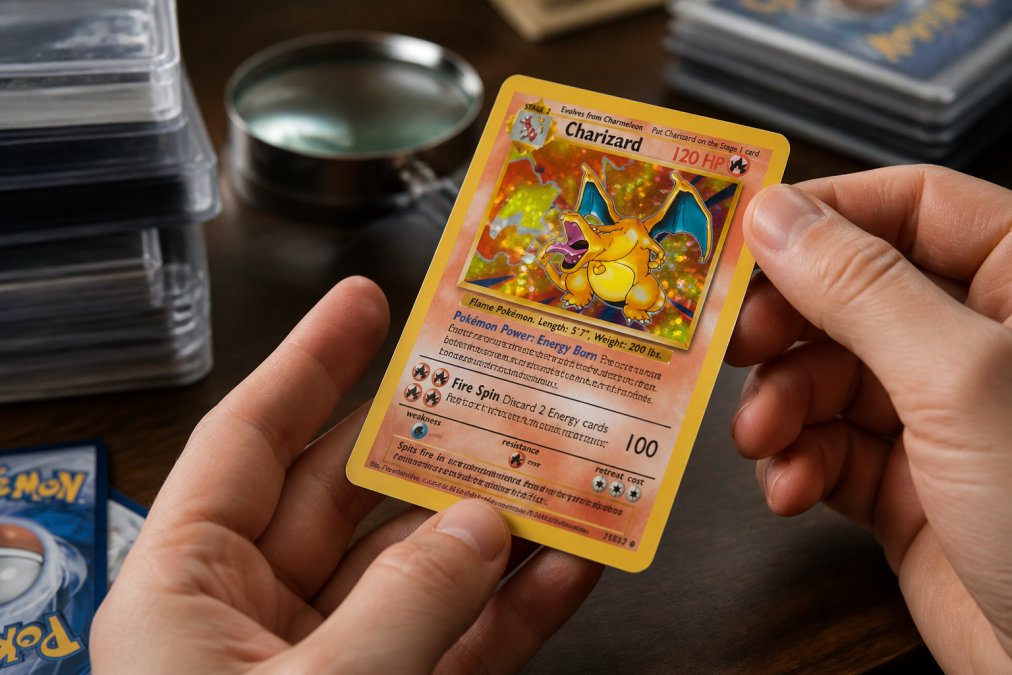
Weight and feel provide quick checks. Hold an authentic card and suspected fake side by side, the weight difference becomes obvious.
Purchase from established retailers. Cardboard Superstars verifies all products before shipping. When buying from online marketplaces, prioritize sellers with extensive positive feedback and clear return policies.
Pokémon Card Grading Services and Market Value
Professional grading transforms the Pokémon trading card game market by evaluating condition on a 1-10 scale, encapsulating cards in protective slabs, and providing authentication. This standardization enables the secondary market for high-value cards.
The major grading companies, Beckett Grading Services (BGS), Professional Sports Authenticator (PSA), and Sportscard Guaranty (SGC), dominate the industry. PSA slabs command premium prices in the current market, though this shifts over time.
A card graded 9 (Mint) might sell for 3-5 times the price of an ungraded copy.
Card condition determines value dramatically. A Charizard ex graded 10 (Gem Mint) sells for thousands; graded 7 (Near Mint) might fetch $200-400.
The secondary market for graded cards has matured. Prices fluctuate based on demand, rarity, and competitive relevance. Cards from popular competitive decks appreciate faster than unplayable vintage cards.
Investing in graded Pokémon cards requires research. According to PSA's market analysis of trading card valuations, certain first-edition cards from early expansions have appreciated 15-25% annually. However, not all cards appreciate equally. Competitive-relevant cards spike during tournament seasons, then stabilize or decline.
Pokemon White Flare Deluxe Booster Box →
Cardboard Superstars stocks graded legends from established sets with transparent condition descriptions and clear photos before checkout.
Beginner's Guide to Deck Building
Building a competitive pokemon trading card game deck requires understanding structure and strategy. A legal deck contains exactly 60 cards, forcing difficult choices about which cards to include.
Most competitive decks run 12-18 Pokémon, 30-35 Trainer cards, and 10-15 Energy cards. This ratio varies by strategy, but these ranges provide a solid starting point.
Choose a primary attacker and include 2-4 copies to ensure consistent draws. Add supporting Pokémon that set up your attacker or provide alternatives. Most decks run 1-2 evolution lines plus standalone basics.
Trainer cards provide the deck's engine. Search cards find specific Pokémon or Energy; draw cards replenish your hand. Item cards provide one-time effects; Supporter cards offer powerful effects but limit you to one per turn. Stadiums affect both players' Pokémon.
Run the minimum Energy needed to power your attacks, usually 10-15 cards. Special Energy cards provide additional effects while counting toward your total. Too much Energy clogs your hand; too little leaves you unable to attack.
Testing refines your build. Play 10-20 games, track which cards help, and cut underperformers. This iterative process separates competitive decks from casual ones.
Start with a theme deck to learn mechanics, graduate to a budget competitive deck, then invest in premium cards as you improve.
Best Protective Supplies for Trading Cards
Proper storage preserves condition, maintains value, and prevents damage from handling, humidity, and light.
Quality matters, cheap sleeves contain residue that damages cards. Premium sleeves provide acid-free protection. Use sleeves immediately when you acquire cards.
Top loaders protect individual high-value cards. Store in a cool, dry place away from direct sunlight. Top loaders work best for cards worth $20+.
A quality binder holds 360-432 cards in acid-free, PVC-free pages.
Safe Trading Practices and Scam Prevention
The Pokémon trading card game community includes both trustworthy collectors and bad actors. Protecting yourself requires vigilance and knowledge of common scams.
| Protective Supply | Cost Per Unit | Best For | Durability |
|---|---|---|---|
| Card Sleeves | $0.05-0.15 | All cards | 1-2 years |
| Top Loaders | $0.50-2.00 | High-value singles | 3-5 years |
| Binder Pages | $0.20-0.50 | Display collections | 5+ years |
| Storage Boxes | $5-15 | Bulk storage | 5+ years |
| Silica Gel Packets | $0.50-2.00 | Humidity control | 6-12 months |
Frequently Asked Questions
Is the Pokémon TCG worth starting as a beginner?
Yes, the Pokémon trading card game offers value for both casual collectors and competitive players. Beginners can start affordably with starter decks and booster packs, then scale up their investment as they learn card values and market trends. Entry-level sealed products like the Pokémon Korean Ruler Of The Black Flame Booster Box ($80) provide authentic gameplay without premium pricing, making it accessible for new hobbyists.
How do I determine the value of my Pokémon cards?
Card value depends on rarity, condition, set edition, and current market demand. Check the card's rarity symbol (star, diamond, or other icon) on the bottom right corner. Graded cards from recognized services command higher prices. Secondary market platforms track pricing for ungraded cards. Condition matters significantly, even rare cards in poor condition sell for a fraction of near-mint examples. Professional grading through established services provides objective condition assessment and authentication.
What are the best Pokémon TCG sets for beginners to start with?
Start with recent expansion releases that offer strong pull rates and affordable booster boxes. The Pokémon White Flare Deluxe Booster Box ($288) and Japanese Black Bolt Deluxe Booster Box ($300) deliver high-impact cards and rare holographic treasures. For budget-conscious collectors, the Pokémon Korean Ruler Of The Black Flame Booster Box ($80) provides factory-sealed authenticity at lower cost. Starter decks are also excellent entry points, offering pre-built gameplay without the investment of sealed boxes.
How does Pokémon card grading work, and why does it matter?
Grading services evaluate card condition on a standardized scale, typically 1-10, assessing centering, corners, edges, and surface quality. Graded cards are encased in protective slabs with authentication labels. Grading matters because it increases resale value, provides third-party authentication against counterfeits, and allows collectors to build portfolios of high-grade cards with verified condition. Graded cards command premium prices on the secondary market compared to ungraded versions.
What's the difference between playing and collecting Pokémon TCG?
Playing focuses on competitive deck building, tournament rules, and meta game strategy. Collectors prioritize card condition, rarity, set completion, and long-term value preservation. Many enthusiasts do both, building playable decks while maintaining a separate investment collection. Players care about playability and card function; collectors focus on authenticity, grading, and portfolio growth. Understanding your primary goal determines which products and protective supplies you'll need.
How can I avoid counterfeits when buying Pokémon cards online?
Buy from established retailers with transparent product details and authentication guarantees. Verify seller feedback and return policies before purchasing. Examine card weight, texture, and holographic quality, counterfeits often feel thin or have dull holograms. Check for precise centering and font clarity. Graded cards from recognized services include authentication that's difficult to forge. Avoid unusually low prices on rare cards, and request detailed condition photos before checkout to confirm authenticity.
What protective supplies do I need for my Pokémon card collection?
Essential supplies include card sleeves for individual protection, deck boxes for storage, and binders or display cases for high-value cards. Use acid-free sleeves to prevent deterioration. Top loaders provide rigid protection for graded or valuable ungraded cards. Store collection in a cool, dry environment away from direct sunlight to prevent fading and warping. For serious collectors, archival-quality storage boxes and climate-controlled display cases preserve condition and value long-term.