


Table of Contents
- Why Japanese Cards Command Premium Prices
- How to Identify Rare Japanese Pokemon Cards
- Where to Buy Authentic Japanese Booster Boxes and Sealed Cases
- Best Online Stores for Graded Cards and Rare Singles
- Japanese Pokemon Card Price Tracking Tools and Databases
- Shipping, Customs, and Proxy Buying Services Explained
- Counterfeit Detection: Avoiding Fakes in the Secondary Market
- Managing a Japanese Card Collection for Long-Term Value
- Frequently Asked Questions
Last Updated: September 24, 2026
Why Japanese Cards Command Premium Prices
Japanese trading cards often sell for more than their English-language counterparts, and the gap comes down to scarcity and print quality rather than hype.
Print Runs and Card Stock Differences
Japanese sets typically ship in smaller quantities than their international equivalents, which shrinks the supply of any single card. The stock itself is thicker, with a glossier finish that holds up better over time. That durability matters for grading, because corners and edges survive handling more cleanly. A card that would grade poorly from one region can grade higher from another purely because of paper quality.
Exclusive Artwork and Promo Releases
Some of the most sought-after Japanese cards never appear in English sets at all. Promo cards distributed through events, magazine inserts, and special campaigns stay exclusive to the region, which keeps demand high. According to The Pokémon Company's official card database, these promos are catalogued separately from main expansion sets, and that separation is exactly what makes them hard to track down.
How to Identify Rare Japanese Pokemon Cards
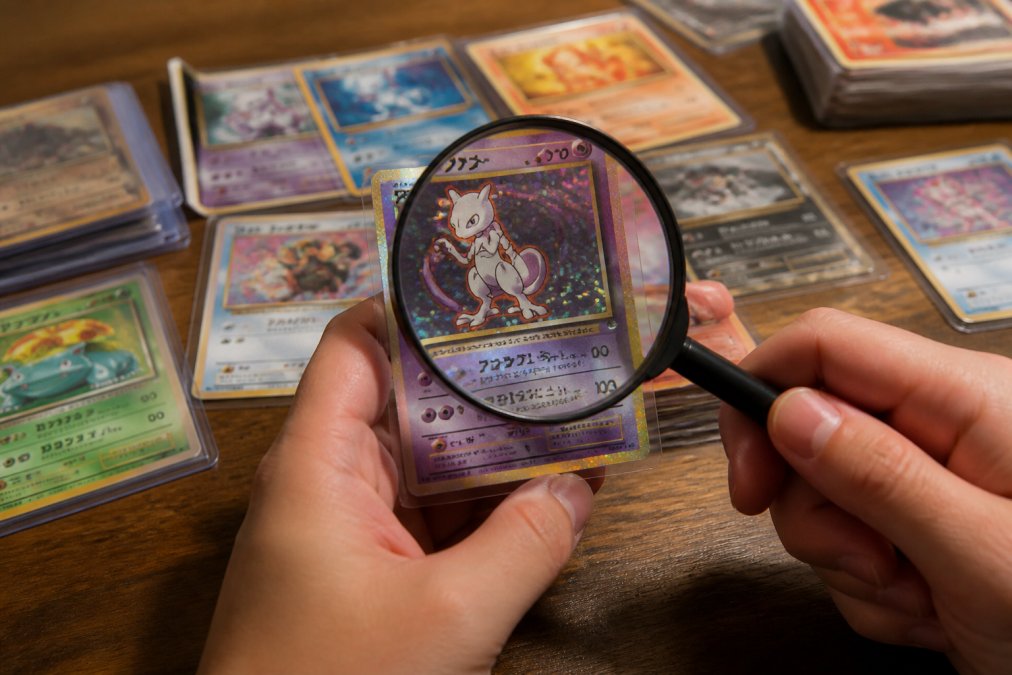
Identifying rare Japanese Pokemon cards starts with three things: the rarity symbol, the collector number, and the foil pattern. Get those right and you can separate a common from a chase card in seconds.
Reading Rarity Symbols and Collector Numbers
Every Japanese card carries a small symbol near the bottom, and that symbol tells you the tier. A circle marks common, a diamond marks uncommon, and a star marks rare. Collector numbers follow a set-list format like 045/098, where the first number is the card's position and the second is the total in the set. Cards numbered above the set total, such as 102/098, are secret rares and almost always worth more.
Spotting Foil Patterns and Holo Variations
Foil patterns separate a standard holographic card from an art rare or super art rare. Tilt the card under direct light and watch how the shine moves. Classic holo covers the whole art box, while newer textured foils show a fine grain that catches light in layers. Monochrome and textured variants are the ones collectors chase hardest.
Where to Buy Authentic Japanese Booster Boxes and Sealed Cases
The safest source for authentic Japanese booster boxes and sealed cases is a seller who shows the factory seal, the shrink wrap, and the case code in the listing photos. Sealed product is the hardest category to fake convincingly, but it still happens.
Look for these signals before you commit:
- Factory shrink wrap with no reseal seams or heat marks
- A visible case code that matches the set and print run
- Listings that state condition and contents clearly before checkout
- A seller with documented feedback history and a clear return policy
Best Online Stores for Graded Cards and Rare Singles
The best online stores for graded cards are the ones that publish exact condition details and grade labels rather than vague descriptions. A graded card is a card that has been authenticated, assigned a numeric condition score, and sealed in a tamper-evident holder by a third-party grading service.
| What to Check | Why It Matters | Red Flag |
|---|---|---|
| Grade label and cert number | Lets you verify the card | No cert number shown |
| Condition notes | Sets expectations | "See photos" only |
| Packaging description | Protects the holder | No packaging detail |
| Return policy | Covers damage claims | No returns accepted |
Japanese Pokemon Card Price Tracking Tools and Databases
Japanese Pokemon card price tracking works best when you triangulate three sources: a set database, a graded-population report, and completed auction results. Databases tell you what exists; population reports tell you how rare a high grade is; completed sales tell you what buyers actually paid this month.
The Three Sources Worth Bookmarking
- Set databases. The Pokemon Company's official card database catalogs main expansions and promos separately, which matters because a promo's print run is often a fraction of a main-set card's. Community-maintained set lists fill in the gaps for older eras the official database handles thinly.
- Population reports. [PSA's card grading(https://shop.cardboardsuperstars.com/blogs/news/how-to-evaluate-card-grading-services) and population report | psacard.com] shows how many copies of a specific card have been graded at each level. A card with a low population at a high grade is genuinely hard to find in mint condition, and that scarcity is priced in. Cross-check the cert number on any graded listing against the report before you pay.
- Completed auction results. Pull sold listings, not active ones. An asking price is a wish; a completed sale is a fact. Track the same card across several sales before you set your own number, and note the grade and the sale date on each one. A sale from last month tells you far more than one from last year.
Reconciling Japanese-Language Listings
Most rare Japanese cards are listed by sellers who write in Japanese, so the card name you search in English may return nothing. Two workarounds close that gap:
-
Search by set code and collector number instead of name. A string like
sv2a 183/165is language-neutral and will surface the card regardless of how the seller titled it. - Use image search on the card art. Crop the artwork, run it through a reverse image search, and you'll often land on the Japanese listing directly. This is faster than translating a card name you don't know.
Reading the Spread Between Raw and Graded
The gap between a raw card's sale price and the same card's graded price tells you whether grading is worth the submission cost. A common pattern is that a card selling raw for a modest amount can command a meaningful multiple once it's in a high-grade holder, but only if the population at that grade is low. If thousands of copies already sit at the top grade, the premium shrinks.
Shipping, Customs, and Proxy Buying Services Explained
Shipping is where most first-time importers get surprised, and it's the part of this hobby almost no guide covers properly. A proxy service is a company that buys a card on your behalf from a seller who won't ship internationally, receives it at a local address, then forwards it to you for a fee. That fee is usually a flat per-item charge plus a domestic shipping charge plus the international shipping you'd pay anyway.
How the Proxy Workflow Actually Runs
- Pick a service that publishes its fee structure upfront. Reputable proxies list per-item fees, consolidation fees, and storage windows on a public page. If a service won't show its fees before you sign up, that's a signal.
- Buy from the domestic seller and ship to the proxy's local address. The proxy gives you a Japanese address and a customer ID. You enter both at checkout on the seller's site.
- Consolidate multiple purchases into one shipment. This is the single biggest cost saver. Five small parcels cost far more to ship than one combined box, and consolidation fees are typically a fraction of the per-parcel savings.
- Declare the contents accurately on the customs form. The proxy fills this out based on what you tell it. Accuracy protects you.
- Expect a separate customs assessment on higher-value parcels. U.S. Customs and Border Protection import guidance explains how personal shipments are assessed. Personal-use imports below the de minimis threshold generally clear without duty; above it, you may owe a percentage based on the declared value and category.
The Cost Math That Matters
International shipping is priced by weight and dimensions, so a single heavy box of top loaders costs more than a padded envelope of raw cards. Two practical rules:
- Ship raw cards flat and light. A stack of raw cards in a rigid mailer weighs a fraction of the same cards in individual holders.
- Batch graded cards. Graded slabs are heavy and bulky. Consolidating ten slabs into one shipment spreads the base shipping cost across all ten instead of paying it ten times.
Language Tools for Buying Direct
Most Japanese sellers write listings in Japanese, and the card name you know in English may not appear anywhere in the listing. Three tools close that gap:
- Live camera translation. A phone app that translates text in real time handles condition notes, shipping terms, and seller policies well enough to read them.
- Reverse image search. Crop the card art and search by image. You'll often land on the Japanese listing directly, no translation needed.
-
Set code and collector number search. A string like
sv2a 183/165is language-neutral and surfaces the card regardless of the seller's title.
Counterfeit Detection: Avoiding Fakes in the Secondary Market
Counterfeits concentrate in the secondary market, and the tells are usually physical. Counterfeit detection comes down to card stock, print quality, and light behavior.
Run through this checklist before buying any high-value single:
- Card stock feels thin or flimsy compared to a known authentic copy
- Colors look muddy, oversaturated, or slightly off-register
- The back print is blurry or the border is uneven
- Foil pattern looks flat and doesn't shift under angled light
- Font on the collector number is slightly wrong in weight or spacing
- The seller won't provide a close-up of the corners and surface
Managing a Japanese Card Collection for Long-Term Value
Collection management is the quiet part of this hobby that separates people who keep value from people who lose it. Store cards in acid-free sleeves and rigid top loaders, keep them out of direct sunlight, and log every purchase with the date, price, and grade. That log becomes your market value reference later.
Frequently Asked Questions
Are Japanese Pokemon cards worth more than English ones?
It depends on the specific card and era. Japanese cards often have smaller print runs and exclusive artwork, which can push market value higher for certain chase cards. However, English cards sometimes have broader demand. Always check recent auction house results and price tracking databases for the exact card you are considering. Condition, grading, and rarity symbols all affect final value.
What is the best way to verify the authenticity of Japanese trading cards?
Start by checking card stock texture, centering, and foil pattern under good lighting. Authentic cards have crisp rarity symbols and consistent print quality. Compare collector numbers against official set lists. For high-value purchases, buy graded cards from reputable grading services or sealed booster boxes from trusted online stores that provide clear product details and authenticity guarantees.
Where can I find reliable pricing for rare Japanese promo cards?
Use Japanese Pokemon card price tracking tools that pull data from auction house sales and secondary market listings. Sites that aggregate sold prices give a clearer picture than active listings. Cross-reference multiple databases and check set lists to confirm the card's era and print run. For graded cards, the grading service's population report adds another layer of pricing context.
How do I import rare Japanese cards safely?
Use a proxy buying service or a trusted online store that handles international shipping. Proxy services let you purchase from Japanese sellers and consolidate packages. Declare the full market value on customs forms to avoid delays. Request collector-grade packaging with rigid sleeves and tracking. Reputable sellers provide clear shipping timelines and damage-free delivery.
The hardest part of collecting isn't finding rare japanese cards, it's finding them from a source you can trust with your money and your collection. Cardboard Superstars solves that with authentic products, collector-grade packaging, and clear product details provided before checkout, so you know exactly what's arriving. Get started with Cardboard Superstars and find your next hobby win with total confidence.